


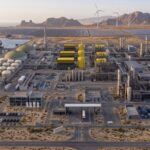



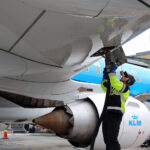
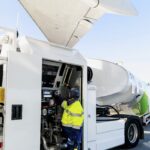



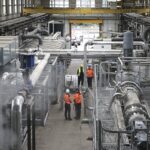

Two fresh initiatives have emerged in Denmark to help reduce emissions produced by aircraft, both in flight and on the ground. The nation’s biggest oil refinery, Kalundborg, has announced it is supplying Airbus with a new, low-aromatic aviation fuel developed to help reduce contrails, which form when soot particles from aircraft engines freeze in certain meteorological conditions, trapping heat in the atmosphere. And at Copenhagen Airport, the nation’s largest aviation hub, Swiss technology group Assaia has launched EmissionsControl, a system designed to monitor the use of and emissions from auxiliary power units, generators installed in aircraft to provide them with power on the ground when other sources are limited or not available. Copenhagen is the world’s first airport to introduce the Assaia monitoring capability at most of its aircraft parking stands to help reduce emissions from APUs, which, like engines, use jet fuel and emit CO2.
Aromatics are a naturally occurring element of jet fuel which cause seals within engines to swell, helping to prevent fuel leaks. But because aromatics burn more slowly than other hydrocarbons in the fuel, they emit soot particles that in certain conditions can freeze and collectively create contrails, which increasingly are recognised as a critical climate consequence of aviation.
Kalundborg Refinery considers low aromatic fuel to be a key interim measure to help reduce aviation’s emissions, and is demonstrating that it can be produced at industrial scale while various other new fuel pathways are developed, tested and eventually commercialised.
Airbus is accepting the low-aromatic fuel as part of the PACIFIC project, in which it is developing models to examine and minimise the impacts of aircraft engine emissions. A key element of the project is investigating soot formation in engines, particle emissions and contrail formation, and how they may be linked to fuel composition and engine cycles.
The first supply of the new fuel to Airbus was marked by an event at the Kalundborg Refinery attended by representatives of the airframer, the independent environmental advocacy group Green Transition Denmark and Danish politician Rasmus Horn Langhoff, Chairman of the Transport Committee.
“The aviation sector is actively seeking solutions that address both climate and environmental challenges,” said Claus Navntoft, Managing Director of Kalundborg Refinery.
“We are proud of our cooperation with Airbus. It underlines the product’s potential and the great interest from the industry.
“This fuel can already be produced on an industrial scale, reducing aviation’s global climate and environmental footprint. We would like to invite the industry and the authorities to engage on dialogue on how the fuel can be implemented.”
At Copenhagen Airport, which is targeting net zero carbon emissions from its own operations by 2030, new technology has just been activated to monitor emissions from aircraft auxiliary power units (APUs).
The AI-powered EmissionsControl system developed by airport technology group Assaia uses camera technology to observe and track the use of APUs during aircraft turnarounds, providing airports with specific, “weather contextualised” data that reflects usage in various conditions.
Copenhagen is the world’s first airport to deploy EmissionsControl across most of its aircraft parking stands, providing continuous assessment of APU usage, and expanding the hub’s capabilities to identify and reduce emissions on the ground.
The system advises the airport’s operations teams in real time if APUs are being used when ground power sources are available and enables both the airport and airlines to consider remedial action.
“The use of APUs contributes to noise and emissions of CO2 and air pollution, including ultrafine particles, which are a concern for both our employees and our neighbouring communities,” explained the airport’s Chief Operating Officer, Kristoffer Plenge-Brandt. “That’s why we aim to reduce APU usage as much as possible.
“With this new tool, we can identify when our operational guidelines are not being met and understand the reasons behind it. That insight is essential for developing effective measures to support cleaner ground operations.”
APU usage is significantly driven by weather conditions, ranging from extremely cold temperatures requiring longer warm-up times for aircraft to hot conditions which require cabin cooling.
“We know that effective reduction strategies require real-world data,” said Assaia’s CEO, Christiaan Hen, “but until now, airports have been working with incomplete information.”
The company said its APU monitoring technology will enable airlines serving Copenhagen to reduce operating costs by identifying unnecessary use of APUs, while also assisting airports to cut emissions generated on their property.
Photo: Copenhagen Airport

Tony Harrington
Correspondent



More News & Features
Synthetic aviation fuel projects advance in Europe, Africa, US and China
Over €400m in free EU ETS allowances given to airlines in 2025 to support SAF uptake
EASA reports 2025 supplies of SAF exceeded first year of EU mandate
United and FedEx sign agreements to extend SAF supplies and scale up use
Nova Pangaea takes major step towards commercial-scale SAF production
COMMENTARY: Why action lags ambition among States seeking SAF mandates