






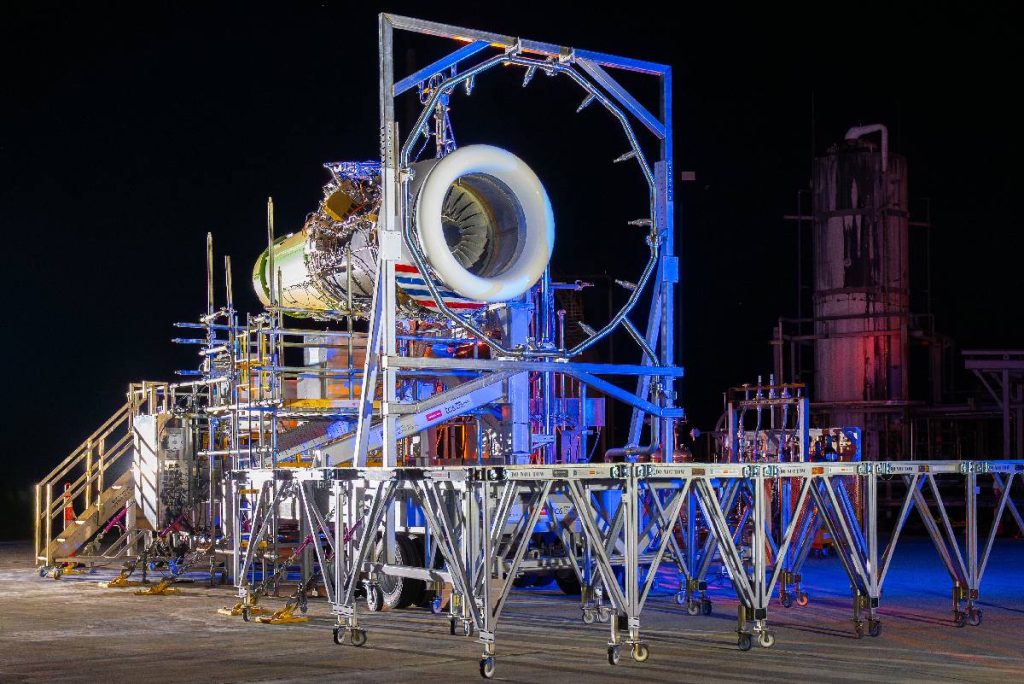
Rolls-Royce and easyJet report they have successfully completed industry-first ground testing of hydrogen as an aviation fuel at NASA’s Stennis Space Center in Mississippi. A modified Rolls-Royce Pearl 15 engine, used on business jet aircraft, reached full take-off power while running on 100% hydrogen, so proving, say the two partners, that a modern jet engine can operate on hydrogen across a full flight cycle and under demanding conditions. The milestone is a result of a four-year programme involving the aircraft engine manufacturer, the airline and other global partners to explore hydrogen as a potential aviation fuel and “generate engineering insight for future propulsion applications”. It started in 2022 with the running of a Rolls-Royce AE2100 on 100% green hydrogen at Boscombe Down in the UK.
“This programme has given us the clearest understanding in the industry of how hydrogen behaves in a modern aero gas turbine,” said Adam Newman, Chief Engineer of the Hydrogen Demonstrator Programme at Rolls-Royce. “Through a collaborative, staged testing approach, we have validated combustion, fuel and control system technologies, and demonstrated the safe use of hydrogen through design, commissioning, maintenance and testing.”
He said a wide range of operating conditions had been explored, including fault scenarios, enabling operation at maximum power and across a full flight cycle.
“The pace of delivery has been critical,” he added, “and the insights gained, many of which are fuel agnostic, will now be applied across our future programmes, including UltraFan, strengthening our confidence that the gas turbine will remain at the forefront of sustainable aviation’s future.”
Following the early engine testing at Boscombe Down in 2022, the technology was scaled and further developed through a UK and European programme of component and system rig tests, including the development of a full-scale hydrogen test facility at the Health and Safety Executive’s Science and Research Centre in the UK. This was followed by full integration into a hydrogen-fuelled demonstrator engine. Earlier modifications also focused on adapting the engine to replace traditional jet fuel with hydrogen while considering both carbon and non-CO2 impacts through an expansive combustion programme.
Rolls-Royce’s expanded partnership with Tata Consultancy Services added capability and capacity across critical engineering workstreams, said the engine OEM.
“During this phase of the testing programme, engineers demonstrated that a modern jet engine, scalable to power a narrowbody aircraft, can safely operate on gaseous hydrogen across a fully simulated flight cycle, including start-up, take-off, cruise and landing,” it reported.
Rolls-Royce also received support for hydrogen research through the UK’s Aerospace Technology Institute, HyEST, RACHEL and LH2GT programmes; Germany’s LUFO 6 WotAn programme; and the CAVENDISH programme supported by Innovate UK and the EU’s Clean Aviation programme.
Commented easyJet COO David Morgan: “This industry-first is a real testament to the progress our partnership with Rolls-Royce has achieved, taking hydrogen from early concept through to full engine build and successful testing in just a few years.
“Demonstrating 100% hydrogen operation at scale is a significant milestone and marks an important step towards easyJet’s net zero ambition, supporting the long-term transition to more sustainable aviation.”
In its roadmap to net zero by 2050 published in 2022, the low-cost airline revealed it had set an interim SBTi-validated carbon emissions intensity reduction target of 35% by 2035. It said its aim was to fully transition its fleet to zero carbon emission technology through a number of strategic partnerships, including with Airbus, Rolls-Royce and GKN Aerospace Solutions.
Photo (Rolls-Royce): Ground testing at NASA’s Stennis Space Center of the hydrogen-powered modified Pearl 15 aircraft engine

Christopher Surgenor
Editor



More News & Features
Over €400m in free EU ETS allowances given to airlines in 2025 to support SAF uptake
EASA reports 2025 supplies of SAF exceeded first year of EU mandate
United and FedEx sign agreements to extend SAF supplies and scale up use
Heathrow expansion incompatible with climate targets, advises UK government watchdog
Nova Pangaea takes major step towards commercial-scale SAF production
COMMENTARY: Why action lags ambition among States seeking SAF mandates