
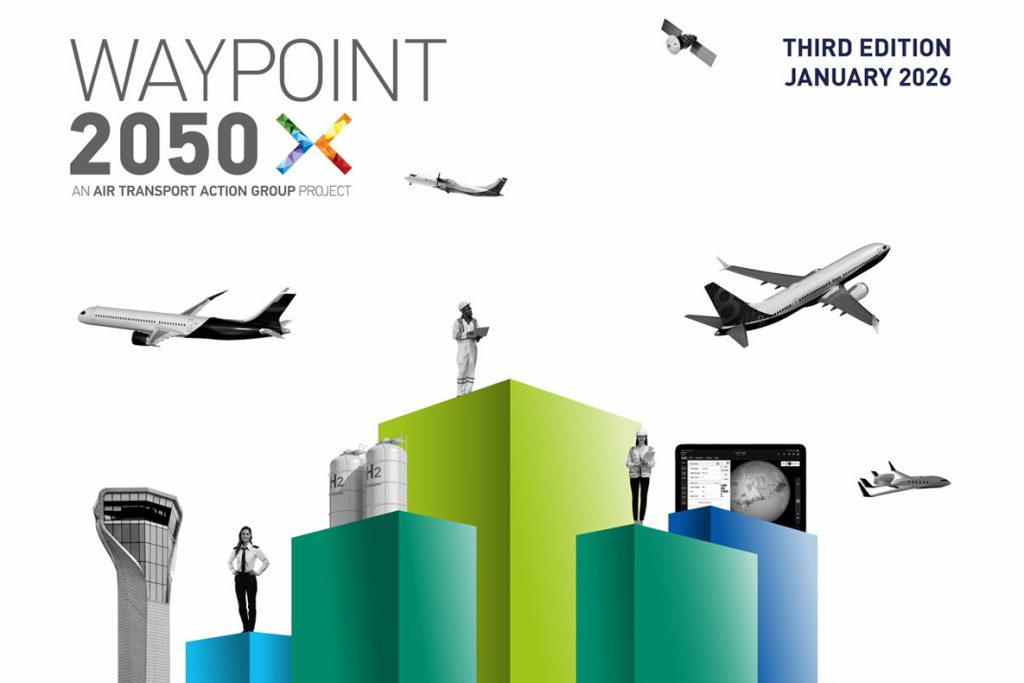
Momentum to achieve the aviation’s long-term goal of net zero emissions by 2050 must accelerate over the next five years, says the Air Transport Action Group’s (ATAG) latest Waypoint 2050 report. Its analysis reiterates there is no single solution to decarbonisation and outlines two scenarios to demonstrate how the sector could reach net zero by mid-century, the first with sustainable aviation fuel as the primary lever, the other a more technology-led pathway. The deployment of SAF remains central to the net zero transition, although the report notes that it has been slower than required but points to a significant increase in global production in recent years. It says SAF could contribute between 38% and 58% of required carbon reductions by 2050, down from the 53-71% forecast in the last edition in 2021, with carbon removals playing a bigger role.
“This edition of Waypoint 2050 details the actions the aviation industry is taking and calls for support from key stakeholders to enable the decarbonisation of air transport,” said ATAG Executive Director Haldane Dodd on unveiling the report at the Singapore Airshow. “This update confirms that net zero aviation by 2050 remains achievable only if momentum is accelerated.
“The next five years are critical to ensure air transport is on course for 2050. This is a collective effort, which requires joint action from the aviation industry, governments, and the finance and energy sectors.”
Across its scenarios, the report highlights that accelerating progress in the short term will avoid higher costs and more complex and abrupt transitions later.
“Each year of delay makes net zero harder and more costly to achieve,” said Dodd. “Each missed opportunity for the right policy to be deployed pushes back progress. Many of the required foundations are in place. Now, urgent acceleration is required to get the trajectory of scale-up and deployment of key measures to reduce carbon emissions. Long-term policy certainty, investment and collaboration across the value chain will determine whether the sector stays on track.”
To achieve the goal, the report by the cross-industry coalition lists five key requirements vital for early action:
• The rapid scale-up of SAF production through strengthened policies, industry and customer commitments, as well as investment in global supply chains;
• Reaffirming and expanding support for the Carbon Offsetting and Reduction Scheme for International Aviation (CORSIA);
• Deploying fuel-efficient aircraft faster into the fleet to enable significant fuel saving;
• Modernising air traffic management systems to reduce operational emissions; and
• Accelerating the development and scaling of “high quality, affordable” carbon removals.
Despite recent supply chain and geopolitical challenges, the report says the aviation sector is continuing to make progress, noting around one-third of the global fleet now consists of latest-generation aircraft, with further efficiency gains expected as new aircraft enter service.
“Airports are improving infrastructure and operational efficiency, and air navigation service providers are enhancing flight efficiency,” it adds. “Manufacturers continue to advance research into aircraft and engine technologies, including hydrogen and electric propulsion concepts.”
Improving the way the sector operates and provides infrastructure could reduce emissions by 9% and next-generation aircraft technology could contribute another 12% to 21% of emissions reductions by 2050, depending on the adoption of hydrogen, electric and hybrid electric aircraft over the coming decades.
However, it is SAF that is central to the industry’s decarbonisation goal with its first scenario estimating a need for around 430-500 million tonnes of SAF per year by 2050, similar to that in the previous 2021 edition.
That report estimated passenger traffic growing 2.5 times higher than 2019 by 2050. The new edition projects an average annual traffic growth rate of around 3.8%, resulting in a growth of 2.7 times higher than 2023 by 2050.
Whereas the 2021 Waypoint 2050 report estimated carbon removals would probably be needed for around 8% of residual emissions – those remaining emissions that cannot be mitigated through in-sector means – by 2050, the latest analysis forecasts that market-based measures, including emissions avoidance, reductions and removals, will likely be needed for 19% to 32% of residual emissions.
Aviation’s energy transition comes with benefits other than cutting emissions, said Dodd. “The net-zero pathway and roadmap of actions is an important framework to encourage investment, support jobs and create the right conditions for the continued growth in the economic and social benefits of air travel around the world,
“Scaling SAF will drive investment, create new jobs and support energy security and economic prosperity, especially in developing economies.”

Christopher Surgenor
Editor



More News & Features
Global aviation’s gross emissions to rise 87% by 2050 despite efficiency gains, forecasts IBA
SkyNRG’s latest market outlook finds a SAF industry moving from ambition to implementation
ANALYSIS: What an expanded EU ETS coverage could mean for airlines
Cirium’s airline emissions efficiency annual rankings highlight importance of younger fleets
Cirium analysis challenges assumptions between aviation growth and environmental impact
Aviation likely to be the UK’s leading emitter by 2040, forecasts Climate Change Committee