




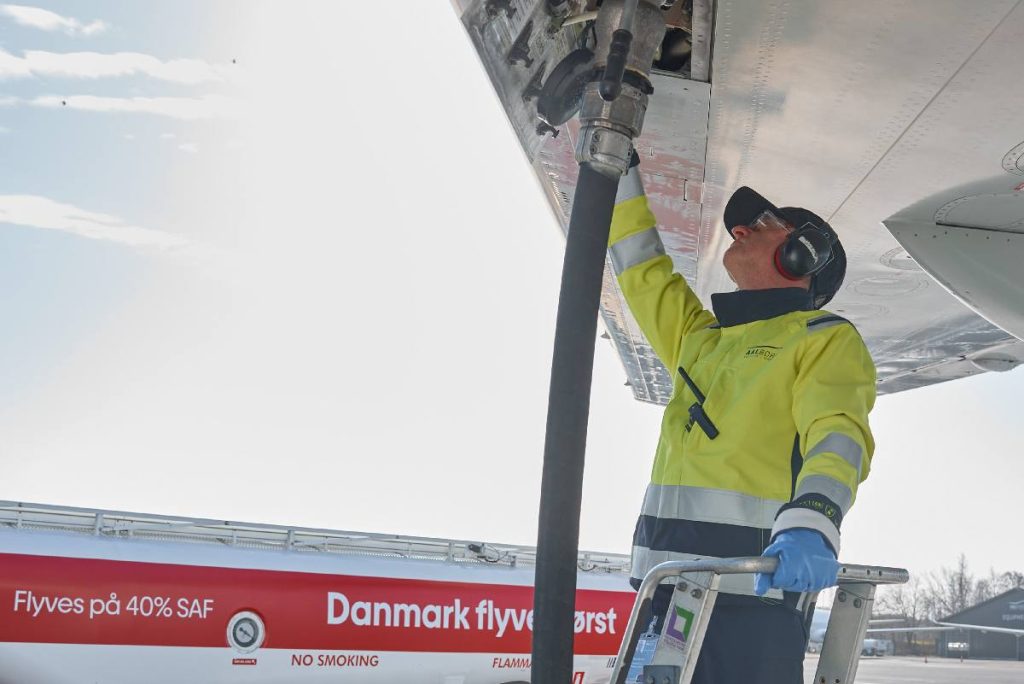
Norwegian has launched a new Danish domestic daily route between Aalborg and Copenhagen that will be the first in Europe to use sustainable aviation fuel on a permanent basis. A 40% blend will be used on all departures in 2026 and 2027, with the SAF consisting of European raw materials and produced by Finnish energy company St1 at its biorefinery in Gothenburg, Sweden. The route has been created through a tender under the Danish government’s ‘Green Aviation’ agreement in which the state is actively supporting the use of more SAF. Emissions from the route are expected to be reduced by more than 3,000 tonnes of CO2 on a lifecycle basis. Meanwhile, Norwegian is fighting through the courts a NOK 400 million ($40m) penalty incurred for non-compliance with the EU Emissions Trading System during Covid-19 and the airline’s reconstruction process.
Norwegian says the purpose of the new route is to speed up production of SAF and make it more accessible through demand and building dedicated supply chains, while strengthening Europe’s security of supply. In addition to the airline and St1, the collaboration includes Aalborg Airport, fuel supplier DCC & Shell Aviation Denmark and Norwegian fuel supplier AFSN. The SAF, certified under ISCC sustainability standards, is sold via DCC & Shell Aviation, with AFSN facilitating the transaction structure.
“This is not just a new route. It is a new model for how we accelerate the restructuring of aviation because it creates demand for SAF. In this way, we get volume, and volume is what drives investments and production,” said Geir Karlsen, CEO of Norwegian.
“The Danish state has chosen to use market forces actively. We are proud to have won the tender with the lowest price per tonne of CO2 saved and have been able to deliver documented evidence.”
St1 is supplying the SAF under a three-year agreement and will be blended and delivered through existing aviation fuel infrastructure.
“This is scheduled commercial traffic operating with a stable SAF supply,” said Henrikki Talvitie, CEO of St1. “For a producer, that makes all the difference. Long-term agreements allow us to plan feedstock sourcing, refining volumes and logistics in a responsible way.”
The company’s biorefinery, a joint venture with SCA, is located next to the St1 refinery and has an annual production capacity of 200,000 tons of biofuels, including SAF, renewable diesel, bio-naphtha and bio-LPG. It is designed to process a variety of raw materials, including used cooking oil, fatty food waste and crude tall oil fractions such as fatty acids.
In another collaboration with SCA, St1 is developing Biorefinery Östrand, a large-scale biorefinery that will utilise by-products from the Nordic forest industry and renewable power, and is expected to have an annual production capacity exceeding 200,000 tons of biofuels and e-fuels.
Meanwhile, Norwegian has announced its intention to appeal to Norway’s Supreme Court a decision by the Borgarting Court of Appeal – one of the country’s six intermediate appeals courts – that overturned a previous ruling in Norwegian’s favour from the Oslo District Court. The dispute centres on Norwegian’s EU Emissions Trading System obligations for 2020 at a time when the airline was in a reconstruction process following difficulties encountered during the Covid-19 crisis.
Norwegian maintains that it was legally unable to fulfil the obligations during its court-mandated reconstruction. The airline has already paid the approximate NOK 400 million penalty in 2023 to avoid enforcement but reserved the right to claim a full refund plus interest pending a final legal conclusion.
Photo: Norwegian (Jasper Carlberg)

Christopher Surgenor
Editor


More News & Features
Over €400m in free EU ETS allowances given to airlines in 2025 to support SAF uptake
EASA reports 2025 supplies of SAF exceeded first year of EU mandate
United and FedEx sign agreements to extend SAF supplies and scale up use
Nova Pangaea takes major step towards commercial-scale SAF production
COMMENTARY: Why action lags ambition among States seeking SAF mandates
Syzygy signs agreement with World Bank arm IFC to advance Latin American SAF production