










ICAO’s Carbon Offsetting and Reduction Scheme for International Aviation (CORSIA) is structurally changing carbon market demand prospects for the coming years, says a report by carbon market platform Abatable. It expects the demand for CORSIA-compliant carbon credits, called Eligible Emissions Units (EEUs), will begin to materialise this coming year as airlines procure EEUs to cover their emissions for the First Phase (2024-2026) of the scheme. Aviation emissions grew 15% from the scheme’s 2019 baseline to 2024, resulting in a demand for 58 million tonnes of eligible units to cover 2024 units. In 2026, ICAO will publish its emissions compensation volumes for 2025 emissions, which Abatable estimates will see an additional 78 million tonnes of new demand this year.
Abatable says the likely combined 2024-2025 demand for CORSIA carbon credits is equivalent to 40% of total voluntary carbon market (VCM) retirements over the same period.
Its 2026 carbon market overview report estimates total EEU demand to be between 200 and 220 million tonnes during the whole CORSIA First Phase, compared to ICAO forecasts of 100-150 million tonnes and IATA’s 146-246 million tonnes (see graph below).
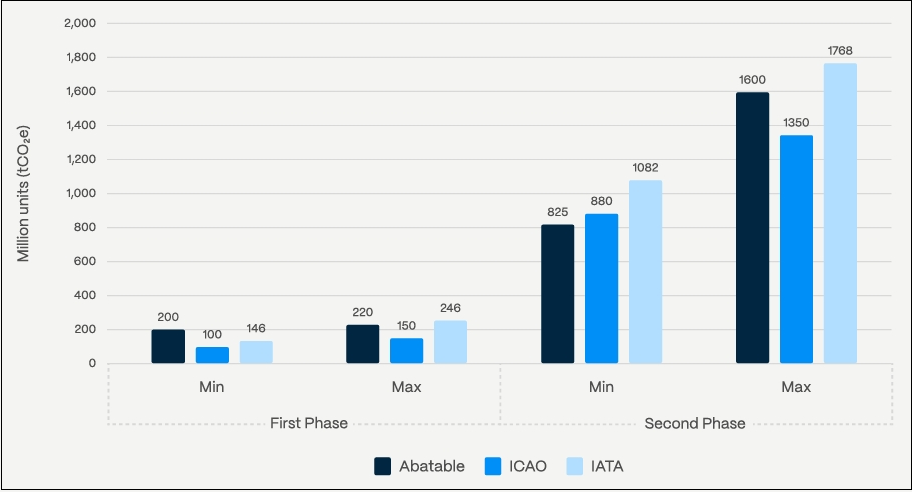
Forecasted minimum and maximum CORSIA carbon credit demand scenarios under the scheme’s First and Second Phases from Abatable, ICAO and IATA (source: Abatable)
Supply of EEUs for First Phase use, on the other hand, stood at just 31.3 million tonnes as of early February 2026. As recently as mid-2025, the supply was limited to a single ART TREES project in Guyana as a result of a bottleneck caused by the slow issuance of Letters of Authorization (LoAs) from carbon project host country governments to allow credits to be used in CORSIA.
Certain countries have been accelerating LoA issuance, says Abatable, resulting in more supply for use in the First Phase. It expects additional LoAs to unlock more supply in the coming months, while ICAO is assessing additional programmes for eligibility to potentially further increase CORSIA supply. However, a major cookstove project developer, KOKO, which had intended to offer CORSIA credits to the market, shut down recently after the Kenya government refused to issue it with a LoA (see article).
National authorities participating in CORSIA are due to notify airlines by 30 November 2027 of their total final offsetting requirements for the entire First Phase. By 31 January 2028, airlines must cancel the required number of EEUs for the First Phase and by 30 April 2028, airlines must submit their final Emissions Unit Cancellation Report to their state authority.
According to ICAO, 130 of its 193 member states are currently participating voluntarily in the First Phase, with 690 aeroplane operators in 2025 reporting their emissions. Only flights between participating states are subject to offsetting requirements in the First Phase. All international flights, except those to and from certain exempted smaller states, will be subject to offsetting requirements from 2027, although major countries such as Brazil, China and India have yet to confirm their participation.
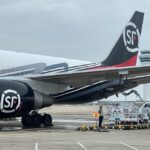
Photo: ART TREES credits from a jurisdictional REDD+ programme in Guyana were the first to be eligible under CORSIA

Christopher Surgenor
Editor


More News & Features
Commission proposes a limited extension of the ETS to international departing flights from Europe
Extending the EU ETS to all international flights departing Europe could raise $10bn a year, finds ICCT study
ANALYSIS: What an expanded EU ETS coverage could mean for airlines
COMMENTARY: CORSIA – A flawed scheme worth saving?
Airlines and the carbon market form alliance to unlock supply of CORSIA-eligible credits
Hope fading fast for industry net zero by 2050 target as SAF growth slows, says IATA chief