

The Singaporean Civil Aviation Authority (CAAS) has announced it will defer the implementation of its SAF Levy on the sale of tickets and services, due to start on April 1, in view of the ongoing Middle East conflict. The levy will now apply to tickets and services sold from October 1 for flights departing from 1 January 2027. With the deferment, the SAF target of 1% will now take effect from 2027 and plans to raise the target to 3-5% by 2030 remain in place, said CAAS, subject to “global developments and the wider availability and adoption of SAF”. Unaffected is Singapore’s first voluntary sustainable aviation fuel procurement trial launched last month by CAAS, the Singapore Sustainable Aviation Fuel Company (SAFCo) and nine companies. SAFCo was established by CAAS in October 2025 to centrally procure SAF in support of the 1% target on the use of SAF for flights departing Singapore.
Announcing the deferment of the SAF Levy, Han Kok Juan, the Director-General of CAAS, said: “Singapore remains firmly committed to aviation decarbonisation. We are taking a pragmatic pause in view of the current situation. We will continue to work closely with our aviation industry partners and monitor global developments.”
The SAF Levy is based on distance from Singapore travelled, with destinations grouped into four geographical bands. Economy class passengers will pay a fee ranging from S$1 (US$0.77) to S$10.40 (US$8) on their tickets, with premium class passengers paying four times more. It does not apply to transit passengers. Separate SAF levies apply to cargo shipments and general and business aviation flights.
Proceeds from the levy will be used to support the joint procurement of CORSIA-eligible SAF through the non-profit SAFCo, which is chaired by CAAS’ Han Kok Juan and led by Tan Seow Hui, a former senior executive at Shell.
The nine companies involved in the trial of buying SAF through SAFCo are Boston Consulting Group, Changi Airport Group, DBS Bank, GenZero, Google, OCBC, Temasek and Singapore Airlines together with its low-cost subsidiary Scoot.
The trial will enable SAFCo to test the end-to-end operational, commercial and accounting processes needed for a national level SAF procurement and environmental attributes (EAs) allocation system. It will allow participants, says SAFCo, to:
• Access SAF and associated EAs through a national SAF policy framework that ensures transparent and credible emissions reduction;
• Get first-hand experience on the procurement and accounting process for SAF EAs to meet sustainability commitments; and
• Leverage SAFCo’s aggregated demand to access SAF cost-effectively, more efficiently and with greater certainty compared to individual procurement.
“This voluntary trial is an important step in building confidence and capability in Singapore’s SAF ecosystem,” said SAFCo CEO Tan Seow Hui. “By aggregating demand and working closely with airlines, corporate partners and government agencies, we aim to demonstrate a practical and credible approach to SAF procurement and EA allocation that can scale over time.”
Han Kok Juan reported strong commercial interest in the initiative and hoped more companies would join. “We are seeking to grow a robust and efficient SAF ecosystem to achieve a more resilient and affordable fuel supply for our aviation sector,” he said.
In May last year, the Singapore Airlines Group acquired 1,000 tonnes of CORSIA-eligible SAF produced at Neste’s Singapore refinery, blended locally and uplifted at Changi Airport. In addition, the Group purchased around 2,000 tonnes of CORSIA-eligible SAF in the form of emissions reduction certificates (SAFc) from US-based World Energy, utilising the book-and-claim chain of custody model.
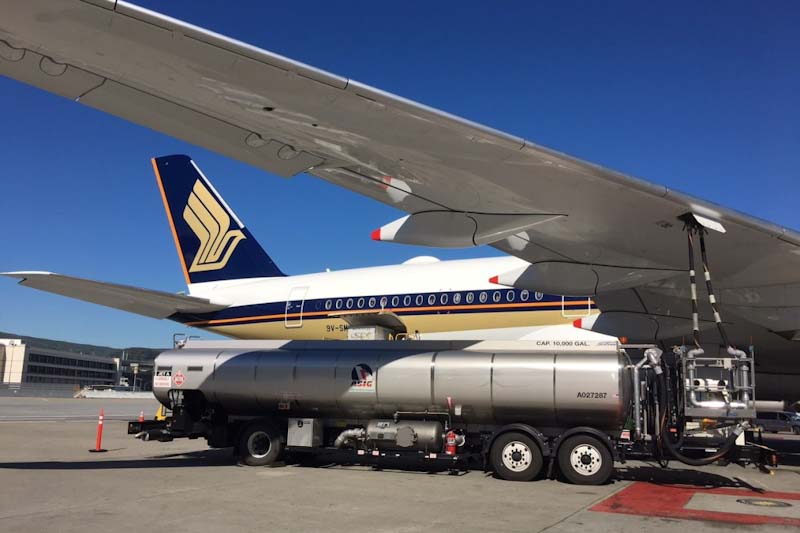
Photo: Singapore Airlines

Christopher Surgenor
Editor


More News & Features
Synthetic aviation fuel projects advance in Europe, Africa, US and China
Over €400m in free EU ETS allowances given to airlines in 2025 to support SAF uptake
EASA reports 2025 supplies of SAF exceeded first year of EU mandate
United and FedEx sign agreements to extend SAF supplies and scale up use
Cathay Pacific trials Google’s AI-powered contrail avoidance technology across its network
Nova Pangaea takes major step towards commercial-scale SAF production