

Digital traceability solutions provider Finboot has signed an agreement with Acelen Renewables, which has ambitions to produce 1 billion litres of sustainable aviation fuel and renewable diesel (HVO) from high-energy macauba oil in Brazil, to monitor the lifecycle of the production chain. The partnership will implement and set up Finboot’s MARCO Track & Trace according to Acelen’s specific traceability needs. With plans to export its renewable fuels to Europe and the US, Acelen says it needs a robust and auditable traceability solution to meet regulatory requirements domestically as well as internationally. The Brazilian project was unveiled by Acelen Renewables, a subsidiary of global asset management company Mubadala Capital, at COP28 in 2023, held in Dubai. The macauba palm fruit is seen as a promising feedstock for biofuels as it can be grown on degraded agricultural land, thus avoiding deforestation concerns.
With an initial duration of 12 months, the Finboot and Acelen project will include the modelling of the phases of the production chain, with a focus on land eligibility, production on farms, an emissions calculator, tokenisation via blockchain and sustainability criteria.
“The tool will ensure transparency throughout the value chain, from the origin of the biomass to the production of the fuel, and will allow us to show compliance with criteria such as feedstock eligibility, sustainability and emissions calculation, while incorporating technology solutions such as blockchain and tokenisation,” said Pedro Estrela, VP New Business and Digital at Acelen Renewables.
The Brazilian ProBioQAV programme is establishing certification, eligibility and traceability criteria so that sustainability standards are in line with international best practice.
With operations scheduled to begin in 2028, the United States and Europe are seen as crucial export markets for Acelen’s renewable fuels, which claims to have about 90% of its SAF production sold in advance.
“We are strengthening our ability to meet the regulatory requirements of our target markets and to go through increasingly rigorous certification processes,” added Estrela. “We see this initiative as a strategic step to increase transparency, data reliability and the credibility of our product with regulators, clients and investors, and to build a technological base for us to keep up with the evolving demands of the global low-carbon fuel market.”
Rather than focusing solely on compliance, explained Finboot, the collaboration aims to create a data infrastructure that allows each production batch to be evaluated independently. The MARCO solution, it said, would enable the structuring of such mechanisms as mass balance, batch traceability and preparation for future digital product passport (DPP) requirements.
“As biofuels gain global scale, it becomes clear that not all fuels or value chains are the same,” said Juan Miguel Pérez Rosas, CEO of Spain and UK based Finboot. “Digital traceability allows emissions and sustainability performance to be measured accurately, giving regulators, markets and investors the confidence they demand more and more.”
Acelen will build its refinery in the Brazilian state of Bahia and is supporting the state government in mapping and identifying suitable areas for macauba cultivation, with an emphasis on structuring agreements for the implementation of agro-industrial hubs in the region.
Family farming based on macauba palm (Acrocornia) could become a source of the country’s growth, said Peter Eisner, Director of the German Fraunhofer Institute, which has been involved in a German-Brazil research project, Acro Alliance, to develop sustainable value chains for macauba palm trees.
“By investing in natural capital for the energy transition, Brazil can grow faster and lift more people out of poverty more quickly,” said Peter Eisner, Director of the Fraunhofer Institute, during the launch of the Acelen project at COP28.
“Deforestation has decreased in a relatively short period. This project values diversity, restores nature and creates an economy that is sustainable.”
As part of plans to decarbonise aviation, Brazil introduced in 2024 federal legislation, called Fuel of the Future Law, which establishes an emissions reduction target through the use of SAF blends.
Acelen has planned investments of $3 billion in infrastructure and supply chains, including the building of its first integrated plant, with cultivation of macauba palm on 180,000 hectares of degraded pastureland, along with advanced industrial processing and refining capabilities.
The company inaugurated its 138-hectare Agro-industrial Technological Innovation Center (Acelen Agripark) in August last year, which is located in the city of Montes Claros, Minas Gerais, and was attended by Brazil’s President Lula, who said Brazil had more than 40 million hectares of degraded land.
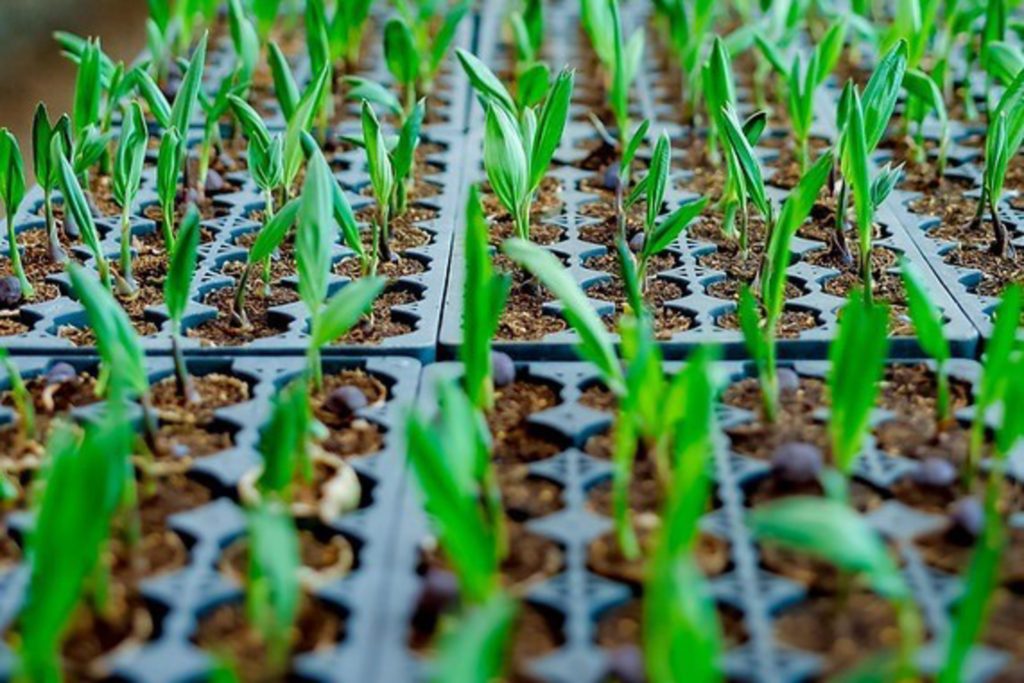
Photo (Acelen Renewables): Macauba (Acrocomia aculeata) seedlings

Christopher Surgenor
Editor



More News & Features
Synthetic aviation fuel projects advance in Europe, Africa, US and China
Over €400m in free EU ETS allowances given to airlines in 2025 to support SAF uptake
EASA reports 2025 supplies of SAF exceeded first year of EU mandate
United and FedEx sign agreements to extend SAF supplies and scale up use
Nova Pangaea takes major step towards commercial-scale SAF production
COMMENTARY: Why action lags ambition among States seeking SAF mandates