

UK cross-aviation industry group Hydrogen in Aviation Alliance (HIA) has announced combined investments of £188 million ($250m) into innovation and R&D for hydrogen-powered aviation. The group, which includes Airbus, Bristol Airport, easyJet, GKN Aerospace and Rolls-Royce, has been joined by new member Intelligent Energy. HIA says its core mission is to ensure the UK maximises its opportunity to be a global leader in hydrogen-powered aviation. Two of its members, easyJet and Rolls-Royce, recently completed ground testing of an engine powered by hydrogen. Meanwhile, the government/industry Jet Zero Taskforce has published a report by its Hydrogen Task and Finish Group that highlights the work it had carried out in 2025 and looks at the potential for domestic commercial hydrogen flight.
Welcoming the investment from HIA members, UK Aviation Minister Keir Mather said: “We have the talent and innovation to lead the future of clean aviation, and this investment by industry will help create high-skilled jobs and drive growth across the UK, alongside our £43 million ($58m) investment for green technology research and development.
“From research labs to the runways of the future, we’re working with industry to back the next generation of sustainable flight and putting Britain at the forefront of green aviation.”
HIA also announced Andy Reynolds, VP Fuel and Inerting Systems at Airbus, would be taking over the role of Chair from Russ Dunn, GKN Aerospace’s Chief Technology Officer.
“No matter which decarbonisation roadmap you look at, hydrogen remains a vital part of reducing the climate impact of aviation. Our aim is now to move beyond the early hype of hydrogen to achieve the next steps in propulsion technologies, airframe systems and infrastructure,” commented Reynolds.
“It is essential this pace is also matched by development in the supporting ecosystem and policy sphere, and this is where HIA can support UK decision makers in seizing this opportunity for growth and decarbonisation.”
Reynold’s own company, Airbus, has broken ground on its ZEROe Development Centre, a new hydrogen testing facility that will focus hydrogen fuel systems testing in the southwest of England, with the ambition to share this capability with other industry partners in the region.
The four-year hydrogen gas turbine demonstration programme completed by easyJet and Rolls-Royce in April involved the successful testing of a Rolls-Royce Pearl 15 engine on 100% hydrogen, representing an industry-first achievement of proving a jet engine can safely run on hydrogen to full take-off thrust and through a full flight cycle, claim the two partners (see article).
New HIA member Intelligent Energy, which is pioneering hydrogen fuel cells for aviation, is advancing the HEIGHTS programme, a government-backed project developing a 300kW modular fuel cell for eVTOL and commuter aircraft. The company is opening a new Technology Development Centre in the UK that will enable full-power testing to accelerate aviation deployment.
“We are committed to the use of hydrogen and fuel cells in aviation,” said Greg Harris, Chief Commercial Officer. “Since our fuel cells were used by Boeing in the world’s first manned fuel cell-powered flight in 2008, we have continued to develop flight specific fuel cell technology with partners such as GKN Aerospace and the support of the UK’s Aerospace Technology Institute (ATI).
“Joining HIA allows us to work alongside partners across the sector – from aircraft design and propulsion to infrastructure and regulation – with the aim to make the UK a key supplier of the technology needed for practical, zero-emission flight.”
GKN Aerospace is leading a number of UK-backed hydrogen programmes, including H2FlyGHT, a £44 million collaborative project developing a 2 MW cryogenic hydrogen-electric propulsion system for larger aircraft.
Bristol Airport, the location for the UK’s first airside hydrogen refuelling trial, Project Acorn, at a commercial airport, will host additional trials during 2026.
HIA said that following recent successes in testing hydrogen propulsion technology, the next milestone will be small-scale, regional flights across the UK. “Putting in place the right infrastructure, regulation and investment for smaller-scale flights will enable larger hydrogen-powered aircraft,” it added.
The report published in March by the Jet Zero Taskforce Hydrogen Task and Finish Group includes a market analysis of the UK and European domestic route aviation network, a roadmap to domestic hydrogen commercial operations and a UK aviation hydrogen demand forecast.
“The analysis shows that the majority of hydrogen impact before 2050 will be delivered through sustainable fuels in combination with direct fuel use for regional airline operations, with larger aircraft directly using hydrogen having a significant impact after 2050,” says the report.
“The target of initial UK commercial operations by 2030 is feasible with the right support. UK-led demonstrations show that hydrogen propulsion systems are maturing to support sub-regional aircraft (with fewer than 19 seats) in this timeframe. These aircraft are expected to be technically capable of supporting the UK’s existing route network, particularly in rural and island regions. Public Service Obligation routes offer an adaptable mechanism to provide subsidy for initial operations while the system is still being optimised.”
The report points out that hydrogen is also an essential feedstock for SAF in supporting the UK Net Zero 2050 target.
“With coordinated investment, policy support and regulatory development, the UK can lead in zero-emission flight and secure long-term environmental, economic and industrial benefits.”
The UK Department for Transport’s Jet Zero Strategy states rapid investment in hydrogen aviation could help the UK secure up to 60,000 new jobs by 2050. Green Alliance’s 2025 report, Flying Start, estimates the sector could contribute up to £37 billion in gross value added to the UK economy by the same date.
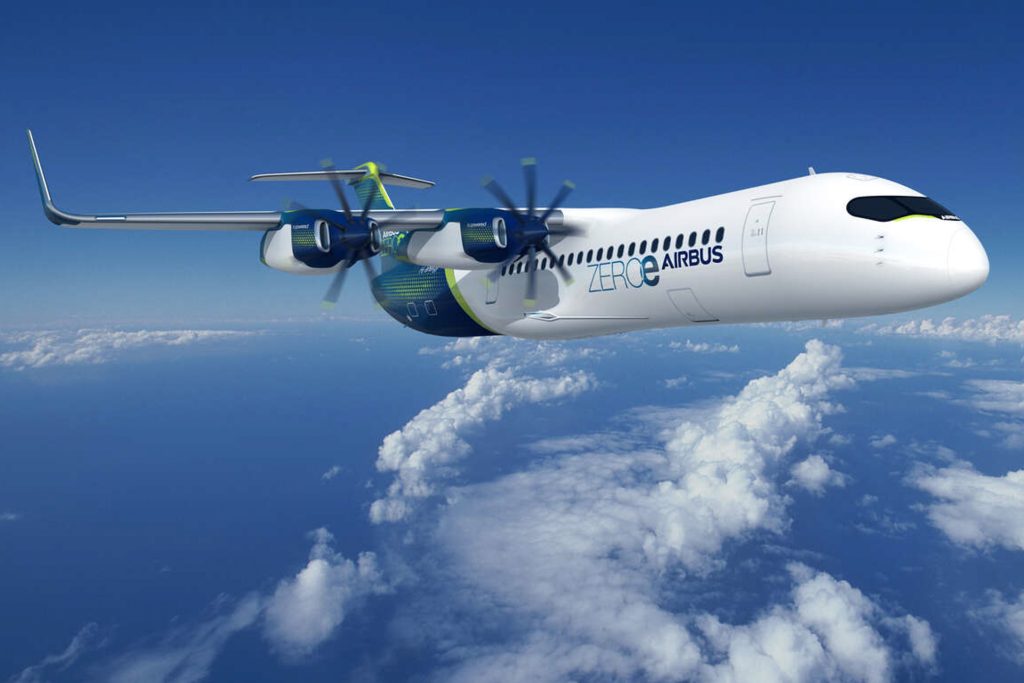
Image: The Airbus ZEROe concept aircraft features an electric propeller propulsion system powered by hydrogen fuel cells, which transform the hydrogen into electricity through a chemical reaction

Christopher Surgenor
Editor



More News & Features
Heathrow expansion incompatible with climate targets, advises UK government watchdog
Nova Pangaea takes major step towards commercial-scale SAF production
UK consortium launches major government-backed oceanic contrail avoidance programme
UK aviation group plots route to net zero in updated decarbonisation roadmap
Farnborough Airshow highlights progress on electric and hydrogen propulsion for commercial aviation
UK government releases pricing mechanism strategy and timelines to support SAF production