




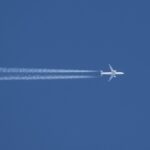


Starting this coming northern hemisphere winter, a UK-based consortium is to conduct the world’s first oceanic airspace-scale trial over a 30-month period, aimed at reducing the climate impact of aviation contrails. Operation Blue Skies comprises Google, the UK Department for Transport (DfT), the Met Office, NATS, Contrails.org, Imperial College London and the University of Cambridge. The programme will include two operational trials during winter testing windows in 2026/7 and 2027/8 across NATS-controlled Shanwick oceanic airspace, the eastern half of the North Atlantic corridor, which accounts for around 5% of global contrail warming. The consortium says around 10,000 flights will pass through the airspace during trial hours each year and a small percentage that would otherwise fly through contrail-sensitive areas will have their altitudes slightly changed by air traffic controllers.
The £5 million ($6.8m) Operation Blue Skies programme is co-funded by its industry partners and a grant of £2.65 million from the DfT through the Aerospace Technology Institute (ATI), the Department for Business, Innovation, Science and Trade, and Innovate UK. To ensure the public funding directly advances sovereign scientific capabilities, all the government funding will be allocated directly to academic, non-profit and aviation partners.
Google UK is participating on a pro-bono basis, contributing £1.4 million in-kind support through AI research expertise, engineering time and high-performance computing infrastructure to advance open climate science, it says.
“We’re partnering with Google to back British experts and innovators to find practical ways to make flying cleaner. This is a world-first, and it’s British ingenuity leading the way,” commented Keir Mather, the UK’s Aviation Minister on the launch of Operation Blue Skies. “By testing small tweaks to flight paths over the Atlantic, we can cut the vapour trails left behind by planes.”
Kemal Armada, Product Manager at Google, believes contrail avoidance has reached “a pivotal moment” and the question, he said, is no longer whether contrails can be mitigated but whether mitigation can be worked at the scale of the global aviation system.
“This trial is an important step towards making that a reality, while demonstrating the strength of British research and innovation in developing practical solutions to one of aviation’s most important climate challenges,” he said.
Contrails.org, a non-profit founded as part of the Breakthrough Energy platform, will work alongside the consortium partners to connect the scientific and operational pieces of the trial. This will involve assessing and integrating forecasts, shaping trial parameters and supporting data analysis so that the programme can test whether contrail avoidance is “safe, measurable and practical” across oceanic airspace.
“For five years, we’ve worked to build the scientific understanding and forecasting tools to predict where and when contrails form, and how much they warm the planet,” said Marc Shapiro, its Executive Director. “The next critical step is to prove these tools work reliably in real operations, leading to real, verified reductions in contrail warming.”
The UK’s national meteorological service, the Met Office, is in the process of developing a new UK contrail forecast capability and ensuring meteorological accuracy throughout the trial.
“Our understanding of regional weather regimes will provide an important scientific basis for the trials,” said James Shapland, Head of Regulated Transport Services at the Met Office. “Developing a global contrail forecast capability aligns with our strategic work to support the aviation industry in managing its longer-term environmental impacts.”
Academic research input into the programme will come from Imperial College London and the University of Cambridge. Imperial will evaluate outcomes from the trial and provide independent climate impact verification. A study it published in 2020 found that small changes to flight paths could reduce the climate impact of contrails.
“Operation Blue Skies is a chance to test that idea in the real world and on a scale we’ve never seen before,” said Marc Stettler, Professor of Transport and Environment at Imperial. “Our role is to assess what happens, from the effects on airline operations to the benefits for the climate, and provide the evidence needed to decide whether this approach could become part of everyday aviation. It’s exciting to see Imperial’s research helping to shape practical solutions to one of aviation’s biggest climate challenges.”
Added Steven Barrett, Regius Professor of Engineering at the University of Cambridge: “Contrail avoidance could drastically reduce the global climate impact of aviation, at minimal cost to passengers and companies. Operation Blue Skies is a big step forward in this process, as it will test the ability of the UK to reduce contrail coverage at an airspace-wide scale and in a real-world setting.”
The task of changing flight levels of aircraft passing through the Shanwick international airspace that lies above the northeast part of the Atlantic will be undertaken by air traffic controllers belonging to NATS, the UK’s air navigation service provider. The busiest oceanic airspace in the world, almost all transatlantic flights between Europe and North America come under the control of Shanwick at some point of their journey.
“This trial will allow us to test how contrail avoidance could work within the complex, highly coordinated environment of air traffic management,” said Ian Jopson, Director Sustainability at NATS.
In the trials, AI-driven tools will be used to predict the ‘pancake-shaped’ pockets of wet and cold air where contrails are likely to be formed and those regions passed on to NATS. The information will then be used by air traffic controllers to deviate aircraft through normal procedures as they would do to avoid air traffic or turbulence. NATS will conduct safety assessment and air traffic controller training.
Jopson assures that deviations from ice super saturated regions where contrails are formed will only take place if it is safe and operationally feasible to do so. Altitude deviations will be limited to around 2,000 feet, which Jopson estimates would result in a one per cent fuel penalty within the Shanwick area, or about 100kgs of fuel per aircraft on average.
Over the two winters, trial manoeuvres will take place 20 to 40 test days per winter and conducted during periods of lower air traffic, with each day limited to around seven to eight hours.
Most contrail avoidance trials that have taken place to date have involved airline partners, in which the airline flight dispatcher or flight planning team file a flight plan ahead that avoids predicted contrail regions. As an airspace-scale trial, no airline or group of airlines has been invited to join the consortium.
“We believed it would be problematic and cause bias to involve a particular airline, given that around 200 operators are likely to pass through Shanwick during trial hours,” explained Jopson. “Nonetheless, we have been engaging with airlines up front about the programme.”
Given the trial is taking place at airspace level, aircraft crews will not be informed during flight they are being deviated for contrail avoidance reasons. The consortium doesn’t expect to see big changes outside of normal operating parameters for aircraft flying through the Shanwick area.
The project is being delivered through the non-CO2 stream of the ATI Programme. “Building on the ATI’s non-CO2 roadmap, the project will explore how contrail avoidance could work alongside decarbonisation measures such as advanced aircraft technologies and sustainable aviation fuels,” said Gary Elliott, CEO of the Aerospace Technology Institute.
“By generating real-world evidence at an unprecedented scale, Operation Blue Skies will help build the understanding needed to inform future industry and policy decisions, while reinforcing the UK’s position at the forefront of aerospace innovation.”
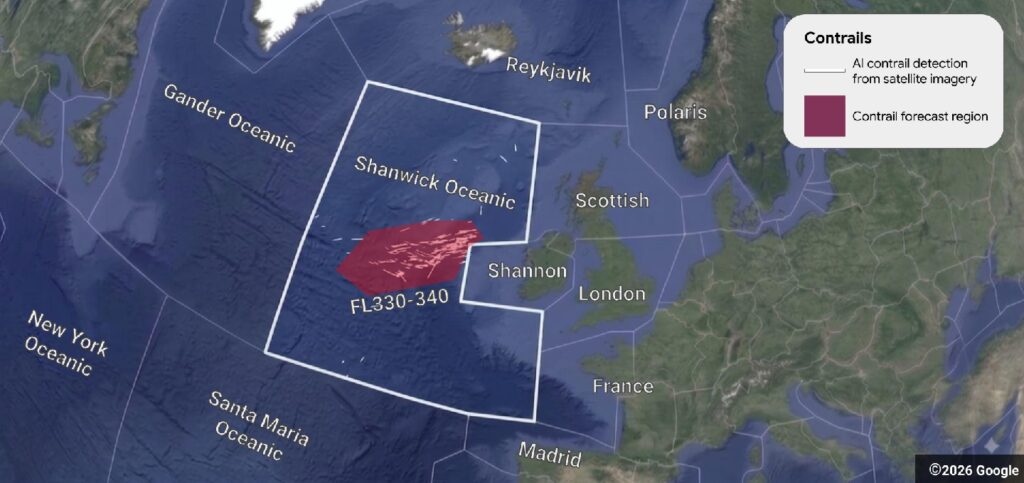
Top photo: NATS manages the Shanwick Oceanic Control Area from the Prestwick Centre in Scotland

Christopher Surgenor
Editor


More News & Features
Flying off into the sunset
News Roundup September 2026
Synthetic aviation fuel projects advance in Europe, Africa, US and China
Global aviation’s gross emissions to rise 87% by 2050 despite efficiency gains, forecasts IBA
Air France shares results of large-scale North Atlantic contrail avoidance trial
Over €400m in free EU ETS allowances given to airlines in 2025 to support SAF uptake