
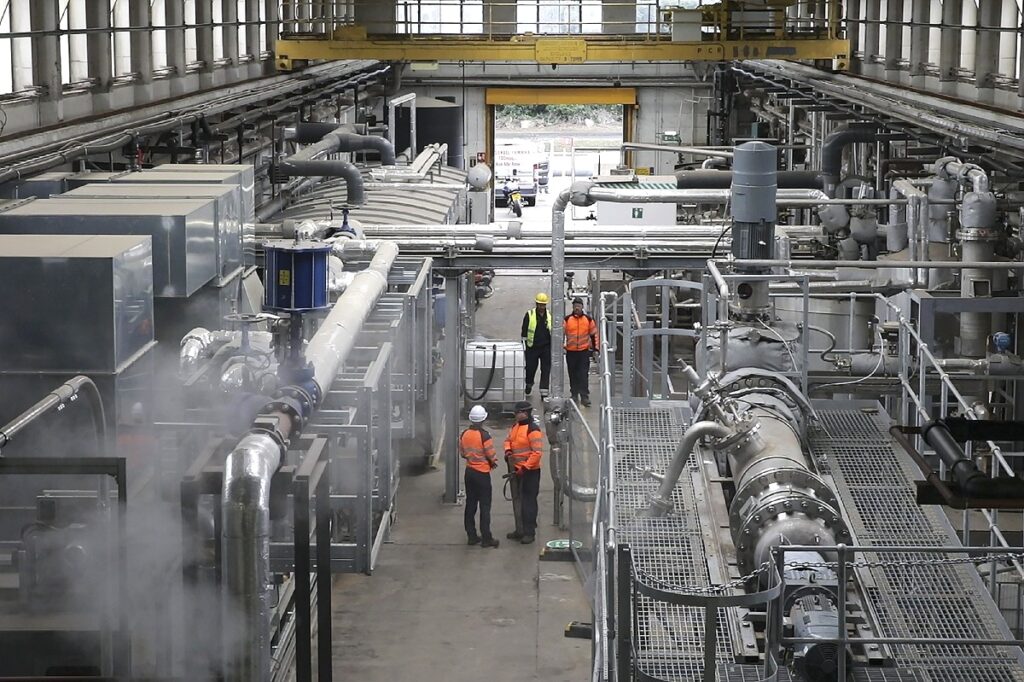
UK SAF developer Nova Pangaea Technologies reports it has successfully completed endurance trials at its Teesside demonstration plant to further validate its process of producing sustainable aviation fuel from waste biomass. The company says the trials, which used softwood residues from timber processing, showed continuous stable operation in production runs of up to 72 hours and achieved above target yields. Nova Pangaea is working with British Airways and LanzaJet on Project Speedbird to produce carbon-negative aviation fuel from local waste biomass and has ambitions to construct four UK facilities to produce bioethanol for upgrading to SAF. Meanwhile, the UK Department for Transport, which has provided funding support for Speedbird, has released an updated comprehensive list of feedstocks, including wastes and residues, eligible under its SAF Mandate.
Nova Pangaea’s REFNOVA process converts waste biomass and residues, such as wood chips, sawdust or wheat straw, into ethanol, which can be used to make SAF and renewable diesel. It also produces a biochar co-product, which can permanently capture carbon to make the whole process carbon negative by removing more CO2 from the atmosphere than it releases, explains the company.
In the latest trials, multiple runs were carried out processing up to three tonnes of feedstock per day. They follow initial smaller-scale trials in early 2025 that demonstrated the viability of the process outside of the laboratory. Nova Pangaea is planning more trials next year to “fine tune” the design of the first commercial-scale plant, it said.
“The latest trials have validated our technology and should further underpin the confidence of investors on our journey towards building this first commercial plant,” commented, Stewart Stewart of Nova Pangaea, who joined the company as CEO earlier this year from New York-based investment bank Javelin Capital, where he advised on green fuel opportunities.
The company says it has raised over £21 million ($28m) to date from investors that include International Airlines Group, PXN Ventures, Mercia Ventures and the first Northern Powerhouse Investment Fund, as well as the government’s grant funding awarded under the Advanced Fuels Fund competition.
Added Stewart: “By tapping into the plentiful supplies of waste biomass, we can boost SAF production – enhancing our energy security and building a new domestic industry that generates jobs and revenues while reducing fossil fuel emissions.”
The Project Speedbird collaboration is expected to result in eventual production of 90,000 tonnes of SAF and renewable diesel annually, with the potential, claims Nova Pangaea, to reduce net CO2 emissions by up to 541,800 tonnes a year on a lifecycle basis. British Airways is a founding investor and shareholder in US SAF producer LanzaJet, whose alcohol-to-jet technology that converts second-generation ethanol from sources like agricultural residues and woody biomass will be used in Project Speedbird.
Meanwhile, the Department of Transport has released an updated list of feedstocks, including wastes and residues, eligible under the UK’s SAF Mandate. The list, divided into categories, includes names and descriptions of the materials.
Photo: Nova Pangaea Technologies’ demonstration plant

Christopher Surgenor
Editor



More News & Features
Flying off into the sunset
News Roundup September 2026
Synthetic aviation fuel projects advance in Europe, Africa, US and China
Global aviation’s gross emissions to rise 87% by 2050 despite efficiency gains, forecasts IBA
Air France shares results of large-scale North Atlantic contrail avoidance trial
Over €400m in free EU ETS allowances given to airlines in 2025 to support SAF uptake