










The UK’s independent statutory Climate Change Committee has advised the government that expansion of Heathrow Airport is not currently compatible with the nation’s net zero target and carbon budgets. Under existing policy, UK aviation emissions would not fall at all from 2025 levels by 2050, forecasts the Committee in a 68-page report requested by the government. It says the only way expansion could be consistent is if ministers implement a “robust” set of policies requiring the aviation industry to reach zero emissions by 2050. This, it recommends, could be achieved through a combination of direct emissions reductions and the purchase of engineered removals. The most efficient way to reach net zero would be for the cost of decarbonising aviation to be reflected in the cost of flying, it argues.
The report highlights emissions from aviation have more than doubled since 1990, while emissions across the UK economy as a whole have halved. Heathrow is already responsible for around half of the UK aviation industry’s emissions. Even without the airport’s expansion, it says aviation emissions are projected to increase from 37 MtCO2e in 2025 to 39 MtCO2e in 2050. “Expanding Heathrow would compound the problem, adding 0.4 MtCO2e to emissions in 2040, rising to 2.4 MtCO2e in 2050 and 4.5 MtCO2e when expansion is complete in 2054,” says the report.
The total impact of the proposed expansion would increase whole-economy residual CO2 emissions of 6.9% of expected 2050 levels, estimates show.
“Emissions from flying are projected to rise, even without Heathrow expansion, and the UK does not currently have a credible plan to bring them down. That poses a serious challenge to our climate commitments,” commented the Committee’s Chair, Nigel Topping.
“Our advice is clear – Heathrow expansion is not currently compatible with the UK’s net zero target. Government needs to ensure that the aviation industry takes responsibility for the emissions it creates and bears the costs of decarbonisation. Those conditions do not exist today.
“This summer’s extreme weather has brought the impacts of climate change into sharp focus. Every tonne of greenhouse gas emissions makes those impacts worse. That’s why it’s so important the right policies are put in place now to fully address aviation emissions.”
Based on the ‘polluter pays’ principle, the report sets out a pathway to net zero whereby in 2050 engineered removals account for 36% of the emissions reduction, lower demand growth 24%, efficiency improvements 20% and the remaining 20% coming from the use of sustainable aviation fuel, with industry paying for SAF and engineered removals (see graph below). It says nature-based removals, such as trees, are not suitable for offsetting residual aviation emissions because they lack the permanence needed to match very long-lived CO2 emissions.
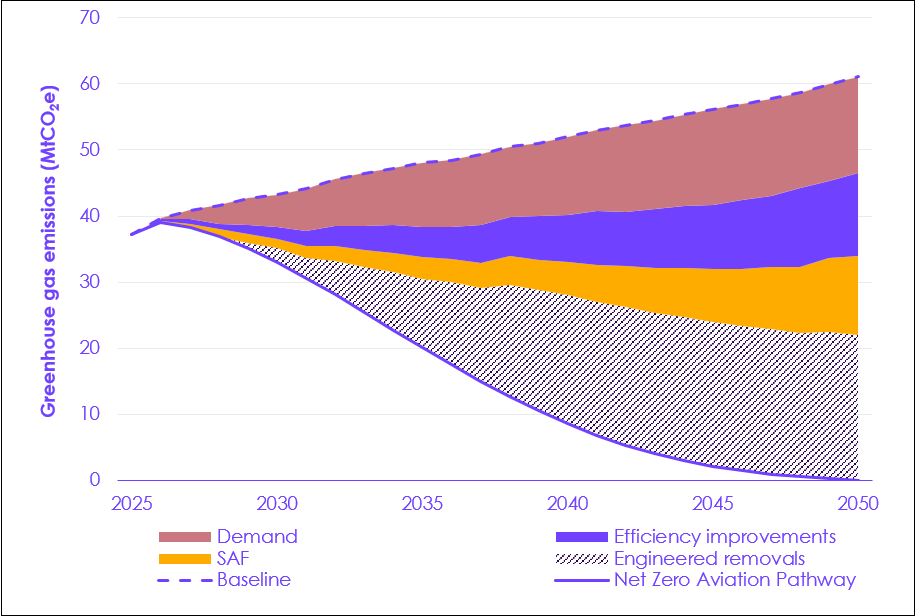
The CCC’s Net Zero Aviation Pathway (includes proposed Heathrow expansion and excludes military aviation emissions)
Source: CCC analysis
The Committee lays out five key considerations for government aviation policy:
• Require the aviation industry to pay the costs of decarbonisation, which need to be phased in starting soon and the sector bearing full costs no later than 2050;
• While SAF and engineered removals are proven to be technically viable, uncertainty remains around their deployment at scale on the timelines required, so government should create contingency policies to allow for delay;
• Manage UK competitiveness and carbon leakage risks through measures including closer cooperation with the EU and continued international action through ICAO;
• If airport expansions are permitted, the commercial risks associated with future aviation demand should sit with investors and not consumers, with government providing a credible and robust policy framework that gives investors confidence in how the aviation sector will achieve net zero; and
• With half of the population in England not flying abroad in any given year, government should ensure a fair distribution of the cost of funding aviation decarbonisation and consider whether to implement policies to influence any distributional impacts of higher aviation costs on lower-income groups.
The report notes that by 2050, aviation will be such a large part of the UK’s remaining emissions that it will not be able to rely on action elsewhere in the economy to reach the UK net zero target. “The aviation sector will have to reach net zero itself, both by reducing its direct emissions and by paying to offset any remaining emissions through engineered removals,” it says.
Limiting airport capacity would likely lead to an increase in costs for consumers, thereby moderating demand growth, adds the report. “However, the profits from constraining capacity would accrue to the aviation industry, rather than providing resources for decarbonisation,” it predicts. “Additional resources would be needed from elsewhere for SAF and engineered removals.”
The UK government is firmly backing Heathrow expansion as a means of kickstarting national economic growth and creating jobs, believing its commitment to developing a UK-based sustainable aviation fuel industry will help bring down transport emissions. It is also supporting expansion plans at London’s Gatwick and Luton airports.
Responding to the Committee’s report, a Department for Transport (DfT) spokesperson said: “Any expansion proposal would need to align with our net zero targets. We’re investing £219 million ($295m) in sustainable aviation fuel production and a further £43 million in cleaner technologies to support greener aviation, while expansion could deliver around £40 billion to the economy and support up to 60,000 local jobs.
“We will carefully consider CCC’s advice along with all responses received to the Heathrow expansion consultation.”
The Chair of the House of Commons’ Environmental Audit Committee, Toby Perkins MP, commented: “The CCC has given clear advice to the government that expanding Heathrow airport is not currently compatible with the UK’s climate commitments. Their findings closely echo those of my Committee last year, when we concluded that expanding airports without safeguards for the environment could put our net zero targets in jeopardy.
“The government needs to take this advice very seriously. If the government wants to pursue airport expansion, it must ensure a more ambitious and convincing approach to decarbonising the heavily polluting aviation industry. Without that, it risks putting our net zero targets in serious peril and becoming stuck in a quagmire of legal challenges.”
In July, UK cross-aviation industry body Sustainable Aviation published an updated decarbonisation roadmap to show how it expects the sector can achieve its net zero by 2050 target, albeit with significant government policy support. It expects SAF to be the single largest driver of emissions reduction and, under its central scenario, contribute 31% of total decarbonisation by 2050, a more optimistic figure than the Committee’s 20%.
The roadmap showed further carbon reductions would be delivered through aircraft fleet renewal (20%) and airspace and operational upgrades (4%), alongside a gradual moderation in demand growth (15%). Greenhouse gas removals to remove residual emissions would account for 29% of the required reductions to meet net zero.
Under the ‘polluter pays’ principle, the Climate Change Committee’s report estimates its net zero pathway recommendations could add around £150 ($200) per passenger for a return trip from the UK to a holiday destination in Spain and £400 ($540) for a return trip to New York.
Responding to the report, Tim Alderslade, CEO of industry body Airlines UK, commented: “UK airlines back cost-effective airport growth and net zero by 2050 – but the transition has to be affordable. Airlines are already investing billions in new aircraft, SAF and airspace upgrades and we have a plan to deliver it.
“The CCC’s approach would add £600 to a family’s trip to Europe and £1,600 to New York by 2050, putting holidays out of reach for millions and turning the clock back to a time when flying was the preserve of the rich. You can’t solve the climate crisis by pricing Britain out of the skies.
“The answer is affordable SAF – already cutting emissions since the mandate began – and airspace reform by 2035 for more direct routes and scaled-up carbon removals. Both SAF and GGRs are proven technically viable, as the CCC itself admits. We should focus on delivering them, not pricing ordinary people out of the joys of travel.”
Karen Dee, Chief Executive of industry body AirportsUK, said: “The UK aviation knows that if it is to expand, to contribute to economic growth and to keep us connected with the world, then it must continue to work hard to reduce its carbon footprint. But it is essential that this is delivered in a way which protects UK competitiveness and that the considerable sums consumers are already being asked to pay are better used to support decarbonisation.
“Industry has a credible plan to decarbonise by 2050 taking into account growth through expansion, through sustainable aviation fuel, airspace modernisation, more efficient aircraft and other measures. The government’s focus should be to work with the sector to ensure its policy framework supports this plan.”
Tim Johnson, Director at the UK-based campaign group Aviation Environment Federation, said: “The CCC’s message to the government couldn’t be clearer, there is simply no credible way to accommodate Heathrow expansion under current policies that have left a significant gap in aviation’s decarbonisation strategy. You can’t disguise the reality that the sector is failing to make a significant dent in its emissions, which are estimated to be higher in 2050 than they are today, even without a third runway.
“Timing is really important here – modelling by the DfT suggested there won’t be a sudden jump in emissions from Heathrow’s third runway because terminal development would be slow, conveniently delaying the biggest emissions impacts until after 2050. But with nothing in the draft Heathrow Expansion National Policy Statement to ensure that promoters adhere to this timetable, it seems a fantasy to think that the airport will build a third runway and not seek to use it fully for 20 years.”
Photo: Heathrow Airport

Christopher Surgenor
Editor



More News & Features
News Roundup August/September 2026
Transport NGOs call EU ETS aviation extension proposals a missed opportunity
Cathay Pacific trials Google’s AI-powered contrail avoidance technology across its network
Nova Pangaea takes major step towards commercial-scale SAF production
COMMENTARY: Why action lags ambition among States seeking SAF mandates
News Roundup July/August 2026