
Current EU sustainability policy, in particular the ReFuelEU sustainable aviation fuel mandate, risks undermining European airlines’ competitiveness as well as sectoral decarbonisation goals by shifting passenger activity to non-EU destinations and carriers not subject to the same level of sustainability rules, finds a study carried out by Deloitte for industry advocacy group Airlines for Europe (A4E). The EU’s stricter environmental regulations could create additional market distortions, particularly on EU–Asia routes, because of widening cost gaps. In response, A4E calls on the European Commission to propose a series of policy measures to mitigate this, including a proposal for a SAF Border Adjustment Mechanism (SAF-BAM) that would charge connecting flights the same SAF-related costs faced by EU airlines.
The study estimated that ReFuelEU will widen cost gaps, for example on key EU–Asia routes to a significant 15% by 2030, and suggests that a SAF-BAM could eliminate ‘leakage’ on modelled routes and “restore a level playing field without raising consumer prices overall,” says the report on the study.
Commented Ourania Georgoutsakou, A4E’s Managing Director in the foreword to the report: “The aim of this study is not to outline the policy preferences of A4E, but to map the different options to mitigate carbon leakage from European aviation and list their advantages and drawbacks.”
The Deloitte study says the carbon and business leakage risks for EU Aviation include:
1. Hub-switching – Flying via non-EU hubs like Istanbul and Dubai instead of EU hubs like Paris or Frankfurt to reduce the share of the journey covered by ReFuelEU.
2. Additional layover – Opting for a layover outside the EU instead of taking a direct flight as ReFuelEU only applies to the first leg of the journey.
3. Destination switching – EU residents choosing a non-EU holiday destination instead of an EU one to avoid costs from the EU ETS, or non-EU residents avoiding the EU as a destination.
Deloitte used an Aviation Competitiveness Model to analyse nine journeys that it considered particularly relevant for EU passenger and cargo airlines to quantify the carbon and business leakage from additional layovers and hub-switching.
“With regard to carbon leakage, around 26% of achieved emissions reductions in the EU merely switch to carriers with non-EU hubs, who become more competitive as a result of EU climate policies and gain market share,” says the report. “The emissions are still released into the atmosphere, just by carriers with non-EU hubs instead, causing carbon leakage and making EU climate policies less effective.”
The EU already has an environmental policy tool in place to deal with carbon leakage, the Carbon Border Adjustment Mechanism (CBAM), which aims to put a price on carbon emitted during production of carbon-intensive goods – such as cement, iron and steel, aluminium and fertilisers – entering the EU from third countries, where less stringent climate policies are in place. The policy is meant to ensure that through the purchase of CBAM certificates, the carbon price of imports is equivalent to the carbon price of domestic production. CBAM will apply from 2026 following a transitional pilot phase, and is aligned with the phase-out of free allowances under the EU Emissions Trading System (EU ETS), a measure that also impacts aviation.
The Commission’s Directorate-General for Taxation and Customs Union (DG TAXUD) is understood to be considering a proposal to include aviation in CBAM as part of a wider assessment to extend the scope to transportation services. According to a 2024 analysis by Ishka, this is complicated by the Commission’s review of ICAO’s CORSIA carbon offsetting scheme due in 2026, which will assess its effectiveness in delivering Paris Agreement goals. If it is determined not to be effective enough, the scope of the EU ETS could be extended to all EEA departing flights, which, says Ishka, would alter the design of a potential aviation CBAM.
The Deloitte report, however, concludes that extending CBAM to aviation services “is not legally and practically feasible,” and a different system is required to cover international air transportation services departing from the EU.
It proposes a SAF-BAM mechanism be introduced via EU regulation, enforced by national authorities. “Revenue generated from the sale of SAF-BAM certificates could be dedicated to further support the aviation sector, including green transition projects.”
The mechanism would require passenger data to be integrated with broader flight data systems to generate reports on SAF consumption per flight segment and per passenger. Alternatively, airlines could rely on default values based on average passenger occupancy for specific routes, such as an EU hub to a specific non-EU hub, to calculate SAF consumption on each flight segment per passenger or per shipment.
The taxable event would be triggered when a passenger has bypassed SAF mandates by transiting through a non-EU hub instead of complying in full with ReFuelEU obligations.
“While there are challenges such as passenger data privacy concerns,” acknowledges the report, “the legal basis for SAF-BAM appears feasible, provided it is structured to align with the principles of international trade, including compliance with the ICAO and WTO’s GATS and TBT agreements.”
The study also assesses six alternative policies to address carbon leakage, which include establishing SAF Climate Clubs (multilateral agreements between countries), strengthening CORSIA, introducing a SAF levy or SAF buyer subsidies, extending SAF allowances and implementing tax rebates.
“EU policymakers should consider a combination of policies that collectively work towards reducing aviation emissions, while minimising the risk of carbon leakage and maintaining the competitiveness of Europe’s aviation industry,” recommends the report. “SAF-BAM could be part of a comprehensive strategy to address the complex issue of carbon leakage in the aviation sector.”
Adds A4E’s Georgoutsakou: “Europe cannot afford a climate policy that haemorrhages passengers, jobs and emissions to competitors and destinations next door that don’t face the same ambitious climate policies as in the EU.
“This report shows that a well-designed mechanism to mitigate against this would keep fares fair, cut carbon where it counts and ensure Europe continues to have a vibrant airline market. We urge policymakers to act swiftly and pragmatically to implement a combination of policies set out in our policy recommendations to deal with this issue.”
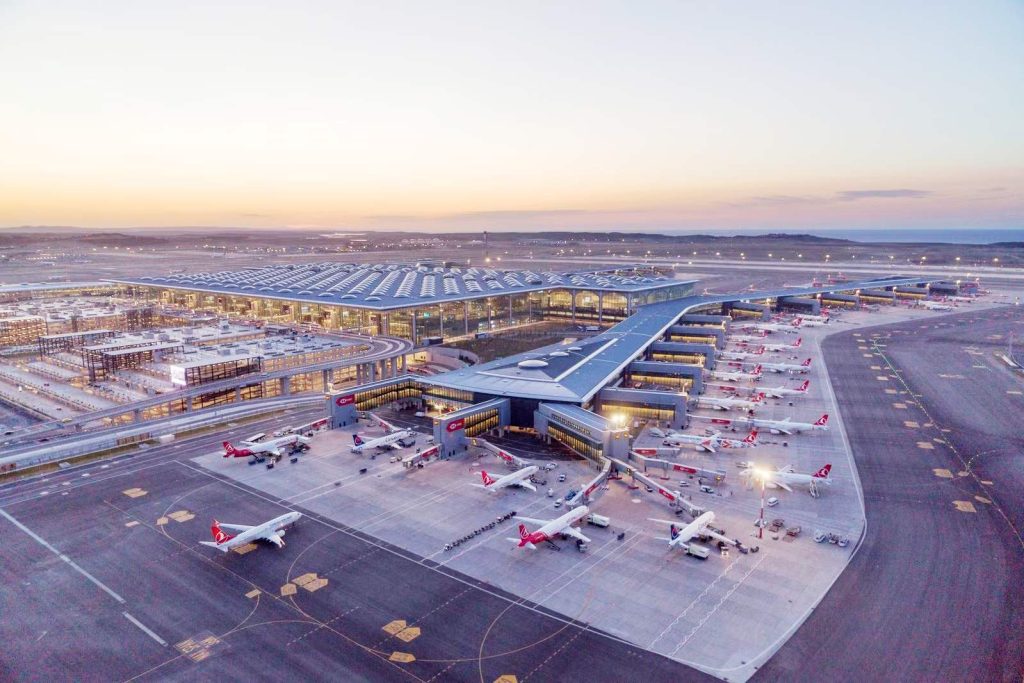
Photo (iGA): Istanbul Airport was Europe’s second-busiest airport in 2024 but is outside the scope of the EU’s ReFuelEU regulation

Christopher Surgenor
Editor

More News & Features
Synthetic aviation fuel projects advance in Europe, Africa, US and China
Air France shares results of large-scale North Atlantic contrail avoidance trial
Over €400m in free EU ETS allowances given to airlines in 2025 to support SAF uptake
EASA reports 2025 supplies of SAF exceeded first year of EU mandate
United and FedEx sign agreements to extend SAF supplies and scale up use
Nova Pangaea takes major step towards commercial-scale SAF production