

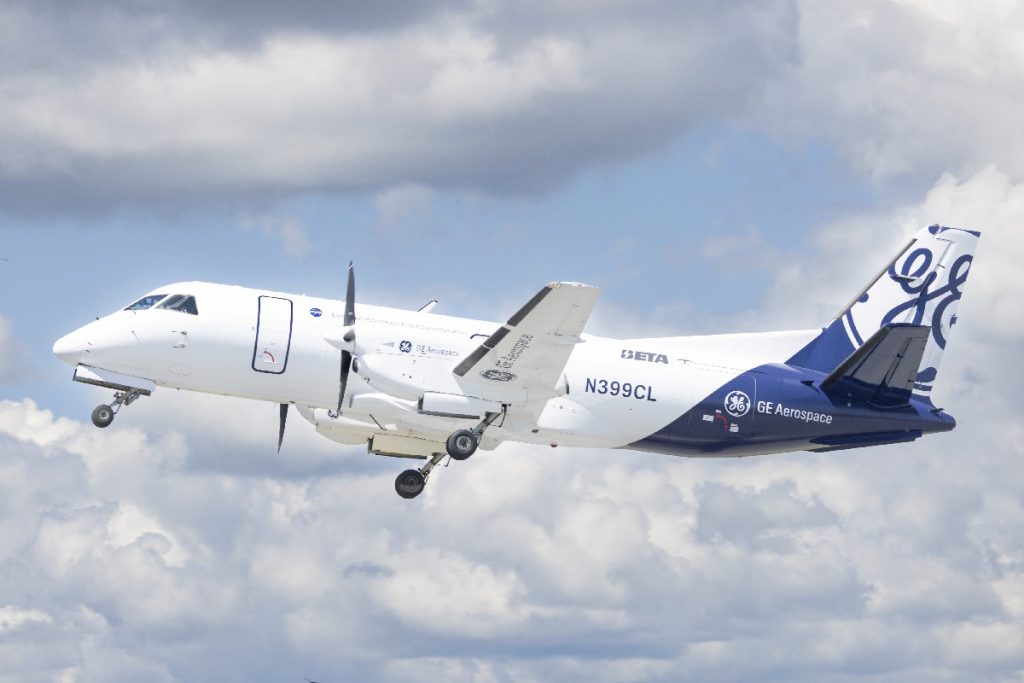
Significant advances in the development of commercial hybrid-electric and hydrogen aircraft involving major aerospace companies have been revealed at this year’s Farnborough Airshow. GE Aerospace announced the completion of first test flights of a hybrid-electric passenger aircraft at high altitude, reaching above 30,000 feet. The test campaign has been conducted in collaboration with NASA, Boeing’s Aurora Flight Sciences and BETA Technologies, a US early-stage electric aviation developer that also announced an agreement to deliver five ALIA CX300 CTOL electric aircraft to UK regional carrier Loganair. Airbus, meanwhile, says it is joining the EU-supported LEIA project that aims to advance high-voltage generation and distribution for electrical aircraft systems for short-to-medium range aircraft. French aerospace manufacturer Safran said it would partner with ZeroAvia to advance hydrogen-electric propulsion technologies for aviation, and the UK government announced funding for hydrogen aviation developers.
GE Aerospace’s test campaign was enabled by its fully integrated megawatt-class and multi-kilovolt hybrid-electric propulsion system developed through the NASA Electrified Powertrain Flight Demonstration (EPFD) project. GE Aerospace was first awarded the EPFD contract in 2021 to demonstrate flight readiness of hybrid-electric technologies for single-aisle aircraft. The following year, ground testing took place at the NASA Electric Aircraft Testbed of a megawatt-class and multi-kilovolt hybrid electric propulsion system in altitude conditions up to 45,000 feet that simulated single-aisle commercial flight.
Since then, the right side of a Saab 340B turboprop aircraft, capable in normal commercial operations of seating 33-36 passengers, was modified with a hybrid electric system that fits inside an inverted nacelle, providing extra ventilation. The left side has a conventional General Electric CT7 engine. BAE Systems provided the batteries used and Aurora Flight Sciences supplied the complete nacelle.
A hybrid-electric engine system combines an electric powertrain with a traditional gas turbine to optimise power management during different phases of operation. GE says such systems are highly compatible with different fuel types and advanced aircraft engine architectures like Open Fan, a “game-changing” design it is developing with NASA and Boeing.
Pilots from GE Aerospace and BETA supported flight tests in the US, including the high altitude testing in May. BETA Technologies served as the systems integrator and its pilots ferried the aircraft, operating in hybrid electric mode during each leg of the journey, from BETA’s facility in Plattsburgh, New York, to Farnborough via stops in Canada, Greenland, Iceland and Scotland.
Christine Andrews, GE Aerospace’s Executive Hybrid Electric Systems Leader, reported the system operated during the flight test campaign “seamlessly” and the flight across from the US had been “flawless”. During testing, the single longest flight in hybrid-electric operation was over two hours.
“I’ve never been part of a test campaign in the lab, on the ground and in flight that went as smoothly or as quickly through each milestone,” she said. “Day after day, we were coming in, breaking our own record for flight time, flight duration and altitude. It gave a new life to the entire technology and we’re looking forward to the next steps.”
GE Aerospace CEO Larry Culp told a media briefing at Farnborough that the flight test campaign was a result of 15 years of investment and innovation, “not only creating new ideas but testing them both in the lab and in the air, solving along the way some of the industry’s toughest technical challenges. This has really been a partnership between government and industry. It’s been a powerful combination of both entrepreneurial spirit and engineering talent.”
Responded NASA Administrator Jared Isaacman: “When NASA began exploring this technology nearly 15 years ago, many questioned whether it could ever become practical at scale. We spent years working through the hardest technical problems – electrical components, battery size and weight, thermal management and the power systems needed for megawatt class performance – and make it a reality. Now, alongside GE Aerospace, we made those systems lighter, more efficient and ready for the demands of flight.”
With the unique challenges of electric flight, engineering and test teams addressed heat management, lower atmospheric pressures and power density using flightworthy components that met higher safety and reliability requirements than typical test hardware. During flight testing, GE Aerospace reports the electric powertrain helped successfully power the propeller and generated power to the battery.
Mohamed Ali, CEO of GE Aerospace Commercial Engines & Services, claimed the successful altitude flight testing ushered in a new age of hybrid-electric flight. “This is not a lab experiment or a one-off prototype,” he said. “We flew a high performance hybrid-electric engine system built with durable flight quality hardware. This shows technology capable of helping an aircraft reach commercial aviation altitude, both in words and in deeds.
“Some might ask why this matters. It matters because this is more than a demonstration. It’s a meaningful step forward for future propulsion and it helps validate hybrid-electric technology as a credible path for next generation engine systems.”
With GE Aerospace having taken a financial stake in the company, BETA Technologies joined the programme last year and served as the systems integrator, as well as supplying pilots.
“This hybrid-electric system improved the high-altitude performance and climb capability while creating a flying laboratory to inform all future hybrid designs,” said Kyle Clark, founder and CEO of BETA Technologies. “The ground and safe flight test campaigns, capped by a flight across the North Atlantic, is the first of many important milestones for hybrid-electric technology.”
BETA is developing the ALIA A250 all-electric vertical take-off and landing (eVTOL) aircraft capable of carrying five passengers or cargo up to 250 nautical miles and the ALIA CX300, an electric conventional take-off and landing (eCTOL) aircraft that can be used for passenger, cargo, medical or military missions. The company is also building a network of charging stations across the US, supporting both electric aircraft and ground vehicles.
During Farnborough, the company signed a term sheet – a non-binding agreement – under which Loganair, the UK’s largest regional airline, has agreed to purchase five CX300 aircraft, with options for five more. The move will ensure Loganair becomes Europe’s first commercial airline operating an electric aircraft fleet, it said.
Serving island and remote communities in Scotland, with most regional sectors being under 100 miles and therefore within the CX300’s mission profile, Loganair said this was a natural first market for commercial electric flight.
As part of an electric flight demonstration programme completed in March, BETA’s CX300 flew 23 flights in 10 days across Loganair’s network, connecting Glasgow, Dundee, Aberdeen, Inverness, Wick and Kirkwall, covering more than 1,000 nautical miles in real-world operational conditions. The programme was aimed at validating performance, ground handling, charging and integration into existing airport and airspace systems, as well as demonstrating a model for short regional routes across the UK.
The first aircraft are expected to enter service in 2029 and support passenger and cargo operations. The agreement also includes plans for technical support and integration “to ensure the aircraft can be introduced seamlessly into Loganair’s existing fleet,” said the airline.
Commented Luke Farajallah, Chief Executive of Loganair: “Our demonstration programme proved that electric aviation is no longer a future concept, it is a viable commercial opportunity and one I can see working within our existing network, complementing our vital services to communities across the country. The aircraft demonstrated the potential to reduce operating costs by up to 80% while maintaining the reliable regional connectivity our customers and communities depend on.”
Responded BETA’s Kyle Clark: “This agreement is what happens when demonstrated performance meets an operator serious about the future of regional aviation.”
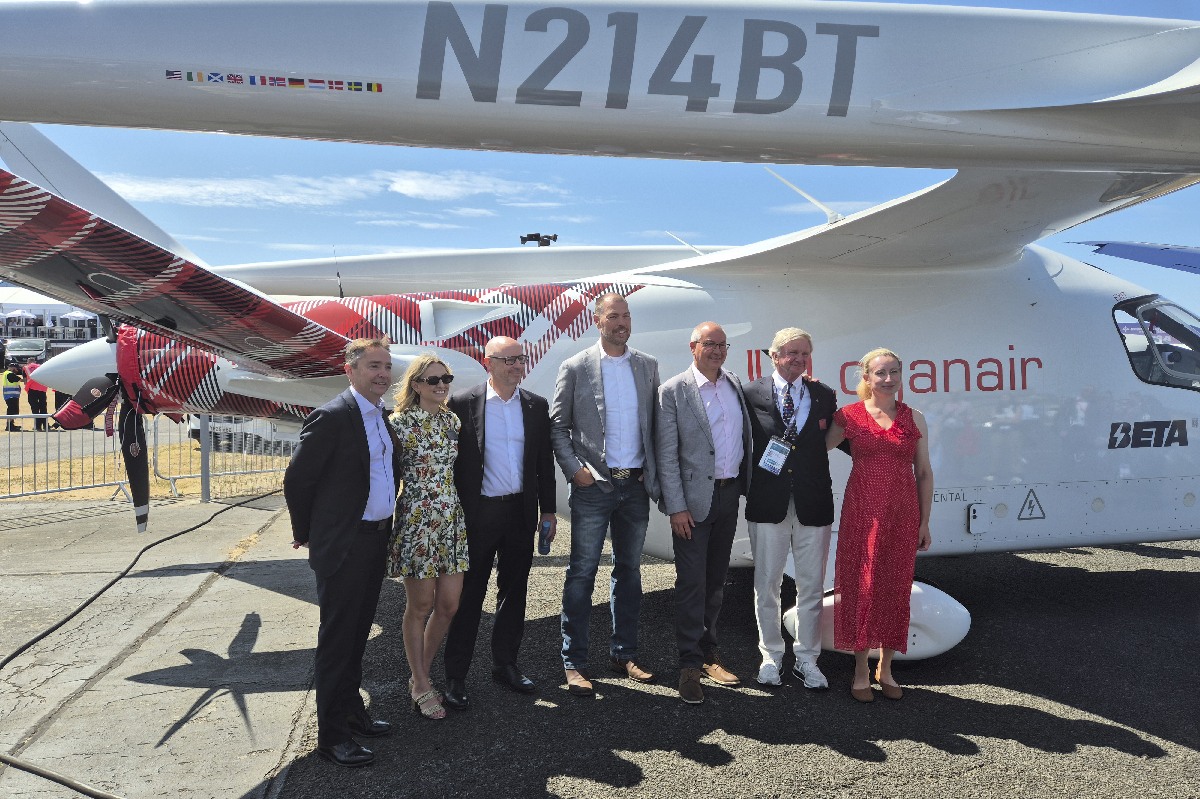
Loganair and BETA Technologies executives in front of a CX300 CTOL at the Farnborough International Airshow
Meanwhile, Airbus reported at Farnborough that it is pursuing its hybrid-electric aviation ambition to pioneer a non-propulsive energy architecture through the €35 million ($40m) LEIA (Large Scale Integration Demonstrator of Hybrid Electrical Architecture) project, which is supported by the EU’s Clean Aviation research initiative.
Airbus says the project will be fundamental to advancing high-voltage generation and distribution for innovative electrical aircraft systems for short-to-medium range aircraft.
“Our progress in developing hybrid-electric technologies and our move into the LEIA demonstrator marks a pivotal shift in how we design the future of flight,” said Karim Mokaddem, Head of Aircraft of Tomorrow Research and Technology at Airbus. “By moving to integrated, intelligent hybrid-electric architectures, we are actively laying the physical and digital foundation for the next generation of aircraft. This evolution demonstrates that the future of aviation is about more than just new power sources, it is also about the new ecosystems that will manage them.”
LEIA builds on the completion of the SWITCH project, which focused on hybrid-electric powertrain subsystems and reached a milestone this July when Collins Aerospace completed integrated laboratory testing. Other SWITCH project partners included Pratt & Whitney, GKN Aerospace and MTU Aero Engines.
Also announced during the air show, aviation hydrogen-electric propulsion and power systems developer ZeroAvia and global aerospace manufacturer Safran have agreed a collaboration to accelerate the technological development of hydrogen-electric power across several aviation applications. They will investigate in particular advanced high-temperature fuel cells.
“Safran has achieved world-leading progress in aerospace progress in aerospace electrification, including the world-first certification of our ENGINeUS electric propulsion system. Furthermore, we are pursuing a solid technology roadmap towards the maturation of high-temperature hydrogen fuel cells for aviation,” said Éric Dalbiès, Chief Technology Officer of Safran. “Collaborating with ZeroAvia is an exciting opportunity to build on these advances, foster synergies and further drive innovation in zero-emission technologies.”
Responded Christine Ourmières-Widener, Executive Chair of ZeroAvia: “Hydrogen-electric propulsion has the potential to transform aerospace and defence applications, and collaboration is essential to accelerating that transition. By working hand-in-hand with Safran, we are helping to advance technologies that are critical to building a better, cleaner future for flight.”
The UK government used the air show to announce funding of £7.3 million ($9.7m) towards the development of zero-emissions flight in the UK. The funding will be awarded under the first round of the Zero Emission Flight Demonstrator competition to help eight projects develop and test infrastructure, including electric charging and hydrogen storage. Among the award recipients are Vertical Aerospace’s Project ECLiPSE and ZeroAvia’s Project HyPRIME.
The UK CAA has published findings from the second round of its Hydrogen Challenge, alongside a new roadmap for scaling hydrogen operations for small aircraft towards 2035. The initiative brought together the regulator, industry and academia to explore the potential of hydrogen-powered aircraft, airport operations and supporting infrastructure, the risks of hydrogen and identify possible gaps in existing regulations.
As part of the Challenge, hydrogen-powered ground vehicles at Exeter Airport were used to complete a zero-carbon aircraft turnaround; Cranfield Aerospace Solutions used hydrogen fuel cells to power its Stingray high endurance, high range and high altitude UAS drones; and Rolls-Royce, in partnership with easyJet, modified a Pearl 15 engine to run on 100% hydrogen to take-off thrust and across a fully simulated flight cycle.
“Our programme has given us the clearest insight in the industry into how hydrogen performs in a modern aero gas turbine. We recognise that introducing technologies like hydrogen propulsion means establishing new standards of safety, often beyond the scope of current rules,” said Adam Newman, Chief Engineer, Hydrogen Demonstrator Programme at Rolls-Royce.
“Early engagement with regulators, such as our participation in the CAA’s Hydrogen Challenge sandbox, is critical to delivering these next-generation solutions safely and effectively.”
Top photo (GE Aerospace): The modified hybrid-electric Saab340B aircraft

Christopher Surgenor
Editor



More News & Features
Airbus and MTU form joint venture to develop a fully electric hydrogen fuel cell engine
EasyJet and Schiphol Airport deploy electric TaxiBot for Airbus taxiing operations
UK aerospace partners pledge £188m investment in hydrogen-powered aviation
Rolls-Royce and easyJet complete first-ever hydrogen aviation fuel ground test programme
First firm order placed for AURA’s ERA regional hybrid-electric aircraft
New Zealand initiatives announced on electric aircraft, hydrogen refuelling and carbon removals