

Following a MoU signed a year ago, Airbus and MTU Aero Engines have now agreed to create a joint venture to develop and commercialise a fully electric hydrogen fuel cell engine. The partners say they aim to accelerate technology development, design, testing and certification of a “revolutionary” propulsion system for aviation. The non-binding agreement is subject to standard regulatory approvals and completion of “social processes” at European and national levels, with operations expected to start in 2027. Last year, MTU said it was making good progress with its Flying Fuel Cell programme and had successfully tested its eMoSys electric motor. Airbus launched its ZEROe project in 2020 to explore the feasibility of two primary hydrogen propulsion technologies: hydrogen combustion and hydrogen fuel cells. Last year it announced it would focus on the latter.
The partners will aim to combine Airbus’ commercial aircraft programme knowledge and fuel cell propulsion and liquid hydrogen expertise with MTU’s multi-year fuel cell technology development and its engine design, integration, validation, certification and maintenance expertise.
Commenting on the joint venture, Bruno Fichefeux, Head of Future Programmes at Airbus said: “By pooling our respective technology and expertise into a dedicated entity, we are establishing a European powerhouse capable of transforming advanced research into industrialised, certifiable electric propulsion systems.
“This new company will help secure strategic sovereignty in the next generation of aviation technologies while strengthening our ability to achieve the long-term ZEROe ambition.”
Airbus says the viability of a fuel cell fully-electric propulsion system was shown in the results of its fuel cell prototype and powertrain testing, as well as research into complementary technology such as cryogenics. Hydrogen fuel cell technology generates electricity through an electrochemical reaction between hydrogen and oxygen, producing only water vapour as a byproduct and eliminating harmful inflight emissions of CO2 and NOx.
The partners are aiming to be the first to provide a hydrogen-based fuel propulsion system to a commercial aircraft. They believe hydrogen has the potential to play a crucial role in substantially reducing the climate impact of aviation in the long term and “transforming air transport in a way comparable to the impact of electric vehicles in the automotive sector”.
“Our ambitious goal is to pave the way for a newly developed, safe, reliable and economical propulsion system that will contribute to climate-neutral aviation,” said Dr Stefan Weber, SVP Engineering and Technology at MTU Aero Engines, which is advancing the Flying Fuel Cell. “We want to create a company that covers the entire lifecycle of fuel cell powertrains – from development and testing through certification to commercialisation.”
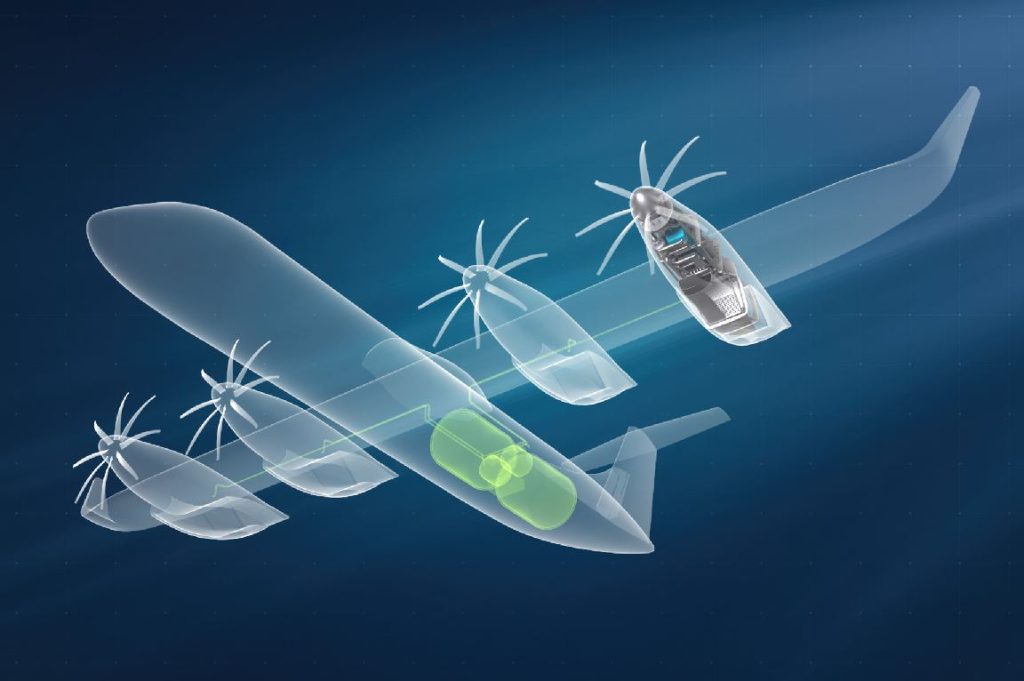
Image (MTU): Hydrogen-powered fuel cell engine mounted on an aircraft

Christopher Surgenor
Editor



More News & Features
Synthetic aviation fuel projects advance in Europe, Africa, US and China
Air France shares results of large-scale North Atlantic contrail avoidance trial
Over €400m in free EU ETS allowances given to airlines in 2025 to support SAF uptake
EASA reports 2025 supplies of SAF exceeded first year of EU mandate
Farnborough Airshow highlights progress on electric and hydrogen propulsion for commercial aviation
Commission proposes a limited extension of the ETS to international departing flights from Europe