

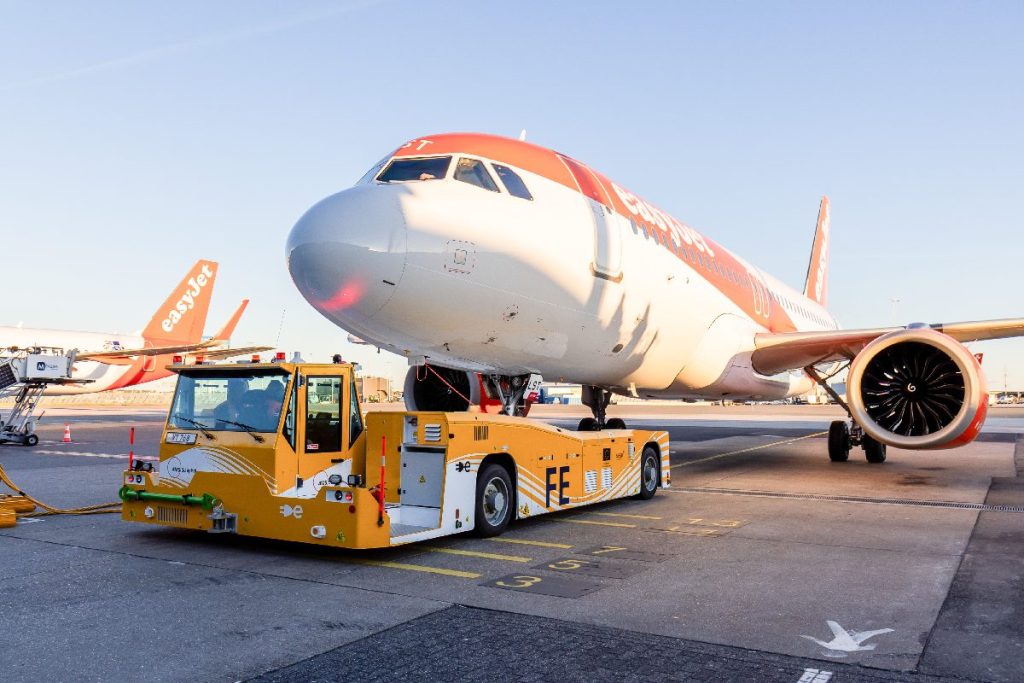
Following a trial earlier this year, easyJet and Amsterdam Schiphol Airport have begun deploying electric TaxiBot technology for Airbus aircraft operations at the airport. TaxiBot is a semi-robotic aircraft tractor that enables aircraft to taxi between the gate and runway without using their main jet engines. The low-cost carrier estimates the technology will save an average 95kg of fuel and 299kg of CO2 per flight, while also reducing apron noise. Four easyJet Airbus aircraft are being equipped for TaxiBot operations at Schiphol, with the two partners collaborating with Airbus, Menzies Aviation and Smart Airport Systems. The airport has ambitions to achieve fully sustainable taxiing operations by 2030 and is the first in Europe to deploy electric TaxiBot technology for Airbus aircraft.
TaxiBot was originally developed by Israel Aerospace Industries as far back as 2007 as a towbar-less hybrid electric aircraft tractor controlled by the pilot and intended for towing aircraft between the gate and the runway with the aircraft’s engines turned off. In cooperation with Lufthansa LEOS and French airport equipment firm TLD, and after extensive testing, the TaxiBot was approved by the European Aviation Safety Agency. In 2015 it entered operations, towing a Lufthansa Boeing 737 to the take-off position at Frankfurt Airport. In 2019, Air India used a TaxiBot at New Delhi International Airport.
TLD is owned by Paris-based Alvest Group, a specialist in aviation ground support equipment that also owns Smart Airport Systems (SAS), which focuses on sustainable solutions for airlines and airports. In October 2025, SAS signed a MoU alongside KLM, Royal Schiphol Group and Airbus to further develop and scale TaxiBot operations at Schiphol.
The purchase by Schiphol of the first electric TaxiBot was made possible in part by the European Climate, Infrastructure and Environment Executive Agency (CINEA) under the Connecting Europe Facility, in collaboration with the SESAR 3 Joint Undertaking, as part of the HERON flagship Digital Sky Demonstrators.
“By deploying the TaxiBot, we’re taking another practical step towards reduced emissions and noise on the apron. This is how we’re creating a healthier and cleaner workplace, and an ever more sustainable and modern airport that is ready for the future,” said Esmé Valk, Chief People and Transformation Officer at Amsterdam Airport Schiphol.
Commenting on the rollout, easyJet COO David Morgan said: “TaxiBot is another important step in our mission to operate as efficiently as possible. This technology delivers immediate reductions in fuel consumption, carbon emissions and noise, while supporting more efficient ground operations at one of Europe’s busiest airports.”
Photo (easyJet): The TaxiBot electric semi-robotic aircraft tractor at Amsterdam Schiphol

Christopher Surgenor
Editor



More News & Features
Heathrow expansion incompatible with climate targets, advises UK government watchdog
EasyJet pilots to save fuel and emissions in switch from paper to digital fuel uplift
Farnborough Airshow highlights progress on electric and hydrogen propulsion for commercial aviation
Airbus and MTU form joint venture to develop a fully electric hydrogen fuel cell engine
First firm order placed for AURA’s ERA regional hybrid-electric aircraft
UK SAF projects progress as Heathrow increases SAF incentive for airlines