
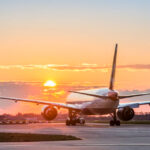

The BETA prototype aircraft, leased by Air New Zealand for four months, is the first in the airline’s Next Generation Aircraft technical demonstrator programme. It is undertaking what the airline calls “an intensive proving programme” at Hamilton, on New Zealand’s North Island, before it flies to the national capital, Wellington, extending by late January across the Cook Strait to Blenheim, at the top of the South Island.
The test aircraft will be supported with 65Kw electric chargers at each of these three airports, enabling charging in 90 minutes and daily operations across multiple routes.
The airline has one firm order for a CX300 through aircraft lessor Avolon, with options to acquire two more and purchase rights for another 20. It plans to use its first electric plane to carry freight for NZ Post, initially between Wellington and Blenheim, though the introduction has been deferred from next year to 2027.
Air New Zealand’s newly appointed CEO, Nikhil Ravishankar, said 60% of regional flights in New Zealand are on routes of less than 350 km, while about 85% of the nation’s electricity is renewably produced, “the perfect laboratory for next generation aircraft,” he commented.
“In bringing the Alia CX300 to New Zealand, we’ve experienced true collaboration, a world-leading global innovator in BETA Technologies working with Kiwi engineers, pilots, regulators and airports, all focused on understanding how this emerging technology can be safely and practically integrated into the New Zealand airspace when it’s scalable and ready.”
Findings from the tests, on routes of up to 200km, are expected to be used to advance certification, while providing regulators with a base on which to develop governance of functions including pilot training, aircraft maintenance and airport handling.
“Emerging aviation technologies don’t always fit into existing rules,” said Kane Patena, Director and CEO of New Zealand’s Civil Aviation Authority. “It’s our job to facilitate a clear pathway that helps operators to safely bring these technologies into New Zealand’s unique aviation system.”
Simon Newitt, Head of Global Sales for BETA Technologies, said the New Zealand trials would provide valuable insights for global deployment of the CX300.
“This collaboration between airline, regulator and infrastructure partners sets an example for how the aviation industry can continue to progress and innovate while safely bringing lower-emission, lower-cost, next-generation aircraft into service.”
To help encourage a voluntary carbon market in New Zealand, the airline has also committed to buy 8,000 tonnes of internationally-verified carbon removals by 2030 – 500 tonnes in 2028, 2,500 in 2029 and 5,000 in 2030.
It will do so in partnership with My Native Forest, which invests in planting and restoring native forests in New Zealand in return for providing offsets verified to international standards and issued through a global registry.
The deal illustrates how carbon finance can enable large-scale restoration of native forests, said Mitchell McLaughlin, co-founder of My Native Forest, with sites being considered in seven regions across both the North and South Islands.
“Air New Zealand will provide capital in return for carbon removals that would have otherwise flowed offshore. Instead, it will be directed straight into local native forests,” he said.
Kiri Hannifin, Air New Zealand’s Chief Sustainability and Corporate Affairs Officer, said the partnership shows “planting trees is no longer just a goodwill exercise” but also a decarbonisation initiative and an investment enabling New Zealand landowners to restore biodiversity, protect waterways and make their land more resilient.
“Levers like scaling sustainable aviation fuel, optimising our fleet and network, and alternative propulsion aircraft are complex, expensive and heavily reliant on third partes.
“High-integrity carbon credits will also play a significant role in the aviation industry reaching net zero by 2050. Native forest planting takes time, so it’s important to secure future supply now.”
The airline is also in the final stages of procuring more internationally verified nature-based carbon removals and expects to sign a contract with another New Zealand-based provider by year’s end.
Meanwhile, in the South Island city of Christchurch, engineering group Fabrum and Australian hydrogen aircraft start-ups AMSL Aero and Stralis Aircraft have partnered to develop and fill a new type of hydrogen fuel tank with supplies produced in the renewable energy precinct of the city’s international airport.
Fabrum said its proprietary triple-skinned liquid hydrogen tank technology enhances thermal insulation and enables refuelling up to 70% faster than is possible with conventional tanks, while reducing by up to 80% ‘boil off’ losses during refuelling.
“Our lightweight composite tanks, together with our hydrogen liquefier and refuelling systems, are critical enablers for hydrogen-powered flight,” said Christopher Boyle, Fabrum’s Managing Director.
“By bringing all the elements together for the first time on site at an international airport – producing, storing and dispensing liquid hydrogen into composite aviation tanks as fuel – we’re proving that liquid hydrogen technologies for aircraft are now available and that hydrogen-electric flight will soon be a reality in Australasia.”
Partners in the project are Sydney-based AMSL Aero, which is developing Vertiia, a hydrogen-electric vertical takeoff or landing aircraft, and Brisbane-based Stralis Aircraft, which is developing hydrogen-electric propulsion systems for retrofitting into existing aircraft and has plans for an all-new, hydrogen-powered regional airliner in the 2030s.
“We are working with Fabrum to develop onboard tanks for our fixed-wing test aircraft to supply hydrogen to our hydrogen-electric propulsion system,” said Stralis CEO Bob Criner, whose company plans its maiden flight next year with a converted Beechcraft Bonanza A36 aircraft.
Stralis said its patent-pending technology was six times lighter than current state-of-the-art equipment and would deliver up to 10 times the range of battery-electric aircraft, at half the cost of similar-size fossil fuelled planes.
“We’re excited to see Fabrum’s hydrogen fuel dispensing systems for these onboard tanks proven out in testing,” said Criner. “This is a vital step toward our first liquid hydrogen test flights.”
AMSL CEO Dr Adriano Di Pietro said his company’s Vertiia aircraft needed to be as light as possible to achieve a target 1,100 km range, 500 kg payload and 300 km/h cruising speed.
“Liquid hydrogen is the lightest zero-emission method of storing energy for long distance flight. No other technology comes close,” he said.
“With Fabrum, we have demonstrated the key steps in that process, from producing liquid hydrogen to filling our ground transport container, then filling the tank that we will install to our aircraft before our first liquid hydrogen flights next year. This is a major milestone.”
Photo (BETA Technologies): Air New Zealand has commenced testing of a battery-electric BETA Alia CX300 aircraft

Tony Harrington
Correspondent


More News & Features
Synthetic aviation fuel projects advance in Europe, Africa, US and China
Farnborough Airshow highlights progress on electric and hydrogen propulsion for commercial aviation
Airbus and MTU form joint venture to develop a fully electric hydrogen fuel cell engine
EasyJet and Schiphol Airport deploy electric TaxiBot for Airbus taxiing operations
UK aerospace partners pledge £188m investment in hydrogen-powered aviation
Rolls-Royce and easyJet complete first-ever hydrogen aviation fuel ground test programme