







Zurich-based synthetic fuel startup Synhelion has signed a MoU with the Moroccan government to develop a large-scale commercial plant in the country. Another Swiss synthetic fuel startup, Metafuels, opened a first-of-a-kind methanol-to-jet demo facility in August and has since signed a collaboration with MB Energy on its Turbe commercial-scale project. In South Africa, the Phelan Green Group says it has reached FID on the first phase of a 35,000-tonne eSAF project. Elsewhere in Europe, Arcadia eFuels has entered into a 10-year offtake agreement with Uniper for the purchase of eSAF from its proposed Denmark facility and the UK’s Carbon Neutral Fuels has signed a MoU with Energy Estate to explore a SAF project in Queensland, Australia. In the US, eSAF producer Twelve has secured a $45 million refinancing credit facility and in China, Carbonology has started construction of a 1,000-ton DAC to eSAF pilot plant.
Synhelion reports it has reserved a site for its synthetic fuel plant in the Guelmim-Oued Noun region, which it says will provide renewable energy resources and favourable conditions for establishing a renewable fuel value chain. The facility is planned to produce 100,000 tonnes of renewable jet fuel, diesel and gasoline per year.
The MoU was signed with Morocco’s Ministry of Industry and Trade; the Ministry of Energy Transition and Sustainable Development; the Ministry of Investment, Convergence and Evaluation of Public Policies; and the Investment and Export Development Agency. Synhelion has established a new branch in the country and gained Casablanca Finance City status.
“This MoU reflects Morocco’s ambition to attract high-impact investments that combine innovation, sustainability and industrial development,” said Karim Zidane, Minister of Investment, Convergence and Evaluation of Public Policies. “We welcome Synhelion’s commitment to Morocco and look forward to supporting the project as it moves towards its next stages of development.”
Responded Gianluca Ambrosetti, co-founder and co-CEO of Synhelion: “We are now moving from evaluation to execution and towards our first commercial-scale plant in the region, and we look forward to deepening our collaboration with the Moroccan government.”
Synhelion’s DAWN plant in Jülich, near Cologne in Germany, has been operational and producing synthetic fuels using solar energy since summer 2024. Last year, it supplied a first 190-litre barrel of synthetic crude oil to a refinery in Northern Germany for processing into Jet-A1 aviation fuel and then fed into SWISS’s flight operations infrastructure via the fuel supply system at Hamburg Airport.
The Metafuel’s agreement with Hamburg-based MB Energy was signed at the opening of its Aerobrew demonstration plant at the Paul Scherrer Institute in Villigen, Switzerland. The company, which also has the support of SWISS and Lufthansa Group, is developing its Turbe commercial-scale eSAF project in the Port of Rotterdam, with production slated to start from 2030 onwards.
The collaboration will see Metafuels and MB Energy work across market access, blending, infrastructure and logistics, including certification and information flow for eSAF deployment at the Turbe project. Metafuels’ technology converts methanol produced from renewable feedstocks into synthetic aviation fuel. Under a proposed methanol arrangement, MB Energy would also be a potential supplier of methanol feedstock.
The family-owned renewable energy group Phelan Green has confirmed the first phase of its 35,000-tonne Hopefield eSAF project near Saldanha Bay on the south-western coast of South Africa will go ahead after the family board approved a R12 billion ($73m) investment in the R47 billion ($2.9bn) three-phase project. Construction is expected to begin in the first quarter of 2027 and production targeted from 2029.
Johnson Matthey has licensed its HyCOgen and FT CANS technologies for the project, while Honeywell UOP will provide its Fischer Tropsch Unicracking technology.
The project is being driven by European demand for eSAF to meet the synthetic fuel blending sub-mandate. Phelan Green Group’s Luca Guerrini, Head of eFuels, said its renewable fuel would qualify under the EU’s Renewable Energy Directive. The Group’s Managing Director, Blair Phelan, told the recent Africa Green Hydrogen Summit in Cape Town that the company had built early offtake relationships with airlines and fuel majors.
The Hopefield facility will be developed over three phases, with a projected output of 140,000 tonnes of eSAF per annum on completion, which is expected in 2032.
Arcadia’s eSAF Project ENDOR in Vordingborg was awarded grant support from the EU Innovation Fund in March this year and is currently awaiting Final Investment Decision. In a major boost for the project, Düsseldorf-based energy company Uniper has signed an offtake agreement to purchase 40,000 tonnes of eSAF annually for more than 10 years from the plant, which Arcadia claims is one of the largest eSAF offtakes to date.
According to Arcadia, the agreement is legally binding, while the commencement of deliveries remains subject to agreed conditions precedent and the eSAF facility commencing commercial operations. Under current planning, it foresees supply from the early 2030s onwards.
For Uniper, it sees securing access to renewable fuels of non-biological origin (RFNBO) compliant eSAF as strengthening its role in a new European growth market, while expanding its portfolio of low-carbon energy products.
“This agreement brings long-term demand and new supply together, helping to create the conditions for a competitive European eSAF market. For Uniper, it is also an important step in building a strong position in a market with significant growth potential,” said Uniper CEO Michael Lewis.
Responded Amy Hebert, CEO of Arcadia eFuels: “This agreement with Uniper is a foundational step in our commercial journey. Securing long-term offtake from a sophisticated energy partner like Uniper validates our solution, de-risks our capital strategy and accelerates our path to production at scale. eSAF is not only a fuel of the future – it is a present-day answer to the aviation sector’s demand for diversification of supply, and this agreement brings that solution meaningfully closer to expanding production within the EU.”
Under their MoU, power-to-liquid developer Carbon Neutral Fuels (CNF) and Energy Estate, an Australian infrastructure company, will collaborate in the development of a SAF project in North Queensland using sugarcane agricultural waste as feedstock. They will evaluate feedstock supply, site selection, pathway selection and offtake.
Signed with BioNQ Developments, part of the Energy Estate group, the MoU will build upon the strategic affiliation signed between Energy Estate and Queensland Cane Agriculture and Renewables earlier this year to advance the BioNQ Project and position sugarcane as a solution to Australia’s fuel security challenge while delivering long-term economic benefits.
Explained Sophie Zienkiewicz, co-founder and Director of CNF: “Collaborating on the development of a sugarcane-based SAF project in Queensland is the first step towards meeting Australia’s upcoming mandate targets. This project will become a vital asset in Australia’s domestic energy security and we are delighted to be able to share our learnings from the UK and European landscape to help inform Australia’s low-carbon liquid fuel strategy.”
Simon Currie, co-founder of Energy Estate, said: “Our partnership with CNF will help us to accelerate development of BioNQ by leveraging experience from other markets globally.”
CNF is developing Project Starling, a 31,000 tonnes per annum eSAF facility in Cumbria, north-east England, with a wider project pipeline that includes a proposed bio/methanol marine fuels facility in Scotland, Project Osprey, and a 100,000 tonnes per annum eSAF facility, Project Kestrel, also in north-east England.
The $45 million credit facility secured by Twelve has refinanced the company’s AirPlant One facility in Moses Lake, Washington, and will support additional expansion. AirPlant One uses Twelve’s power-to-liquid technology to produce its E-Jet and E-Naphtha products from CO2, water and renewable electricity powered by 100% Columbia River hydropower.
The refinancing, says the company, reflects the facility’s transition from construction to commercial operation “and positions Twelve to expand its footprint at the site”.
Nicholas Flanders, co-founder and CEO of Twelve, said AirPlant One was built to prove that power-to-liquid technology works at commercial scale. “It’s now a fully operating plant producing on-spec aviation fuel and naphtha,” he added. “This financing reflects that shift, from construction phase to operating asset and gives us the capital to expand our capabilities at the site. Scaling additional hydrogen production represents the next phase of growth.”
Securing the credit facility was led by Endurance Capital and Nomura as joint bookrunners, with Nomura acting as administrative agent.
Carbonology is an ambitious and fast-moving Chinese startup founded by ex-Tesla senior executive Robin Ren, who has also worked with Canadian direct air capture (DAC) pioneer Carbon Engineering. In January this year, the company opened its Shanghai Lingang R&D and Innovation Center and commissioned its first 100-ton-scale eSAF test line, with the aim of demonstrating a fully integrated pathway, from direct air capture of CO2 to the synthesis of sustainable aviation fuel within a single closed-loop system.
“While much work needs to be done to optimise efficiency, reduce energy consumption and cost, the pilot line has firmly established the practical feasibility of this technology under real-world conditions,” reports the company.
Backed by a Series A financing round and Chinese investment, the company has now started construction of a 1,000-ton DAC-to-eSAF pilot plant in Ningdong in northwest China. The project benefits from access to low-cost renewable power, established energy infrastructure and ample land availability.
The company says the plant will focus on three priorities: validating the integration of DAC, renewable-powered hydrogen production and fuel synthesis; optimising AI-enabled process control to handle variable renewable energy input; and improving system efficiency and cost performance to enable broader commercial rollout.
Carbonology has plans to build one of China’s first 10,000-ton commercial SAF facilities, possibly as early as 2027, and bring large-scale, low-carbon aviation fuel to market.
Ren told the recent SAF Global Summit in London that he believed it was entirely possible that eSAF could become cost-comparable with fossil jet kerosene in time.
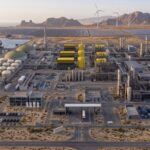
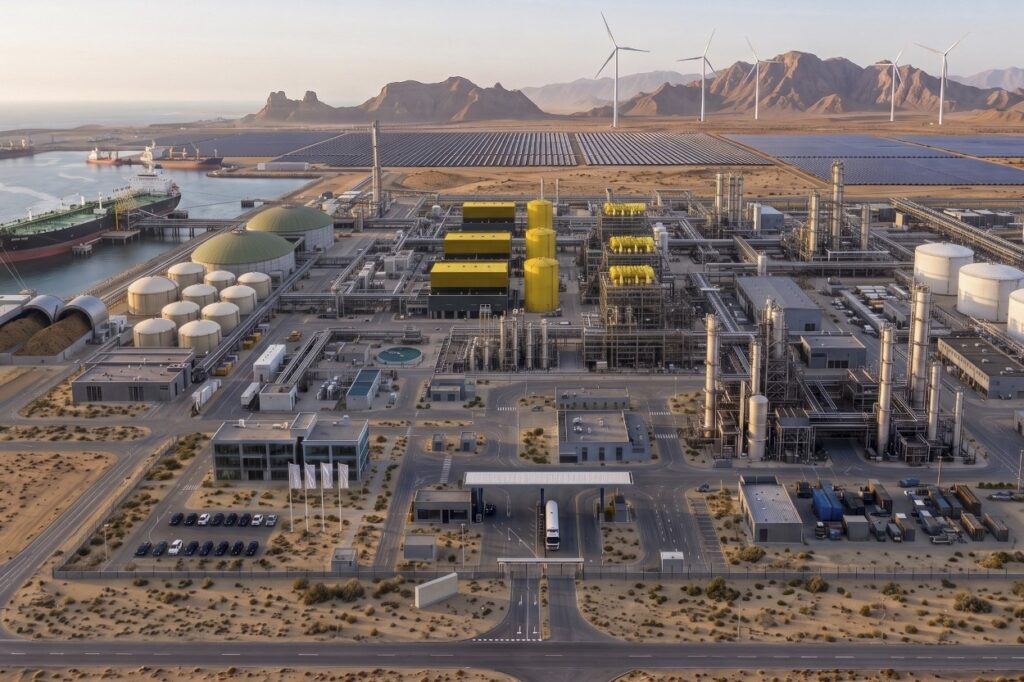
Image: Visualisation of Synhelion’s planned commercial plant in Morocco

Christopher Surgenor
Editor


More News & Features
News Roundup September 2026
Global aviation’s gross emissions to rise 87% by 2050 despite efficiency gains, forecasts IBA
Air France shares results of large-scale North Atlantic contrail avoidance trial
Over €400m in free EU ETS allowances given to airlines in 2025 to support SAF uptake
EASA reports 2025 supplies of SAF exceeded first year of EU mandate
United and FedEx sign agreements to extend SAF supplies and scale up use