
The adoption and scale-up of sustainable aviation fuel remains one of the most intractable challenges in aviation decarbonisation. The International Civil Aviation Organization’s (ICAO) Long-Term Aspirational Goal (LTAG) projections suggest SAF could contribute up to 55% of required emissions reduction by 2050 under an optimistic scenario. In reality, production and adoption have tracked closer to the pessimistic forecast – a mere 15% contribution. Globally, meaningful uptake has occurred largely in the United States and Europe, both driven by aggressive public policy. Beyond these two poles, however, the picture is one of missed targets and diminished ambition. Underlying this are the real consequences of competitive disadvantages and administrative hurdles that face any smaller country or region seeking to follow suit, writes AirAsia’s Yap Mun Ching.
Consider the recent trajectory of national commitments: Japan, an early mover, had pledged a 10% SAF blend by 2030, only to slash this target to 1%. Singapore, which opened the world’s largest SAF refinery in 2023 and announced a levy from 2026, has since pushed implementation back by a year. Brazil has set a 1% SAF emissions reduction mandate from 2027, but without sufficient production capacity, it has to rely on an international book-and-claim system that is still evolving. South Korea, Thailand and Indonesia have also voiced intentions, but none has offered policy clarity.
Some reasons for the lag have been debated extensively. These include a broader shift in climate attitudes, challenges in scaling feedstock supply, slow commercialisation of emerging technologies, and the aviation industry’s protracted pandemic recovery compounded by new disruptions. This article does not revisit those arguments, nor does it seek to provide cover for inaction. Instead, it addresses a set of less discussed but equally consequential dilemmas facing airlines, airports and governments that, if left unaddressed, will continue to delay progress.
Designing the rulebook
For any country seeking to develop a SAF mandate, the most consequential hurdle is foundational: the policy itself must be designed from the ground up. This requires technical expertise spanning aviation operations, fuel production and climate accounting. At a minimum, this includes SAF accounting systems, emissions standards, certification guidelines, monitoring, reporting and verification (MRV) procedures and incentive structures. For many smaller countries that lack existing climate legislation frameworks, the absence of a readily applicable template is a major impediment.
By contrast, CORSIA’s progress owed much to the fact that ICAO developed Annex 16, Volume IV as a detailed implementation framework which many countries could transpose directly into domestic law. The heavy lifting to draft, debate and develop was undertaken by experts in ICAO committees and disseminated through activities funded by the UN body and its donors. Without this institutional support, countries intending to move first often struggle to create rules from scratch.
Singapore’s SAF levy development illustrates this challenge. SAFCo, the designated entity, engaged multiple consultants to design and implement the levy mechanism, from SAF procurement and certification to matching SAF batches to levy charges and auditing collections. Yet, with less than a month left before going live, questions remain over how much SAF airlines will actually receive after administrative costs are deducted from the levy proceeds.
The unlevel playing field
Countries that do overcome design hurdles then have to contend with the inadvertent competitive disadvantage it would create for their aviation sectors and economies. This can be understood through three scenarios.
First, airlines in mandated countries will face an unlevel playing field on all routes where they compete directly with carriers from a non-mandated country, even if anti-tankering rules apply. Airlines based in non-mandated countries can spread cost increases on some routes across their entire networks while mandated competitors bear higher SAF costs on all outbound flights.
Second, in hub-and-spoke operations, the country that introduces a mandate on its main airport risks losing long-haul connectivity. Take this Southeast Asian example: if Bangkok introduces a 1% SAF mandate but Hanoi does not, a European carrier operating long-haul into the region would incur SAF costs on both outbound and inbound legs if hubbing in Bangkok but only outbound if hubbing in Hanoi. At today’s fuel prices, the cost difference would range between US$30 and US$40 per passenger. This risks creating traffic diversion, generating carbon leakage that undermines the mandate’s environmental objective.
Third, many developing countries operate on export-led development models. A higher-cost hub airport translates to reduced air connectivity and consequently, eroded investment attractiveness. Many also are heavily dependent on tourism. Higher travel costs affect incoming visitor numbers and cascade across the economy.
Without a global regime to mitigate these pressures and without funds to cushion the transitional impact, early movers have little recourse. Crucially, both EU and US policies contain financial provisions to reduce the SAF price differentials. These are generally absent in discussions of other SAF mandate proposals.
Furthermore, the proposed EU review of its Emissions Trading System (ETS) to extend coverage to flights within a 5,000km radius of Frankfurt explicitly aims to address the unlevel playing field that long-haul European carriers face against Gulf competitors. As a regional bloc, the EU has the ability to introduce regulation to neutralise the impact. This option is not available to smaller countries.
MRV nightmare
Another significant challenge lies in the administrative complexity that airlines would face. EU-based carriers need only to meet three MRV requirements to operate across 27 countries for CORSIA, ReFuelEU and EU ETS. By contrast, if just five of the 11 Southeast Asian countries introduce standalone mandates, an airline operating within the region could face at least seven distinct MRV regimes – one per mandated country, plus CORSIA and eventually one for domestic compliance frameworks.
Tracking the specific requirements for each scheme adds a further burden as no standard template or harmonised framework exists outside the EU. This is not an administrative quirk. Airlines that have trialled SAF batches for CORSIA eligibility report verification timelines of six to eight months per batch. While this timeline is expected to shorten over time, the prospect of certifying multiple batches purchased in multiple countries, each eligible for claims under different jurisdictions or for CORSIA, presents a daunting web of compliance complexity.
Global agreement vs regional and unilateral solutions
International or regional regimes are the obvious solutions to these challenges. CORSIA’s key benefit is its harmonised framework which applies in 130 countries and is set to expand when it enters its mandatory phase. Getting the world to move on SAF requires aligning biofuel blending targets, such as those adopted at the Third ICAO Conference on Aviation and Alternative Fuels (CAAF/3) in November 2023, with the existing CORSIA regime. However, ICAO processes are time-consuming. Even with broad agreement, global implementation would take years.
Less onerous would be for regional alignment to take place. Without a legislative body equivalent to the EU, regions such as ASEAN could coordinate among member states to agree on a common mandate design, quantum and implementation timelines. This would also require harmonisation of procedures, standards and mutual recognition of certifications. These could go a long way to level the regional playing field and reduce administrative overlaps.
In the absence of such progress, countries that seek to implement mandates must be prepared to provide transitional financing support. This requires elevating SAF implementation as a domestic priority and allocating budgetary resources to compensate for the loss of competitiveness until SAF production scales up sufficiently for market forces to function. The United Kingdom’s Revenue Guarantee Mechanism partially seeks to address the market failure around SAF with a levy on fuel suppliers, but without allocating taxpayer-funded support, the added cost falls squarely back on the aviation sector. The measure only targets lowering barriers to investment by producers. It does not address how to retain airline competitiveness against EU rivals who benefit from EU incentives or Gulf rivals not subject to any mandate.
Another mechanism open to countries whose objective is to grow a domestic production industry is to regulate prices and feedstock supplies. This is particularly relevant for countries such as China, Indonesia and Malaysia, which are currently net exporters of used cooking oil. Producer countries could first seek to limit feedstock exports, as China and Indonesia have done, reserving quantities required by domestic refineries and regulating SAF prices based on feedstock market rates and production costs. This would prevent producers from exercising monopolistic pricing linked to jet fuel movements and ensure that the countries’ objectives – to develop a SAF industry, spur domestic utilisation and shield against anti-competitive impact – are met.
From ambition to implementation
The SAF rollout will continue to be beleaguered by delays and paralysis unless serious attention can be given to these real world challenges. The gap between ambition and action is not merely a matter of political will or technological readiness. It is a function of policy design capacity, competitive asymmetry and administrative burden. They must be confronted directly as design parameters for effective policy.
Where global agreement is out of reach, the path forward could lie in regional coordination and harmonisation. This is where technical assistance can make a difference to close capacity gaps and where mutual recognition can spread roles and risks across several jurisdictions.
Countries that wish to demonstrate individual ambition and leadership must recognise that mandates alone cannot solve the SAF conundrum without addressing the ultimate question of who will pay and what trade-offs they are willing to accept. Certainly, progress is not absent around the globe. Several airlines – notably United Airlines, American Airlines, Air France-KLM Group and International Airlines Group – have signed binding offtake commitments. But these have not emerged in isolation – they are underpinned by domestic regulatory readiness, incentives and a travelling public willing to bear higher environmental costs. For the broader industry, the barriers remain substantial. Without addressing the gaps, the stakes will remain high for any country seeking to move first.

About the author
Yap Mun Ching
Yap Mun Ching is the Chief Sustainability Officer of AirAsia. She chairs Malaysia’s CORSIA Task Force and is a technical expert with the ICAO Committee for Aviation Environmental Protection Working Group on CORSIA. Mun Ching also co-hosts Positive Altitude, AirAsia’s podcast on aviation sustainability.
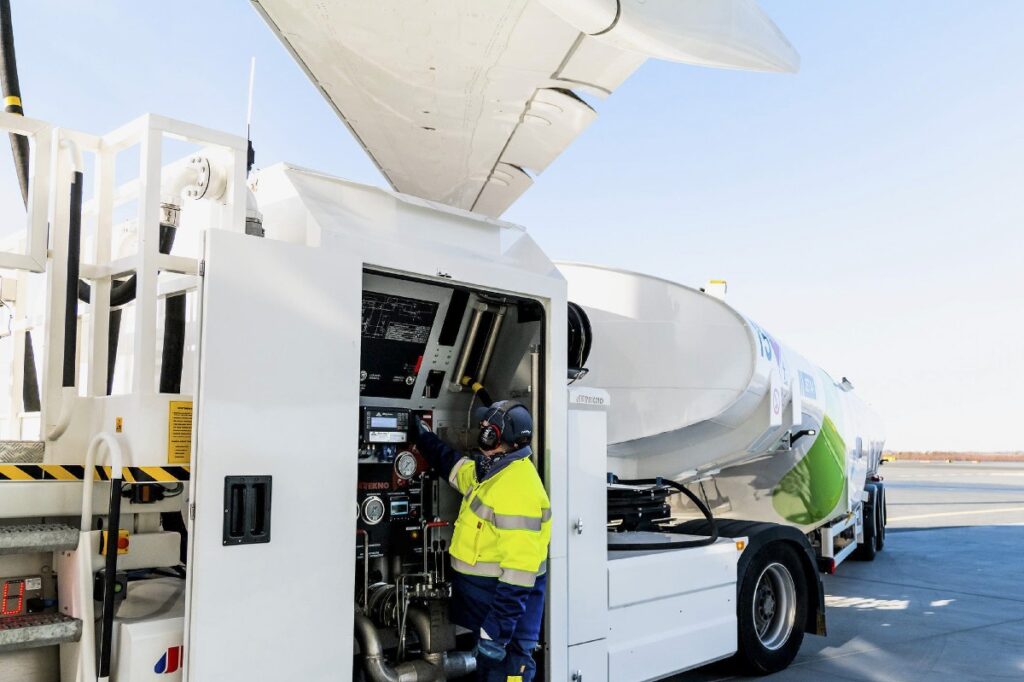
Photo: Tanker refuelling aircraft with Neste SAF blend
Views expressed in Commentary op-ed articles do not necessarily represent those of GreenAir.


More News & Features
Flying off into the sunset
News Roundup September 2026
Synthetic aviation fuel projects advance in Europe, Africa, US and China
Global aviation’s gross emissions to rise 87% by 2050 despite efficiency gains, forecasts IBA
Air France shares results of large-scale North Atlantic contrail avoidance trial
Over €400m in free EU ETS allowances given to airlines in 2025 to support SAF uptake