








Legal advice provided for environmental NGOs Transport & Environment and Opportunity Green shows that all countries have a legal obligation to include aviation non-CO2 emissions, such as those that cause climate warming aircraft contrails, in their national climate plans to comply with commitments under the Paris Agreement. The legally-binding climate change treaty adopted by 195 countries in 2015 requires the Parties to submit to the UNFCCC their plans, known as national determined contributions (NDCs), to communicate actions they will take to reduce GHG emissions in line with the target to limit global warming to 1.5°C. The legal conclusion by environmental law barristers Cornerstone argues that the treaty stipulates reductions in CO2 emissions must occur simultaneously with reductions in non-CO2 emissions, including those caused by aviation, and uncertainty over the science is not a reason to hold back action.
The Paris Agreement works on a five-year cycle of increasingly ambitious climate action, with each successive NDC meant to reflect a higher degree of ambition compared to the previous version.
The legal advice points out that the long-term goal of the Agreement is expressed in terms of global temperature limitation, in contrast to the approach previously taken under the Kyoto Protocol of reducing emissions from specific GHGs, such as CO2.
“Non-CO2 effects have a warming impact and are plainly relevant to the achievement of the long-term temperature goal,” says the advice. “The language of the Agreement indicates that emissions reductions should be economy-wide, with no carve out for specific sectors or categories of emissions.”
It adds that UNFCCC’s Article 3(3) and established case law require a precautionary approach to environmental protection to be taken even where scientific uncertainty exists. “The Paris Agreement requires measures to be based on the best available science and does not require scientific certainty before action is taken.”
Emerging scientific understanding of non-CO2 aviation effects entered the public domain in a 1999 special report, ‘Aviation and the Global Atmosphere’ by the UN’s Intergovernmental Panel on Climate Change (IPCC). A 2009 report by the UK’s Climate Change Committee noted there was already “high scientific confidence that the total climate warming effect of aviation is more than that from CO2 alone.” Another IPCC report in 2018 addressed both CO2 emissions and ‘non-CO2 forcers’, which included all anthropogenic emissions other than CO2 that result in radiative forcing, including that caused by aviation. The IPCC is due to publish a further report in 2027 on short-lived climate forcers.
The Cornerstone advice says that despite the growing scientific consensus, “there has been no substantive regulatory response” from ICAO. Although the UN’s civil aviation agency focused on non-CO2 aviation effects in a symposium in 2024 and concluded that they make an important contribution to radiative forcing, it proposed nothing to address them, other than “closely taking stock” of the scientific knowledge, states the advice. It also notes that ICAO’s climate measure CORSIA applies only to CO2 emissions, and argues the Paris Agreement does not enshrine a role for ICAO in pursuing a reduction in emissions from aviation fuels.
“There is no carve out under the Agreement to exclude international aviation emissions from Parties’ NDCs nor any text indicating that addressing such emissions should fall within the exclusive competence of ICAO,” it adds. “This is especially so given that ICAO lacks enforcement powers and its CORSIA scheme is limited in scope, currently voluntary, based on offsetting of emissions rather than carbon pricing, due to end in 2035 and applies only to CO2 emissions above 85% of the 2019 baseline.
“CORSIA is not an effective scheme, and states’ international legal obligations require a more comprehensive response to reduce international aviation emissions.”
No Parties to the Agreement currently include non-CO2 aviation effects within their submitted NDCs and only the EU and its member states include any international aviation emissions, though some other countries such as the UK include CO2 emissions from international aviation in their domestic carbon budgets.
“Overall, the regulatory and policy response to the known climate risks of non-CO2 aviation effects has been slow, piecemeal and lacking in ambition,” says the advice.
It cites Article 3(3) of the UNFCCC, which says: “The Parties should take precautionary measures to anticipate, prevent or minimise the causes of climate change and mitigate its adverse effects. Where there are threats of serious or irreversible damage, lack of full scientific certainty should not be used as a reason for postponing such measures, taking into account that policies and measures to deal with climate change should be cost-effective so as to ensure global benefits at the lowest possible cost.
“To achieve this, such policies and measures should take into account different socio-economic contexts, be comprehensive, cover all relevant sources, sinks and reservoirs of greenhouse gases and adaptation, and comprise all economic sectors.”
The precautionary principle is supported by recent advisory opinions by international courts such as the Inter-American Court of Human Rights and the International Court of Justice, says the advice.
“Applying the proper precautionary approach in light of the best available science, non-CO2 aviation effects must be included in the forthcoming round of NDCs for 2035, and those Parties which have already submitted NDCs should update them to include such effects,” it concludes.
Legal analysis provided by Cornerstone to Transport & Environment (T&E) in 2021 concluded that Parties to the Paris Agreement must report all emissions – domestic and international – from shipping and aviation in their NDCs.
Commenting on the Cornerstone legal advice on non-CO2 emissions, Carly Hicks, Chief Strategy and Impact Officer at Opportunity Green, said: “The International Court of Justice rules that all countries must do more to prevent the severe consequences that every increment of warming has on our planet. This advice confirms that including the impact of airplane contrails must be part of this effort.
“Aviation has an emissions problem that cannot continue to be ignored. This means including all aviation emissions – both CO2 and non-CO2 – in countries’ climate plans, in compliance with international law.”
Diane Vitry, Aviation Director at T&E, added: “Scientists have been warning about the warming caused by contrails for 25 years. Now legal advice shows countries must act to reduce them. It’s time to move on from paper to action and include the full climate impact of aviation in national climate plans or they will be failing in their commitments signed only 10 years ago in Paris.”
A forthcoming round of NDCs are due to be submitted ahead of COP30 in Brazil in November.
“Those countries which have already submitted NDCs should update them to include long-haul CO2 and non-CO2 aviation effects,” said T&E.
“The EU is due to submit its NDC on behalf of all its member states by September 2025. This would be an opportunity for the EU to lead by example and reiterate its climate ambition by submitting an ambitious NDC that includes contrails.”
The two NGOs point out that contrail warming is a highly concentrated issue, with a recent study showing less than 3% of global flights were found to generate 80% of contrail warming in 2019. Mitigating contrails and their effect, they argue, could be done more quickly and cost-effectively than other climate issues by making a slight change in the route of a small percentage of flights, according to a T&E study in 2024.
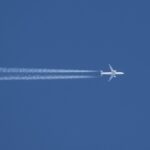
Photo (T&E): Aircraft contrails

Christopher Surgenor
Editor



More News & Features
Air France shares results of large-scale North Atlantic contrail avoidance trial
Cathay Pacific trials Google’s AI-powered contrail avoidance technology across its network
UK consortium launches major government-backed oceanic contrail avoidance programme
High altitude testing of a 100% SAF-powered Gulfstream business jet shows significant non-CO2 benefits
European aviation non-CO2 research report highlights uncertainties and knowledge gaps
COMMENTARY: The climate impact of contrails – why targeting a small share of flights could make a big difference