

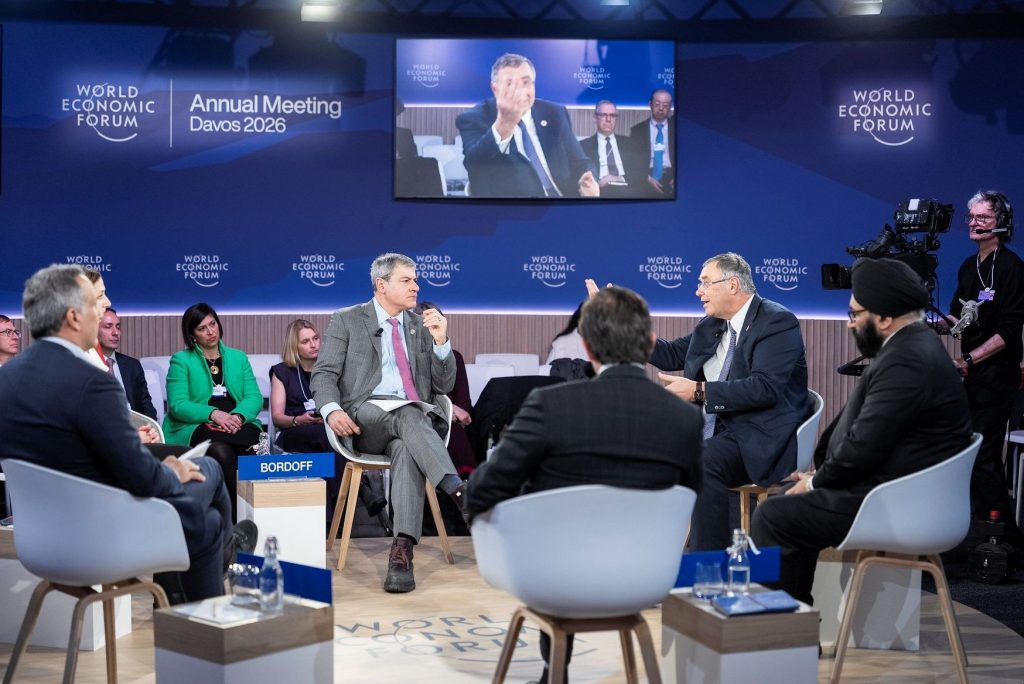
Speaking in a panel session on clean fuels at the World Economic Forum’s Davos meeting, the CEO of French oil major TotalEnergies, Patrick Pouyanné, said he expected the EU would eventually have to revise sustainable aviation fuel mandate targets in the same way it had retreated on the regulation to ban the sale of petrol and diesel cars in Europe from 2035. He said the main barriers to SAF production in the EU was the affordability of the fuels and uncertainty over policy. The gradual increase in the mandated use of renewable diesel had worked as the higher price had been absorbed over time, he said. In contrast, European SAF mandates required a big jump from a current 1% usage to 6%, or even 10%, by 2030 and then steeper rises thereafter, causing “a panic”, he said. As a big fuel producer, he said investing in new biorefineries was questionable at present and would instead focus on producing SAF through co-processing.
“It’s better and more affordable to concentrate today on the technologies that allow us to produce some clean fuels, maybe not the new fuels at 95% or 100% abatement, maybe 50 to 60%,” Pouyanné told the delegates. “When I see the debate on SAF in Europe and the European Commission being obliged to be more flexible about cars, I can make a bet today that what happened to the car regulation will happen to the SAF regulation.”
He said renewable diesel was two to three times more expensive than its fossil equivalent and SAF three to four time more, and their use can only be forced through mandates.
“Nobody wants to pay a premium to be green,” he said. “The affordability must be acceptable. What does not work is big jumps like when you want to move from 1% to 10%. The gradual part is fundamental.”
He said airlines were lobbying hard against the mandate and also accusing oil companies of not investing enough.
“I have no problem to invest,” he said. “I will be able to provide 10% of SAF to airline companies in Europe by 2030, more than the 6%. But it has a cost. Everybody is dreaming they can have this biofuel for the same price as oil. No, it can’t be done.
“That’s why I said recently I will invest less because I’m afraid, as it’s a regulated market, if they move the targets, then I will have invested in a biorefinery for nothing.”
Another factor to consider, he said, was that the cost of CO2 abatement for solar and wind was $200 per tonne, compared to the $350-400 per tonne for biofuels.
“Logically, if I’m thinking about the planet holistically, we should be allocating capital to be efficient in terms of carbon abatement. Unfortunately, that’s difficult because policies are done vertically, so you have a nuclear policy, a renewable policy and so on, and nobody thinks that at the end, it’s all the same. It’s energy, and so the real objective is how to provide the most affordable and sustainably possible energy.”
He said airlines had been smart to now recognise the contribution of co-processed SAF, where existing refineries could be repurposed to produce less expensive SAF.
“Before, I was obliged to invest in a new biorefinery. Suddenly, by putting used cooking oil in my existing refineries, I have a SAF. We have two biorefineries in Europe. We were planning to sanction a third but we stopped as it was too early.”
Co-panellist Arvinder Singh Sahney, Chairman of Indian Oil, said his company too was keen to produce co-processed SAF. He reported that it planned to start co-processing SAF within two to three months and was also looking at the ethanol-to-jet pathway.
“India is importing 85-90% of its crude oil, so if we can develop an ecosystem that will give us a continuous supply of non-fossil fuel, that will be great for the country,” he said. “Because it’s a large agricultural based economy, we have lots of bioenergy potential.”
Richard Holtum, CEO of global commodities group Trafigura, which has a project in Uruguay with Syzygy Plasmonics to convert biogas to SAF, said clean fuels will only exist if people are willing to pay two to three times more than they are paying today.
“The only way that works in the marketplace is either with SAF, where there are mandates, or a sector like hydrogen, where there are subsidies,” he said. “Our facility in Uruguay exists because there are mandates and we have a small green hydrogen facility in Milford Haven, UK, and that exists because we are able to sell it at the equivalent price of natural gas. Without either of those two things, there isn’t a market for clean fuels today. Maybe one day in the future, but what we have to remember is that there is a time value of carbon.”
Elaine Buckberg, Senior Fellow at the Salata Institute for Climate and Sustainability at Harvard University and a former Chief Economist at General Motors, said the focus should be on allocating clean fuels to hard-to-abate sectors. “I think sustainable aviation fuel is the number one,” she said.
A video recording of the session, ‘Time for clean fuels?’ is available here
Photo (Flickr): World Economics Forum ‘Time for clean fuels?’ session

Christopher Surgenor
Editor



More News & Features
Synthetic aviation fuel projects advance in Europe, Africa, US and China
Air France shares results of large-scale North Atlantic contrail avoidance trial
Over €400m in free EU ETS allowances given to airlines in 2025 to support SAF uptake
EASA reports 2025 supplies of SAF exceeded first year of EU mandate
United and FedEx sign agreements to extend SAF supplies and scale up use
Nova Pangaea takes major step towards commercial-scale SAF production