

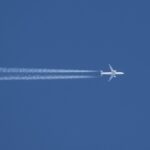



Two newly-published European studies into aviation’s contrail-related global warming impact conclude that adjusting the routes of a small number of flights would have minimal effects on air navigation but result in major climate benefits. Analysis by Transport & Environment (T&E) shows that 25% of European contrail warming impact comes from night flights in autumn and winter, which make up just 10% of European air traffic. The concentration of contrails occurs not only at specific times of the year but also around specific locations and the study confirms the North Atlantic has high contrail avoidance potential. A study by Chalmers University of Technology in Sweden and Imperial College London in the UK analysed nearly half a million flights across the North Atlantic, which the research team says has generated new insights that can support both industry and policymakers in guiding aviation towards more climate optimal operations.
According to the T&E study, 75% of European contrail warming in 2019 occurred between January to March and October to December, with 40% during late evenings and nights.
The airspace above the North Atlantic is dominated by long-haul flights with high contrail warming but has low traffic density, with flights above five hours alone accounting for 40% of contrail warming while representing only 10% of European departures in 2019.
T&E therefore advises contrail avoidance should happen first in regions with high warming but low traffic. Avoiding contrails when traffic levels are below 60% of their annual peak could have addressed around 70% of European contrail warming in 2019, suggests the study.
“Contrails are a very concentrated problem. Fortunately, there are straightforward and affordable opportunities to scale up contrail avoidance in Europe,” said Alexander Kunkel, Senior Analyst at T&E and a co-author of the report.
“The science and the solutions are clear: by adjusting the paths of just a handful of flights, Europe could prevent years of avoidable global warming.”
T&E recommends the EU:
• Includes non-CO2 effects and contrails into air traffic management legislation;
• Maintains the automatic extension of the EU’s non-CO2 monitoring scheme to extra-EEA flights, to further improve data and research on contrails;
• Incentivises airlines and air traffic control centres performing contrail avoidance; and
• Conducts large-scale airspace trials to develop better knowledge on contrail avoidance.
“The time to shift into the next gear on contrail action is now. By boosting research, supporting large-scale trials and designing a policy framework, Europe can pave the way for the deployment of contrail avoidance in the next five to 10 years,” said Kunkel.
The Chalmers study, published in an article in Nature Communications, draws on extensive flight and meteorological data in combination with a contrail model and an advanced climate-economy model.
“Our research provides a basis for strategies to reduce the climate impact of contrails,” explained Susanne Pettersson, postdoctoral researcher at the Department of Space, Earth and Environment at Chalmers.
“Our calculations can be used for optimisation of flight routes where climate impact is considered alongside, for example, fuel cost and travel time. The results give airline operators and air traffic management new tools for climate optimisation. This could bring significant climate and societal benefits.”
The study shows that 38% of flights generate contrails that have a warming effect. It also recommends that it would be beneficial from a climate perspective to reduce the formation of contrails of almost all these flights through minor re-routing, “even if this results in slightly higher carbon dioxide emissions”.
“The new knowledge also provides a foundation for designing new regulations and policy instruments to reduce aviation’s climate impact,” commented Daniel Johansson, associate professor at the Department of Space, Earth and Environment at Chalmers, and a lead author of the next IPCC climate report. “The European Commission is currently working on proposals to steer aviation towards lower climate impact, and our new study can hopefully support this process.”
Meanwhile, the Commission and Eurocontrol have released a second version of its Non-CO2 Aviation Effects Tracking System (NEATS), an IT tool for monitoring, reporting and verifying the non-CO2 climate impacts of aviation. Aircraft operators can now calculate the impact of their flights by providing data they collect.
NEATS includes a set of scientifically established models to calculate per flight climate effects and the tool relies largely on the PyContrails Python library, which models contrails. A third version is due to be released that will support EU ETS reporting for 2025 emissions and will introduce dedicated interfaces for aircraft operators, verifiers and competent authorities.
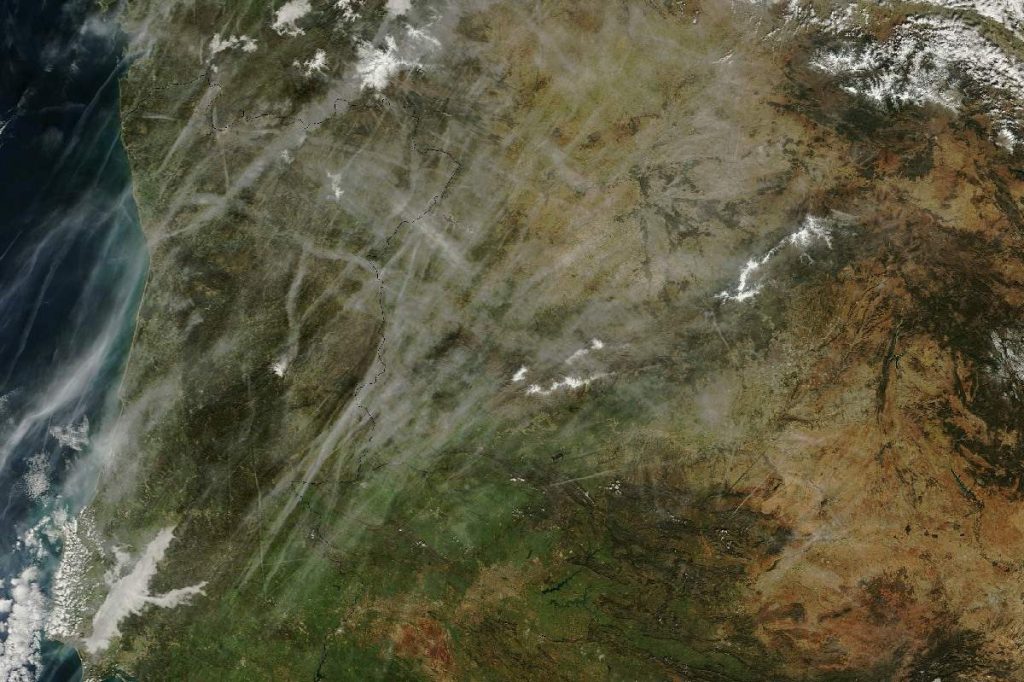
Image (NASA Earth Observatory): NASA’s Terra satellite captured this view in 2013 of numerous contrails over Portugal and Spain

Christopher Surgenor
Editor


More News & Features
Air France shares results of large-scale North Atlantic contrail avoidance trial
Over €400m in free EU ETS allowances given to airlines in 2025 to support SAF uptake
EASA reports 2025 supplies of SAF exceeded first year of EU mandate
Cathay Pacific trials Google’s AI-powered contrail avoidance technology across its network
UK consortium launches major government-backed oceanic contrail avoidance programme
Commission proposes a limited extension of the ETS to international departing flights from Europe