






“Business as usual won’t deliver SAF at scale. Bold, coordinated policy action combining mandates, incentives, flexibility and feedstock investment is essential for APAC’s energy transition,” says the report, produced jointly by the newly-formed Asia SAF Association (ASAFA) and Argus Media, which publishes daily prices, developments and analysis of global biofuels markets including SAF and fuel feedstocks.
It highlights the price gap between SAF and conventional jet fuel as “a major blocker” to scaling SAF, followed by policy uncertainty “reflecting unclear or inconsistent government support”, then feedstock scarcity and high capital and financing costs for SAF projects.
“This underlines that closing the price gap through incentives, scale or carbon pricing and providing stable policy frameworks would tackle the most critical blockers,” it argues.
The report urges airlines to move “from passive to proactive” behaviours to drive up SAF production and progressively reduce prices through actions including forward offtake agreements, co-investment in SAF projects and advocacy for policy support. “Waiting for cheaper SAF isn’t viable, airlines must signal demand and invest early,” it adds.
A key focus of the report is SAF blending mandates. “Many Asian targets are uncertain, but could significantly swing regional demand if firmed.”
It highlights two countries – Singapore and South Korea – with firm SAF targets and proposed implementation mechanisms, initially for 1% mandates, while identifying proposed and discussed SAF targets by Thailand, Japan, Indonesia, Malaysia and India, potential increases in blending mandates by Singapore and South Korea, and targets beyond 2025 under discussion by China.
Asked what SAF blending proportion they expected across the region by 2030, 51% of respondents to a survey for the report predicted 2-5%, while 27% said less than 2%. Another 7% of respondents forecast a 5-7% blend, 10% believed it would rise as high as 7-10%, and 2% said it would be even higher, while 3% were unsure.
Additionally, asked the best way to accelerate SAF uptake, the most common answer was via policy and financial incentives, specifically tax credits or production subsidies for SAF makers, followed by volume-based SAF blending mandates to guarantee demand, while there was also significant support for carbon intensity-based targets instead of volume-based blending.
“The survey shows that there is broad recognition that not all SAF is equal in carbon terms and policies should reward greater greenhouse gas emission reductions rather than just volumetric blending,” says the report.
“Many respondents believe APAC should shift to carbon-intensive based frameworks – as some jurisdictions are starting to do – though a sizable minority is unsure, possibly reflecting that implementing carbon intensity regimes is complex.”
The survey highlighted waste lipids such as used cooking oil, palm waste and animal fats as “the cornerstone” of SAF in APAC near term, reflecting its current widespread use in HEFA-based fuel pathways and its availability as a feedstock within the region.
“The relatively lower emphasis on novel feedstocks like algae or power-to-liquid (PtL), signals that stakeholders view bio-based feedstocks as the primary supply for 2030, with e-fuels and advanced tech likely playing a more minor role by that timeframe.”
The AtJ (alcohol-to-jet, or ethanol) pathway was nominated by respondents as “the most significant contributor beyond HEFA,” leveraging Asia’s ethanol production capacity, followed by co-processing of biogenic feedstocks in existing oil refineries, then Fischer-Tropsch (FT) biomass-to-liquids. The pathway considered least likely as the leading process by 2030 was PtL.
The report highlights significant lack of preparedness across the region for carbon offsets under ICAO’s CORSIA programme from 2027 and expressed concern that progress would be limited.
“Only 8% reported being ‘fully ready’ and having systems and supply in place. The largest group, 50%, said they are ‘partially ready’, but with major gaps remaining, indicating significant work still needed in policy or infrastructure.
“Another 19% feel ‘mostly ready’ with just some gaps, for example in supply or reporting. Worryingly, 15% admitted they are not ready and 8% are uncertain and need more clarity on CORSIA compliance.
“The substantial ‘not ready’ and ‘uncertain’ groups point to a risk that part of APAC may struggle with CORSIA unless support and clarity improve.”
The survey reveals considerable openness to fully integrating book-and-claim processes into APAC SAF mandates, enabling operators to benefit from environmental attributes of buying the fuel without taking physical delivery.
This drives up demand, enabling airlines or their customers to procure supplies, even when not available in their region, by purchasing SAF certificates, then having the associated fuel delivered to airports close to refineries for use by other carriers, still reducing direct emissions from aviation, but shifting the deployment.
“Few purists insist on physical delivery only, acknowledging that might hinder SAF adoption,” says the report. “This points towards policy innovation in APAC to formally recognise SAF certificates, provided robust safeguards are in place.
“The survey reveals that book-and-claim is seen as the most practical mechanism to rapidly scale SAF uptake, likely because it overcomes the logistical constraints of delivering SAF to every airport. This suggests stakeholders prioritise flexibility and administrative solutions to broaden SAF access.”
However, the report found that fewer than 20% of stakeholders were committed to or actively planning to buy SAF certificates “while the majority either have no plans or remain on the fence.”
It adds: “The prevailing view is that to truly scale SAF use, SAF certificates need formal recognition, especially in compliance or at least standard carbon accounting.”
Respondents favoured the formation of regional or multilateral registries to issue and track SAF credits and strongly preferred that these entities be managed either by governments or a centralised international system, with the report noting “purely private voluntary registries have low trust.”
As well, to further boost SAF uptake, a large number of survey respondents suggested integrating SAF contributions into frequent flyer programmes, enabling travellers to either use loyalty points to buy SAF or earn points for doing so.
The report recommends that airlines pursue forward offtake agreements, co-invest in SAF projects, offer incentives such as loyalty rewards for passengers to buy SAF, increase demand for the fuel by using book-and claim systems, and progress corporate purchasing programmes for business travel and freight customers.
It says SAF project developers should strengthen supply chains for used cooking oils as fuel feedstocks while also accelerating AtJ and FT production pathways towards demonstration and commercialisation.
Investors and financiers are urged to “invest upstream” in feedstock aggregation and waste processing to secure supply, invest early in next-generation SAF pathways, anticipate the growth of SAF certificates and low carbon intensity fuel credits as tradeable assets, co-invest with governments and derisk investment through public-private partnerships, loan guarantees or contracts for difference.
It also recommends policymakers combine blending mandates with financial incentives including subsidies, tax credits and cost sharing, transition toward carbon intensity-based targets, incorporate book-and-claim options within national mandates and support a global or interoperable SAF certificate registry to build market confidence in this process.
“SAF transition in APAC offers major upside for patient, strategic capital,” concludes the report. “Investors who partner with governments, back next-gen technologies and engage early in SAF credit markets will be best positioned to lead in clean aviation finance.
“Producers in APAC should capitalise on market momentum now, scaling output, diversifying technologies and leading on sustainability and tech innovation to secure early advantage in the global SAF transition.”
Singapore SAF levy
Meanwhile, Singapore has released details of its SAF levy for airline and private flight passengers and cargo shipments departing Singapore from 1 October next year, with charges applying on flights booked from 1 April. The levies have been designed to support Singapore’s initial SAF blending target of 1%, to be introduced next year.
Charges will be based on geographical bands, segregated into Economy Cabin and Premium Cabin categories for scheduled airline flights, by kilogram weight on cargo flights and by aircraft size on private flights. The fees will apply for passenger or freight flights from Singapore to the next point of arrival, but not to subsequent sectors or for passengers transiting Singapore. Levies will be collected by airlines as part of the ticket price or freight fee, and proceeds held in a Statutory SAF Fund managed by the Civil Aviation Authority of Singapore (CAAS).
“The introduction of the SAF levy marks a major step forward in Singapore’s efforts to build a more sustainable and competitive air hub,” said Han Kok Juan, Director General of CAAS.
“It provides a mechanism for all aviation users to do their part to contribute to sustainability at a cost which is manageable for the air hub. We need to make a start. We have done so in a measured way and we are giving industry, businesses and the public time to adjust.”
The SAF levy amounts have been calculated by CAAS based on the volume of the fuel needed to meet Singapore’s initial 1% uplift target in 2026, and the projected price premium of SAF over fossil-based jet fuel and linked costs including certification, blending and delivery.
They must be collected by airlines and included as line items on passengers’ tickets or air cargo contracts and apply for all passengers or freight departing Singapore, excluding transit passengers. Training flights and those deployed for charitable or humanitarian purposes will be exempt.
Charges are grouped into four geographical bands and based on distance travelled.
Band 1 will apply for flights from Singapore to destinations within Southeast Asia, Band 2 to Northeast Asia, South Asia, Australia and Papua New Guinea, Band 3 to Africa, Central and West Asia, Europe, Middle East, Pacific Islands and New Zealand, and Band 4 to the Americas.
The SAF levy for passengers on scheduled flights is charged per person in either an Economy Cabin, which includes Economy and Premium Economy classes, or a Premium Cabin, which covers Business and First Class, and the Premium levy is four times that of Economy.
For Band 1 passengers, the SAF levy per Economy passenger is S$1.00 ($0.77) and S$4.00 ($3.07) for Premium.
In Band 2, the Economy levy is S$2.80 ($2.15) per passenger and S$11.20 ($8.60) for Premium travellers.
Band 3 passengers will be charged S$6.40 ($4.92) for Economy travel and S$25.60 ($19.66) for Premium.
And for Band 4, the Economy levy is S$10.40 ($7.99) per passenger, while Premium travellers will pay S$41.60 ($31.95).
For freight carried in Band 1, the SAF levy is S$0.01 per kilogram, Band 2 is S$0.04, Band 3 is S$0.09, and Band 4 is S$0.15.
General and private aviation flights are more complex, with six categories, and levies charged per aircraft and distance travelled within each geographical band. Aircraft types are categorised by their wingspan, based on codes A to F, stipulated by ICAO.
These range from a Code A aircraft such as a Cessna Titan, to a Code F Airbus A380 or Boeing 747-8.
Funds collected and managed by CAAS will be used only for the purchase of SAF or SAF environmental attributes, as well as administration costs, and the newly-established Singapore Sustainable Aviation Fuel Company (SAFCo) will manage procurement, allocation and administration of both the fuel and SAF attributes, the latter a value representing the difference between lifecycle CO2 emissions of SAF and those of the same quantity of conventional jet fuel.
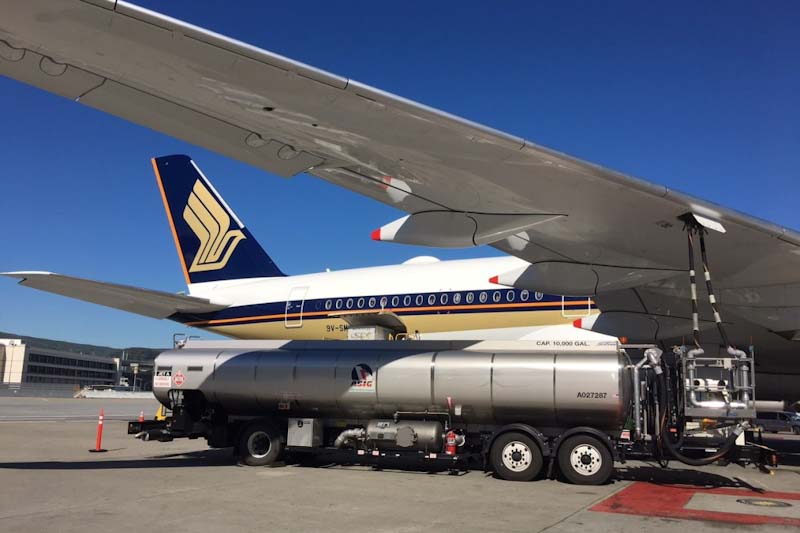
Photo: Singapore Airlines operated its first sustainable biofuel flight in 2017

Tony Harrington
Correspondent



More News & Features
EASA reports 2025 supplies of SAF exceeded first year of EU mandate
United and FedEx sign agreements to extend SAF supplies and scale up use
Cathay Pacific trials Google’s AI-powered contrail avoidance technology across its network
Nova Pangaea takes major step towards commercial-scale SAF production
COMMENTARY: Why action lags ambition among States seeking SAF mandates
Syzygy signs agreement with World Bank arm IFC to advance Latin American SAF production