
Concrete Chemicals, a partnership between sustainable aviation fuel producer Zaffra and renewable energy company ENERTRAG, has secured €350 million ($410m) in public funding to deliver what it claims will be Germany’s largest industrial-scale eSAF production facility. The funding has been approved at national and regional level, and is now undergoing a final review by the European Commission. To be located in the state of Brandenburg, the project is slated to produce more than 37,000 tonnes of synthetic fuels per year, including 30,000 tonnes of eSAF, using biogenic CO2 and renewable hydrogen. It aims to support the delivery of the EU blending sub-mandate on eSAF, which starts at 1.2% in 2030, and contribute to the German federal government’s Sustainable Aviation Strategy.
The Concrete Chemicals consortium plans to source local CO2 through a cooperation with LEIPA Georg Leinfelder, a manufacturer of recycled paper and cardboard products based in the town of Schwedt in northeastern Germany, the planned location of the facility.
The project has been designed in alignment with Germany’s emerging hydrogen infrastructure and the objectives of the IPCEI hydrogen framework. Its location and system design allow for future connection to the national Hydrogen Core Network, subject to the completion of relevant infrastructure and regulatory approvals, and support scalability and long-term integration into the European hydrogen market.
The technical planning phase of the project will begin immediately, say the partners, with a final investment decision targeted by 2027 and production starting in time to support the eSAF 2030 mandate. The ambition is to set a SAF blueprint that can be replicated and rolled out at scale across Europe and beyond.
Concrete Chemicals was formed in 2022 by Germany’s ENERTRAG, the ecoFT business unit of South African energy and chemicals group Sasol and global construction materials group CEMEX. The plan was to combine CO2 extracted from cement production at a plant in Rüdersdorf, near Berlin, with green hydrogen generated from wind and solar energy to produce sustainable aviation fuels (see article).
CEMEX has since ceased its participation in Concrete Chemicals and Sasol has transferred its interests to Zaffra, a joint venture it holds with energy technology company Topsoe, which has extensive power-to-X expertise.
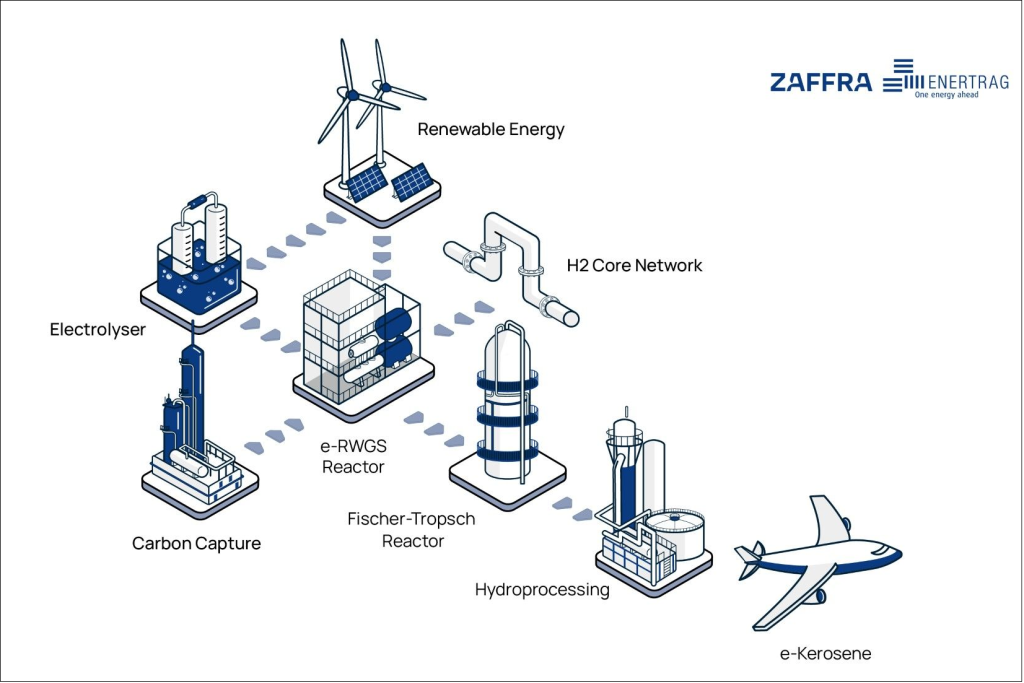
Zaffra provides power-to-liquid eSAF solutions through its proprietary G2L eFuels platform. It combines Sasol’s Fischer-Tropsch synthesis with Topsoe’s eREACT-based Reverse Water Gas Shift and Product Work-up technologies.
Commenting on the Schwedt project, Zaffra CEO Jan Toschka said: “Zaffra and its partners are delivering the kind of frontier industrial innovation Europe urgently needs. This project proves it is possible to marry innovation with energy resilience, climate ambition and economic competitiveness – all with European technology, German infrastructure and Brandenburg-based jobs.”
Added ENERTRAG CEO Dr Gunar Hering: “Our expertise in renewables enables the cost-efficient use of green hydrogen to power the aviation fuels of the future.”
Image: Zaffra’s power-to-liquid eSAF production process

Christopher Surgenor
Editor



More News & Features
Synthetic aviation fuel projects advance in Europe, Africa, US and China
Air France shares results of large-scale North Atlantic contrail avoidance trial
Over €400m in free EU ETS allowances given to airlines in 2025 to support SAF uptake
EASA reports 2025 supplies of SAF exceeded first year of EU mandate
United and FedEx sign agreements to extend SAF supplies and scale up use
Nova Pangaea takes major step towards commercial-scale SAF production