





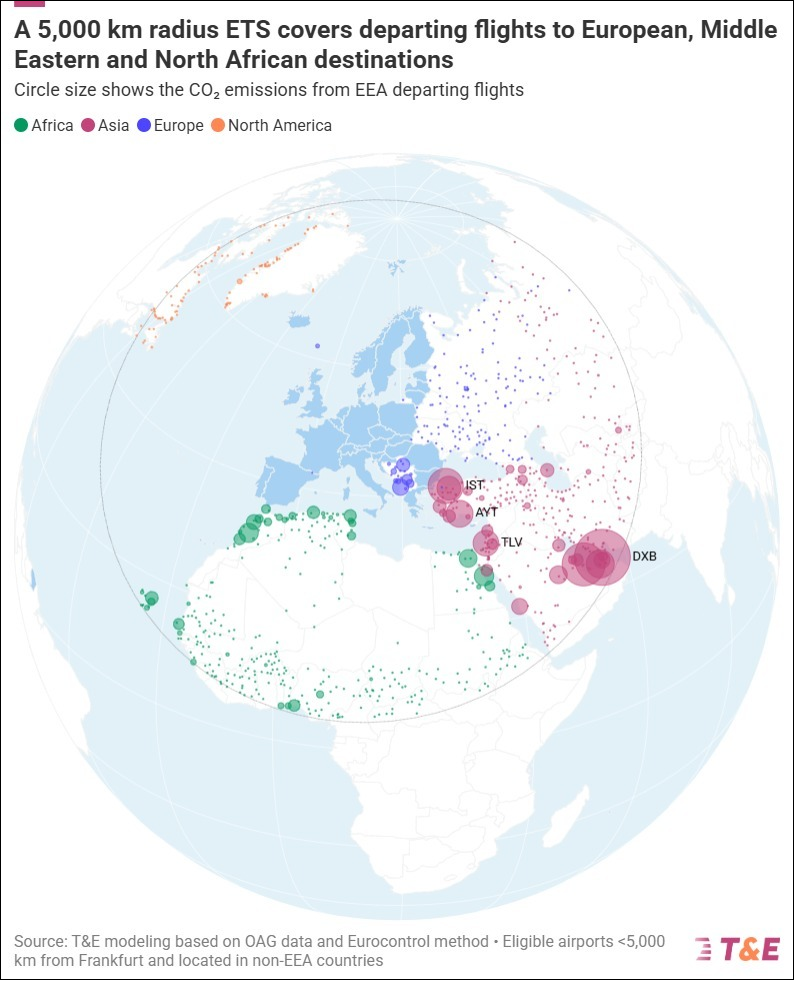
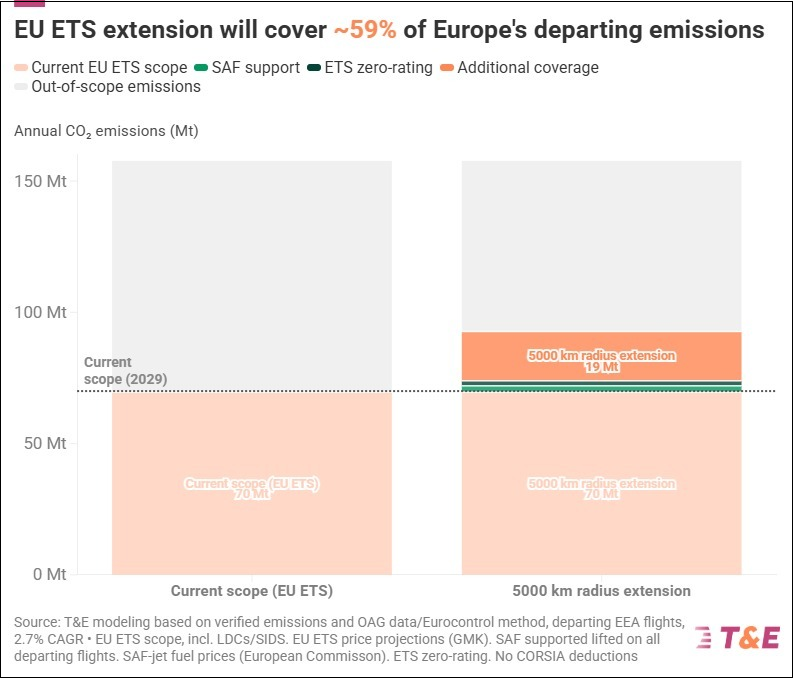
Analysis by Brussels-based NGO Transport & Environment (T&E) shows the recently released proposal from the European Commission to extend the scope of the EU Emissions Trading System (EU ETS) to all departing flights to airports within 5,000km of Frankfurt from 2029 would cover around 59% of Europe’s departing aviation emissions, up from 44% today. It says SAF allowances will offset part of the increase, reducing the proportion of priced emissions to 57%. Meanwhile, a report from another European NGO, Opportunity Green, in collaboration with research consultancy CE Delft, finds European airlines received a cumulative €10.9 billion ($12.5bn) in free EU ETS allowances between 2013 and 2025. Opportunity Green accuses the airlines of not lowering ticket prices as a result or contributing sufficiently to decarbonisation spending.
In July, the Commission published its assessment that the current emissions coverage of the CORSIA carbon offsetting scheme for international aviation was insufficient and recommended an extended scope of the EU ETS to third countries. The scope would include flights to countries such as Turkey and the Gulf states, whose carriers and airports are considered to have an unfair competitive advantage over their European counterparts on carbon pricing, but exclude countries like the US, India and China that have in the past opposed EU extraterritorial application of its flagship carbon scheme (see graphics below).
T&E described the extended scope proposal as a “half-hearted” step towards pricing extra-EEA international flights, although acknowledging it as “a pragmatic first step that protects European interests”.
It points out that with only an effective 57% coverage, nearly half of Europe’s departing aviation emissions still would not carry a carbon price and airlines, including those from third countries, would get financial support for buying sustainable aviation fuel.
The proposal will now be debated by the European Parliament and EU member states through the European Council before a final decision is reached. T&E calls on them to support an EU ETS extension to all departing flights and as of 2028, rather than the proposed 2029.
It welcomed the proposals to include in the EU ETS all private jet flights, many of which have been exempted up till now, and the introduction of free allowances for airlines that avoid creating warming contrails.
Opportunity Green said the Commission’s proposals represented a missed opportunity by exempting major markets like the US and China and leaving the most polluting long-haul flights with no incentive to decarbonise.
New analysis from Opportunity Green and CE Delft shows 350 million free EU ETS allowances were handed to airlines between 2013 and 2025, which they value at €10.9 billion. Six of Europe’s biggest airlines – Lufthansa Group, Ryanair, easyJet, IAG, Air France-KLM and Wizz Air – are calculated to have received €6 billion, while making a combined €21 billion in profit over the period. The report estimates they incurred €320 billion of climate costs, while spending only €1 billion on decarbonisation activities such as SAF and ground equipment electrification.
“These figures show the industry’s narrative about struggling to remain competitive is greatly overblown,” commented Tom Grylls, Director of Analytics at Opportunity Green, on a report by CE Delft entitled ‘Who benefits from free allocation in aviation?’. “In reality, they have enjoyed years of freebies and instead of funding climate action through new innovations in sustainable technology or SAF deployment, this money simply turned to profit and lined the airlines’ deep pockets.”
Opportunity Green says free allowances are an ineffective tool to tackle competitiveness and a barrier to progress on tackling climate change, and calls on the Commission to exclude free allowance allocations in future EU ETS revisions.
Added Carly Hicks, Chief Strategy and Impact Officer: “The history of free allowances tells us that if airlines aren’t compelled to act on decarbonisation, they won’t. Under the latest proposals, any allowances for aviation are conditional upon sustainability criteria, such as using alternative fuels or mitigating contrails. It’s crucial the Commission sticks to this pathway and ensures the criteria are ambitious, even if the industry ends up asking for more free allowances.”
The organisation also recommends airlines should be charged a fee unless they take action to avoid contrails and calls for the abolition of the EU Taxonomy or, alternatively, reformed to adopt a stronger definition of sustainability that excludes investments in fossil-fuelled aircraft.
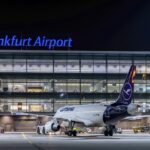
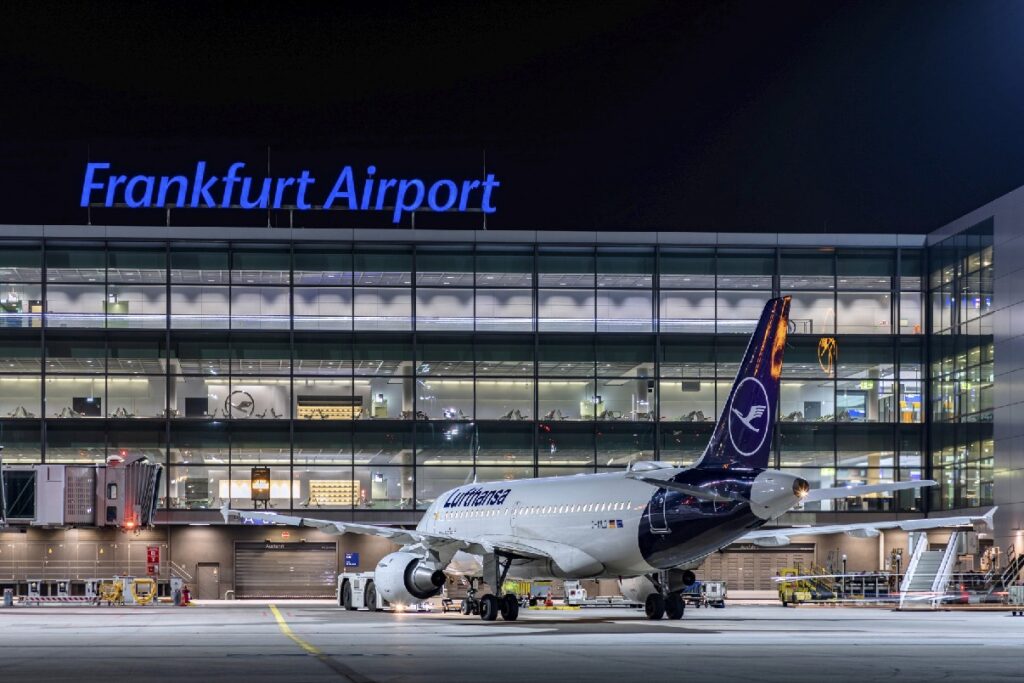
Photo (Fraport AG): Frankfurt Airport

Christopher Surgenor
Editor


More News & Features
Heathrow expansion incompatible with climate targets, advises UK government watchdog
News Roundup August/September 2026
Cathay Pacific trials Google’s AI-powered contrail avoidance technology across its network
Nova Pangaea takes major step towards commercial-scale SAF production
COMMENTARY: Why action lags ambition among States seeking SAF mandates
News Roundup July/August 2026