







US carriers United Airlines and FedEx have signed agreements to increase access to supplies of sustainable aviation fuel. United has extended its existing agreement with Neste on the supply of blended SAF to flights departing Chicago O’Hare and Amsterdam Schiphol. Under the extension, Neste’s deliveries at Amsterdam began in June and continued through to August, while deliveries to Chicago O’Hare started in July and are planned to continue until June next year. FedEx is expanding its SAF procurement through new agreements with undisclosed suppliers that are projected to secure more than 20 million gallons of neat SAF across five US airports during 2027. In other US SAF news, Montana Renewables has announced a revised expansion of its facility that is expected to increase SAF production capacity to reach 200 million gallons annually by the end of 2028.
United reports that it used over 83,000 tonnes (around 27.7 million gallons) of SAF in 2025, a 104% increase over the prior year. This, it says, makes it the largest user of SAF among major US airlines last year, based on publicly available information. The airline expanded its SAF use to three additional hub airports – Newark, Washington DC and Houston – so bringing its SAF usage to six out of its seven domestic hubs.
In August 2024, United became the first airline to purchase and use blended SAF at Chicago O’Hare, the airline’s largest hub by daily departures and so making it a key location for scaling the use of SAF in day-to-day operations. United claims it was the first airline globally to use SAF in ongoing operations and has been refuelling with Neste MY SAF, which is produced from renewable raw materials such as used cooking oil and animal fat waste, at Schiphol since 2022.
“Continuing our work with Neste across two continents reflects a shared conviction that SAF is available and capable of being scalable,” commented Lauren Riley, CSO at United.
Added Carl Nyberg, SVP Commercial, Renewable Products business at Neste: “This extended agreement with United Airlines, covering two international airports across two major aviation regions, is a testament to our joint belief in the critical role of SAF in reducing aviation-related GHG emissions. By continuing to make SAF available at two of United’s key hubs, we are proving that SAF is a readily available, scalable solution and we look forward to continuing our longstanding collaboration.”
Neste’s global SAF production capability is around 1.5 million tonnes (515 million gallons) per year and is set to grow to 2.2 million tonnes in 2027, when the expansion of the company’s Rotterdam refinery is expected to be completed.
FedEx, meanwhile, has a goal to source 30% of jet fuel blended from alternative sources by 2030 while expanding SAF use across its US air network. The new agreements are expected to deliver SAF at blend ratios ranging from 30% to 50%, depending on location, and are enabled in part by state and federal level incentives, said the carrier’s Greg Paulus, VP Enterprise Sourcing.
Starting in 2025, FedEx secured around 5 million gallons of neat SAF through agreements that resulted in the deployment of 16.5 million gallons of blended SAF across the five US airports. It expects that in the next phase of procurement, SAF blends would represent a significant share of FedEx jet fuel use at those airports. As the SAF market develops, it said it would continue to evaluate opportunities to expand the use of SAF “where supply, infrastructure and economics align with the needs of our air network”.
Karen Blanks Ellis, CSO and VP Environmental Affairs at FedEx, added: “For the market to grow, supply needs to be reliable, affordable and sustainable. Expanding our procurement allows us to employ more SAF in our network while bolstering the demand for greater production and scale.”
Montana Renewables is one of North America’s largest SAF producers, with offtake customers that include JetBlue, Alaska Airlines and Delta Air Lines, which are supplied by Shell Aviation, plus corporate buyers through World Energy and Future Energy Global. It has a current annual production capacity of around 60 million gallons and has ambitious plans to expand significantly over the next few years through its MaxSAF 150 project.
Back in 2023, the original plan was to produce 300 million gallons of SAF per year and the project was backed by a conditional US Department of Energy (DOE) loan guarantee of up to $1.44 billion, which was closed in early 2025. Montana Renewables, a subsidiary of Calumet, has now announced a scaled-down revision to the MaxSAF project, from a large-scale expansion to a phased, more capital-efficient approach.
By the end of this year, it expects run-rate production to exceed 80 million gallons, surpass 120 million gallons by spring 2027 and reach around 200 million gallons by year-end 2028. The new plan is based on repurposing proven, installed refining equipment from the adjacent Calumet Montana Refining facility under a long-term lease and thereby significantly lowering the capital requirement and call on the DOE loan guarantee.
Rather than a single large construction project, the new expansion is structured as six small, controllable, quick payback projects, each designed to increase returns and reduce construction risk, explains the company. The project will capture around 70% of the originally expected benefit while spending only 15% of the originally expected Phase 2 DOE funding of up to $658 million, said Todd Borgmann, CEO of Calumet.
“Our amended agreement with the DOE facilitates innovative technology and domestic energy security at a fraction of the original cost,” he said. “We look forward to our continued collaboration with the DOE on the success of this project.”
The expansion increases Montana Renewables’ total annual feedstock consumption to around 2 billion pounds of ranch and farm originated feedstocks that include tallow, distillers corn oil, canola oil, used cooking oil and camelina oil.
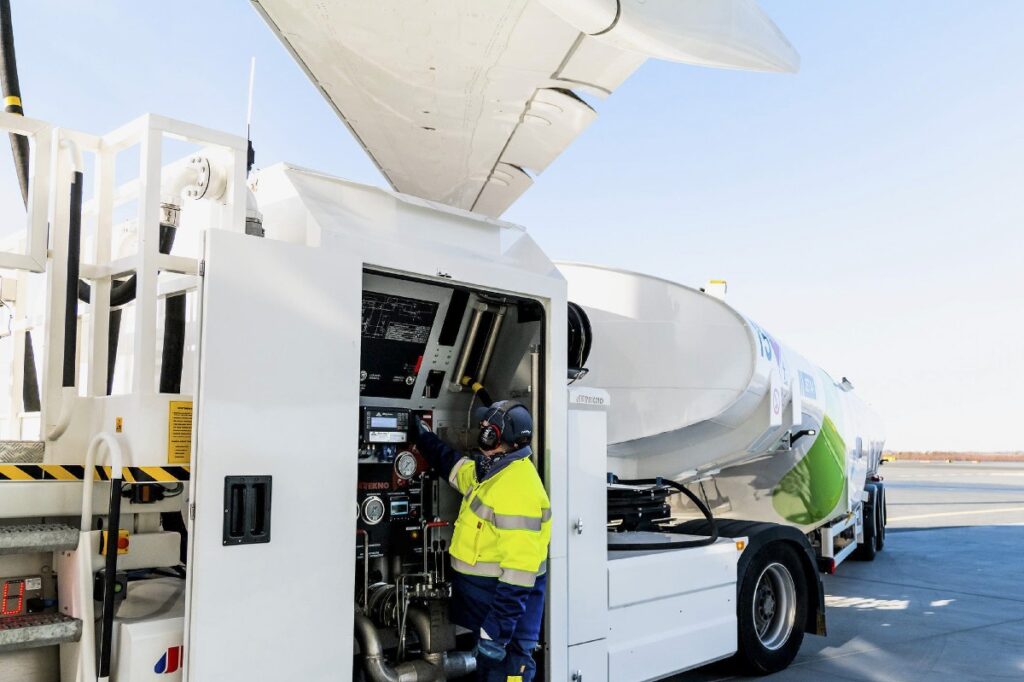
Photo: Neste

Christopher Surgenor
Editor



More News & Features
News Roundup August/September 2026
Transport NGOs call EU ETS aviation extension proposals a missed opportunity
Heathrow expansion incompatible with climate targets, advises UK government watchdog
Cathay Pacific trials Google’s AI-powered contrail avoidance technology across its network
Nova Pangaea takes major step towards commercial-scale SAF production
COMMENTARY: Why action lags ambition among States seeking SAF mandates