










The year 2025 marked a major step change in SAF market development as the industry transitioned from a primarily voluntary uptake towards one that is compliance driven, says SkyNRG’s latest annual SAF Market Outlook, produced in collaboration with consultancy ICF. With SAF mandates now in force across the EU and UK, and additional policy frameworks emerging worldwide, the report concludes regulation is creating the long-term demand certainty needed to unlock investment and accelerate production growth. However, while projected capacity appears sufficient to meet 2030 demand, the reliance on HEFA technology and feedstock availability is making the need to diversify harder to ignore, while a significant gap remains between ambition and project execution on advanced pathways. Against a backdrop of intensifying geopolitical instability, trade fragmentation and energy insecurity, many regions now see SAF as a strategic tool, say the report’s authors.
According to SkyNRG’s sixth SAF Market Outlook, SAF volumes doubled from 1 million tonnes (Mt) in 2024 to 2 Mt (0.7 billion gallons) in 2025, with demand expected to reach 12.8 Mt (4.2 Bgal) by 2030 under its central scenario. While this is a downward revision from last year’s Outlook – which is primarily driven by weaker short-term demand expectations in the United States – confidence in longer-term demand has improved across other regions as various SAF policies move closer to implementation.
Beyond regulatory requirements, airline voluntary commitments and corporate demand for Scope 3 emissions reductions certificates are expected to remain important growth drivers provided, cautions SkyNRG, robust accounting frameworks and long-term offtake agreements continue to develop. Around 60 airlines have committed to using at least 10% SAF by 2030, representing around 13 Mt of potential voluntary demand, notes the report.
Expected global SAF capacity is expected to reach 18.5 Mt in 2030 and although announced capacity is continuing to grow, particularly in Asia, the report says the near-term demand-supply outlook “remains fragile”.
It adds: “Projected SAF capacity appears sufficient to meet 2030 demand, but temporary overcapacity before 2030 may weaken SAF price signals, put pressure on producer margins, encourage flexible producers to shift output towards renewable diesel or even risk cancellations.”
Beyond 2030, demand growth is forecast by the report to quickly overtake the current capacity outlook, with SAF demand expected to nearly triple to around 47 Mt by 2035.
“This makes the near-term period critical for project development,” it says. “While renewable diesel switching and co-processing could provide some flexibility, the HEFA tipping point is still expected around 2030, reinforcing the urgency of commercialising and scaling alternative pathways.”
With a stronger policy focus and emerging de-risking mechanisms, it finds the pipeline of advanced SAF projects has grown, although progress has remained limited, particularly in respect of alcohol-to-jet and Bio-FT pathways.
“More broadly, regulatory and financing frameworks are still insufficient to adequately de-risk first-of-a-kind advanced fuel projects and mobilise private capital at scale,” observe the report’s authors. “Without faster project delivery and commercialisation support, the industry risks hitting a post-2030 supply wall.”
A feature of the annual Market Outlook is its analysis of regional SAF markets. It finds Asia, in particular China, rapidly emerging as the largest source of announced SAF production capacity, overtaking the United States. Countries that historically exported waste oils and biofuel feedstocks are increasingly seeking to move up the value chain towards domestic refining and SAF production, it says.
“Export controls on feedstocks introduced or considered in countries such as China, Indonesia and Malaysia reinforce this trend and could materially reshape future SAF and feedstock trade flows. This may provide these Asian markets with greater runway to scale HEFA relative to regions more dependent on imports.”
However, points out the report, Asia’s current feedstock advantage is unlikely to be sufficient on its own over the longer term, but it notes that China appears to be moving faster than other regions in commercialising new technologies and industrial capacity, “potentially positioning Asia strongly for a post-HEFA market.”
While Europe retains its position as the main SAF demand centre through binding EU and UK mandates, it is structurally exposed to imported feedstocks and the fuel supply chain. Post 2030, its energy resilience will depend on an ability to diversify beyond HEFA towards pathways better aligned with resource availability.
“Operational and planned HEFA capacity already exceeds domestic waste oil availability and this creates growing exposure to global trade flows at a time when domestic feedstock availability remains limited and geopolitical tensions are increasing,” cautions the report.
“Advanced biofuels and eSAF could help maintain domestic refining capacity, repurpose existing infrastructure and reduce exposure to imported fossil fuels as conventional refining capacity continues to decline.”
The United States’ SAF market remains shaped by a layered policy framework that combines federal incentives, state-level fuel standards and support for domestic agricultural supply chains. However, says the report, recent policy developments have strengthened the relative attractiveness of renewable diesel over SAF.
As a result, several producers appear to be shifting focus back towards renewable diesel, and this year’s Market Outlook has softened SAF demand expectations and project momentum in the US compared to last year.
“Nevertheless, projected US SAF capacity still exceeds domestic demand through much of the Outlook period, positioning the country as a potential exporter of SAF volumes, particularly advanced fuels and eSAF needed to support European compliance markets.”
SAF policy momentum is increasingly expanding beyond the major established markets, with countries advancing new mandates, roadmaps and industrial strategies linked to energy security and domestic value creation. The report identifies Brazil and Australia as key future SAF players.
It says SAF can play a strategic role by broadening the aviation fuel supply base to create a more diversified and flexible fuel system. “Where SAF production is based on domestically available resources and supported by regional supply chains, it can reduce reliance on imported fossil fuels and strengthen resilience against external supply shocks.”
Commenting on the findings of the report, Maarten van Dijk, co-founder and CEO of SkyNRG, said: “The market has entered a new phase. Demand is becoming increasingly driven by regulation, production capacity continues to expand, and the industry is now facing important questions around feedstock availability and technology diversification. Understanding these dynamics will be critical for scaling SAF successfully.”
Added Dan Gilpin, Global Aviation Lead at ICF: “The industry is moving from ambition to implementation. Strong policy frameworks are now translating into measurable demand growth, while the challenge increasingly becomes ensuring that supply, infrastructure and feedstock availability can keep pace.”
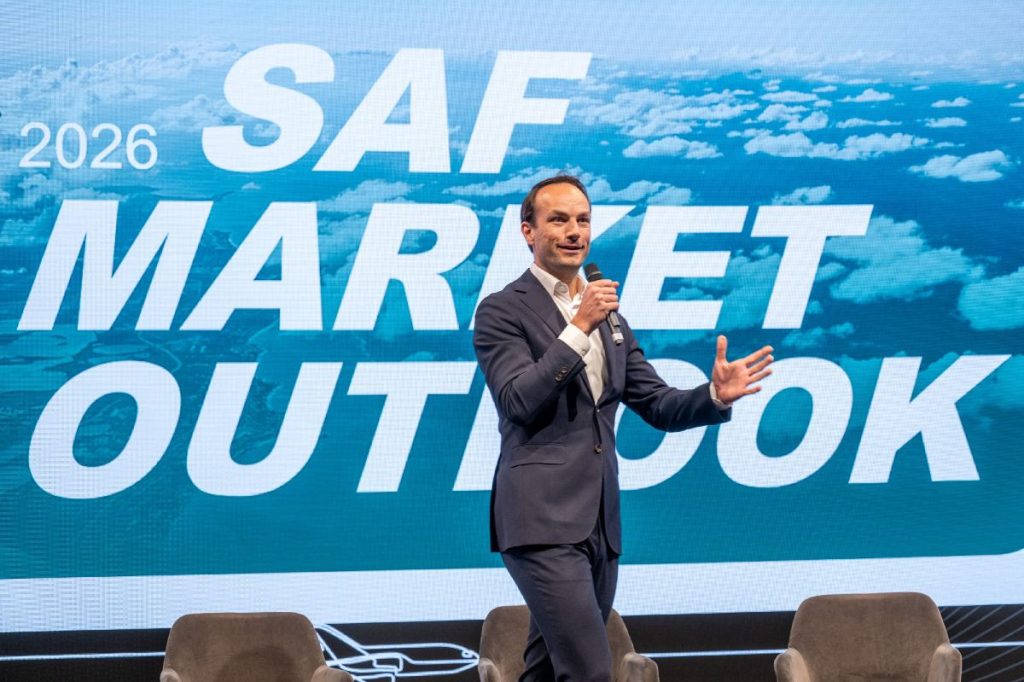
Photo (Geert de Jong / Cheeseworks): SkyNRG and ICF launched the SAF Market Outlook 2026 at the recent SAF Congress in Amsterdam


More News & Features
Flying off into the sunset
News Roundup September 2026
Synthetic aviation fuel projects advance in Europe, Africa, US and China
Global aviation’s gross emissions to rise 87% by 2050 despite efficiency gains, forecasts IBA
Air France shares results of large-scale North Atlantic contrail avoidance trial
Over €400m in free EU ETS allowances given to airlines in 2025 to support SAF uptake