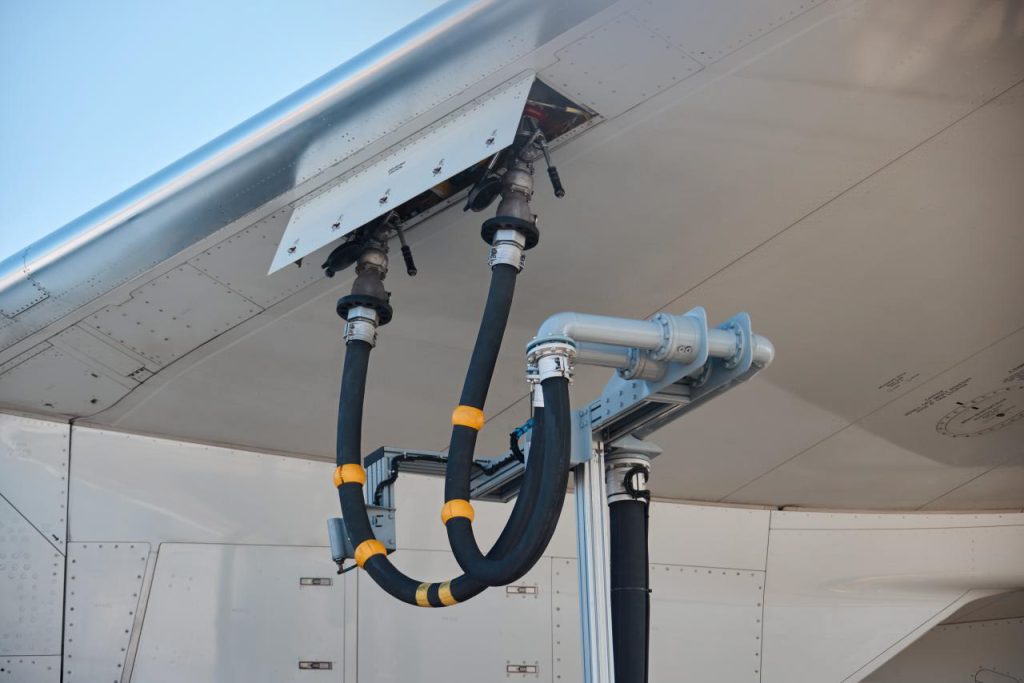
Deutsche Bank is to invest in the deployment of 1,600 tonnes of sustainable aviation fuel with the Lufthansa Group as part of the bank’s efforts to reduce its business travel emissions. The estimated emissions savings of around 5,500 tonnes of CO2 is equivalent to the emissions from 520 flights between Frankfurt and London operated by an Airbus A320neo. Through SAF bulk deals, companies can procure larger quantities of SAF from the Group and from an investment of €2,000 or more, they receive a Scope 3 certificate for CO2 savings in accordance with the Greenhouse Gas Protocol standard. With the Group’s Sustainable Corporate Value Fare, business customers can contribute to saving up to 30% of future CO2 emissions by SAF. Across all its corporate customer products, around 1,700 companies worldwide invested in SAF with the Group in 2025.
“SAF is an important instrument for Deutsche Bank in our efforts to nearly halve our CO2 emissions along our supply chain by 2030 compared with 2019,” said the bank’s Chief Sustainability Officer, Jörg Eigendorf commenting on the deal with Lufthansa Group. “It is also important for us to send a signal: only if there is reliable demand will SAF producers invest in production and make alternative fuels more competitive. This is a key part of our overall approach – we want to reduce CO2 emissions from our business travel and offset the remaining emissions where feasible.”
Both partners say they aim to deepen their collaboration further, with a goal of advancing sustainable transformation and enhancing the credibility and acceptance of climate protection solutions.
“Deutsche Bank’s decision to support the deployment of SAF with Lufthansa Group at this scale is a compelling demonstration that more sustainable flying is becoming increasingly important in the business travel sector,” said Frank Naeve, SVP Global Sales and Distribution for the Group. “We are delighted to set a milestone together with Deutsche Bank, and to show that companies can make a measurable contribution to reducing the climate impact of their travel activities through concrete investments in SAF.”
Lufthansa said it purchases SAF for customers in addition to mandatory SAF quotas, adding that portions of the eligible SAF deployed were co-financed through the EU Emissions Trading System. Logistics companies, it added, were increasingly entering into SAF bulk deals, with Lufthansa Cargo offering a minimum purchase volume of 100 tonnes of SAF.
The airline group reported it is recording an overall rise in demand for more sustainable travel options and enables customers through a variety of private and business travel options to contribute to reducing the climate impact of flights.
More than 5% of Lufthansa Group passengers chose a sustainable travel option, such as Green Fares, in 2025 and the volume of SAF sold more than doubled across various product formats. Passengers contributed to climate protection projects covering more than 710,000 tonnes of CO2, an increase of around 20% compared to 2024.
In May, the Group announced it had reshaped its projects portfolio to place a stronger emphasis on technology-based solutions. The new portfolio comprises 14 projects, with the share of projects that permanently remove CO2 from the atmosphere doubling and accounting for 20% of the total. The projects are being implemented in the Group’s home markets of Germany, Austria, Switzerland, Belgium and Italy, as well as other countries. They include support for myclimate, First Climate, Ceezer, Senken, Climeworks and 1PointFive.
“With our carefully curated portfolio, we are increasingly focusing on technology-based projects that enable long-term CO2 sequestration,” explained Nina Sproedt, Head of Sustainability at Lufthansa Group. “In this way, we are contributing to the further development and scaling of these technologies. We offer our passengers the opportunity to support high-quality climate protection projects and the use of SAF, thereby actively participating in the transformation of aviation.”
Meanwhile, Lufthansa is marking the 15th anniversary of its involvement in collecting climate-relevant data for the European research programme IAGOS. Up to three of its Airbus aircraft collect atmospheric measurement data daily that is freely used by around 400 organisations worldwide to refine climate models and improve weather forecasts. The measurement system is permanently installed beneath the aircraft cockpit, with the outside air reaching the measuring instruments via two probes built into the fuselage.
The IAGOS predecessor system MOZAIC had been installed on two Lufthansa A340-300s, collecting measurement data during cruising flight from 1994 to 2014. Between the two systems, more than 37,500 measurement flights have taken place since 1994.
“The recorded values have made a significant contribution to building one of the world’s most extensive datasets on ozone and water vapour content in the atmosphere,” said the airline.
Ten aircraft operated by eight airlines worldwide are now equipped with the IAGOS system.
Lufthansa says that in addition to IAGOS, it supports climate research activities on non-CO2 effects, climate-optimised flight planning and more precise weather data in operational use.
Photo: Lufthansa Group

Christopher Surgenor
Editor



More News & Features
Synthetic aviation fuel projects advance in Europe, Africa, US and China
Air France shares results of large-scale North Atlantic contrail avoidance trial
Over €400m in free EU ETS allowances given to airlines in 2025 to support SAF uptake
EASA reports 2025 supplies of SAF exceeded first year of EU mandate
United and FedEx sign agreements to extend SAF supplies and scale up use
Nova Pangaea takes major step towards commercial-scale SAF production