
With the European Commission’s reveal of its long-awaited review of the EU Emissions Trading System (EU ETS) just days away, lobbying by climate and industry groups for and against an extension of the scheme to include carbon emissions from flights to destinations outside Europe has been intense. UN agency ICAO has also entered the debate with a plea to its member states, without naming the EU specifically, to maintain a globally harmonised approach to address international aviation emissions through its CORSIA carbon offsetting scheme. Industry argues that extending the scope of the EU ETS would damage CORSIA as it moves from the voluntary to the compliance phase, as well as add higher costs to airlines. Climate lobbyists contend the extension would properly price aviation emissions while bringing in extra revenue for climate action. A new study by ICCT estimates such a move could raise around €9 billion ($10.3bn) a year.
The study also finds concerns that long-haul passengers could switch to using flights from non-EU hubs or adding a stop on otherwise direct flights in order to avoid EU ETS costs passed on to them by airlines are overstated. In all its scenarios, the risk of shifting emissions outside Europe, known as carbon leakage, is limited to a maximum of 3.1%.
The International Council on Clean Transportation (ICCT) says its study is the most comprehensive assessment of the risk to date, quantifying the leakage rate across multiple ETS scope designs.
“The evidence is clear: carbon leakage should not be used as a reason to delay expanding the EU ETS to international flights,” commented Sola Zheng, Senior Researcher at the ICCT. “Our analysis shows that the risk is manageable, and that smart policy design can reduce it further while still generating billions in revenue that could be partially invested into cleaner aviation technologies and fuels.”
The originally intended scope of the EU ETS, which was paused under a ‘stop-the-clock’ provision, was to include both departing and incoming international flights serving the European Economic Area. If the scheme was to revert to the full scope, ICCT estimates it would generate €14.3 billion ($16.4) in annual revenue, with a leakage rate of 3.1%. The €9 billion per annum estimate for departing flights assumes a carbon price of €70 ($80) per tonne of CO2, with a leakage rate of 1.9%.
The study also identifies other design options, such as a distance-based approach. Using real-world 2023 flight data, it evaluates ten options in all for expanding the EU ETS, with choices that may significantly affect both revenue and leakage outcomes (see below).
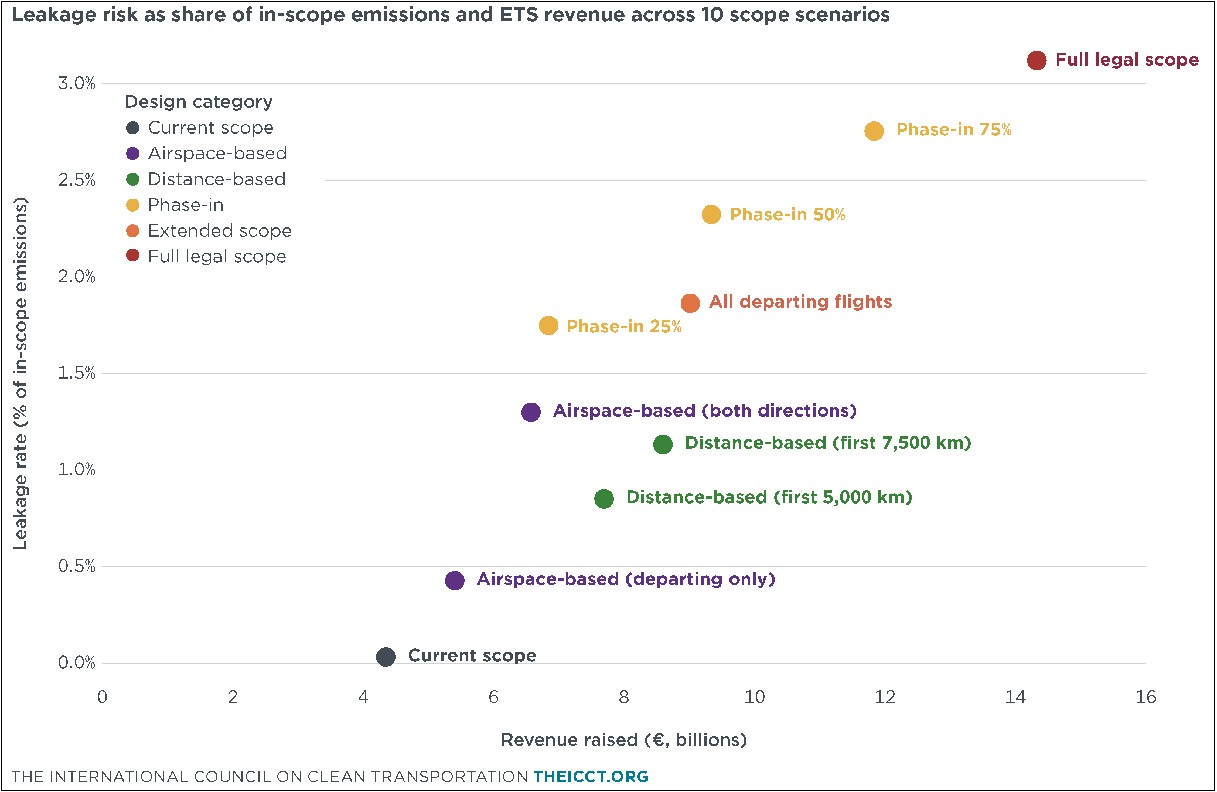
Under its distance-based approach, pricing is applied to only the first 7,500kms of each flight, which the study estimates would reduce leakage to 1.1%, while preserving 96% of the revenue of the full departure-based option. Leakage risks can be addressed, says the study, through targeted measures such as route-specific free allowances or an anti-evasion clause, rather than broad exemptions that would reduce both emissions coverage and ETS revenues. It also suggests coordinated carbon pricing in non-EEA countries such as Turkey and the United Arab Emirates could substantially reduce re-routing incentives.
“Different policy designs involve different trade-offs between emissions coverage, revenue generation and leakage,” said Nikita Pavlenko, Fuels and Aviation Programme Director at ICCT. “Our results show there are multiple viable ways to expand the ETS without undermining the system’s environmental integrity.”
In a briefing to journalists on July 15, Peter Liese, a longstanding member of the European Parliament and the rapporteur who steered the legislative passage of the Directive, adopted in 2008, that originally brought the aviation sector into the EU ETS, indicated his and his EPP political group’s preference to keep the present scope “unless we can adopt smarter solutions”.
He believes extending the scope to all outgoing international flights “would create a storm and I don’t think it is wise. I don’t know anyone in the EPP who is for this proposal.”
Liese said aviation was one of the most difficult industries to decarbonise and “a reasonable approach is imperative”.
He suggested a “smart solution” could be an airspace approach to the ETS to protect European hubs, with more ETS allowances be given to support sustainable aviation fuel uplift in the EU and even free allowances made available to the sector.
Meanwhile, ICAO has urged its member states to maintain a globally-harmonised approach and strengthen CORSIA, “especially by avoiding any duplicative intervention through national or regional measures in a fragmented manner.”
It added in a statement: “Working together through ICAO to ensure alignment will maintain a level playing field for all, ensure transparency and strengthen trust among all countries participating in CORSIA, while addressing aviation emissions in a cost-effective manner. Avoiding overlapping or conflicting systems will also reduce complexity, improve effectiveness and provide greater clarity for airlines.”
The EU’s current position on CORSIA “emphasises its strong preference for a multilateral action to tackle emissions from aviation.”
However, a number of major aviation countries – notably Brazil, India and China – have yet to signal their intention to join CORSIA. The scheme moves in 2027 from its initial voluntary participation phases to a full compliance offsetting phase.
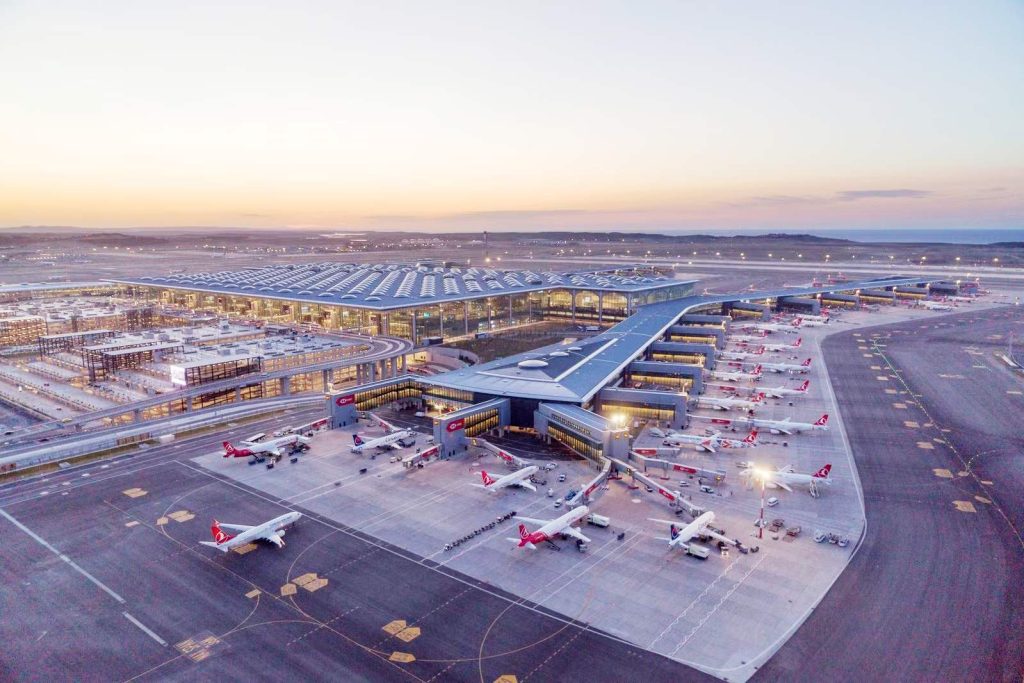
Photo (IGA): Could European long-haul passengers switch to using flights from non-EU hubs like Istanbul or adding a stop on otherwise direct flights in order to avoid EU ETS costs?

Christopher Surgenor
Editor


More News & Features
Synthetic aviation fuel projects advance in Europe, Africa, US and China
Air France shares results of large-scale North Atlantic contrail avoidance trial
Over €400m in free EU ETS allowances given to airlines in 2025 to support SAF uptake
EASA reports 2025 supplies of SAF exceeded first year of EU mandate
Transport NGOs call EU ETS aviation extension proposals a missed opportunity
Commission proposes a limited extension of the ETS to international departing flights from Europe