
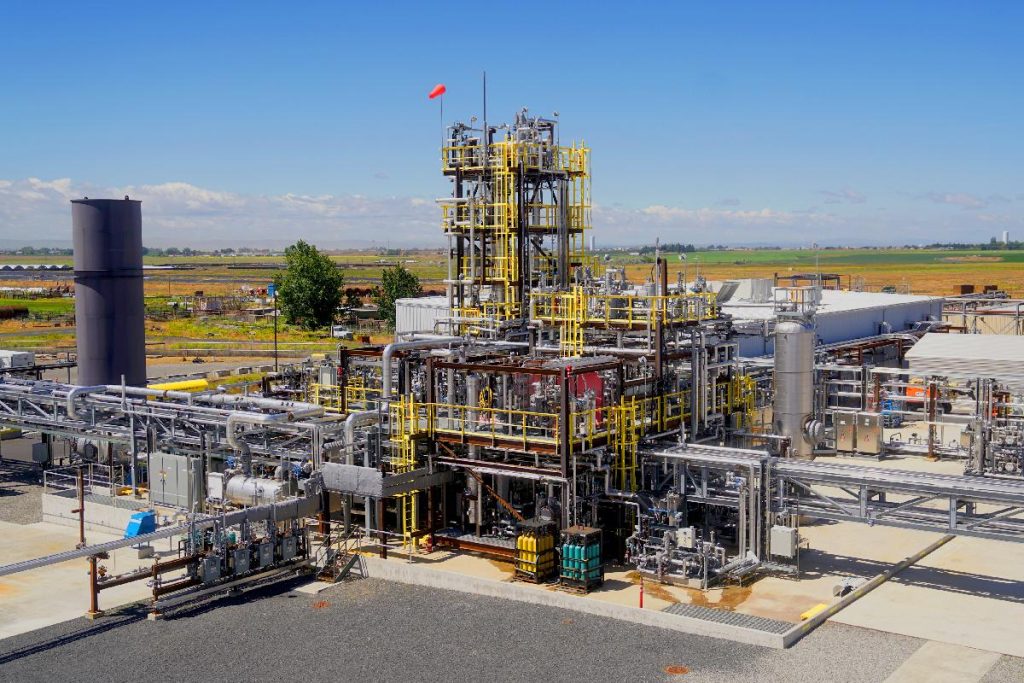
Power-to-liquid technology company Twelve has opened its AirPlant One facility in Moses Lake, Washington, the first in the United States to produce drop-in sustainable aviation fuel at scale from the conversion of CO2 and renewable electricity. The ribbon-cutting was attended by partners Alaska Airlines and Microsoft. The airline intends operating regular domestic flights with Twelve’s E-Jet fuel, with Microsoft supporting the scale-up of AirPlant One through a strategic investment from its Climate Innovation Fund. The deal with Microsoft also includes a SAF offtake agreement that uses a book-and-claim accounting model pioneered alongside Alaska Airlines that will allow Microsoft to reduce reported emissions associated with its business travel.
“We broke ground on AirPlant One with a simple thesis: that the fuels powering the global economy could be made from renewable electricity and air anywhere in the world,” commented Nicholas Flanders, co-founder and CEO of Twelve.
“Today, that thesis is operational and Alaska Airlines will fly on fuel made right here in Washington State. This is what American industrial electrification looks like.”
Twelve’s eManufacturing processs uses captured CO2 sourced from a nearby ethanol producer, combines it with water and renewable electricity, and converts those inputs into hydrocarbon fuel molecules using an electrolyser to produce synthetic aviation fuel meeting ASTM D7566 Anex 1 specifications. The company claims the fuel delivers up to 90% lower lifecycle CO2 emissions compared to conventional jet fuel and requires less water and land to produce than many biofuel pathways. It also says its E-Jet product offers over 10 years of potential price predictability through electricity-based inputs.
Twelve said the early commitment from Alaska was foundational to AirPlant One coming online, with Alaska Star Ventures participating in Twelve’s $645 million funding round as an investor. In 2022, Alaska and Microsoft jointly committed to purchase output from the AirPlant One facility, a commercial signal which Twelve credits as making financing and construction possible.
“As Seattle’s hometown airline, we are committed to supporting in-state production of sustainable aviation fuel, which is currently the best technology for the airline industry to reach net-zero carbon emissions,” said Ryan Spies, Managing Director of Sustainability at Alaska Airlines. “Our partnership with Twelve and Microsoft demonstrates the power of innovation and collaboration to successfully advance SAF, while creating new jobs, diversifying fuel supply chains and strengthening energy security.”
Added Melanie Nakagawa, Chief Sustainability Officer, Microsoft: “Climate progress depends on collaborations that send signals to investors and innovators to move markets. Our investment in Twelve helps scale energy solutions while laying the groundwork for cleaner aviation at a global scale. We look forward to sourcing future gallons of Washington-produced SAF to help reduce our business travel emissions.”
Twelve said producing domestic critical fuels and chemicals from American renewable electricity strengthened supply chain resilience and reduced exposure to commodity market volatility, adding: “AirPlant One is purpose-built for the domestic energy leadership moment. Our technology is designed to scale to additional production sites and airline partners, and fuel and chemical products. AirPlant One establishes power-to-liquid production is commercially viable in the United States today, and positions Twelve to expand domestic production capacity as US energy infrastructure continues to grow.”
The e-fuels producer also sees opportunities for international expansion with SAF mandates in Europe and beyond in place. “Twelve’s geographic flexibility and fixed-price model are built for exactly this environment,” it said.
In addition to eSAF, AirPlant One will also produce e-naphtha, chemically identical to traditional naphtha, which serves as a drop-in substitute and foundational building block for many everyday products, from plastics and packaging to solvents and synthetic fibres. To date, the company has delivered proof-of-concept projects to global manufacturers that include Mercedes-Benz, PANGAIA and Proctor & Gamble.
Photo: Twelve’s AirPlant One facility

Christopher Surgenor
Editor


More News & Features
Synthetic aviation fuel projects advance in Europe, Africa, US and China
Over €400m in free EU ETS allowances given to airlines in 2025 to support SAF uptake
EASA reports 2025 supplies of SAF exceeded first year of EU mandate
United and FedEx sign agreements to extend SAF supplies and scale up use
Nova Pangaea takes major step towards commercial-scale SAF production
COMMENTARY: Why action lags ambition among States seeking SAF mandates