





The supply of sustainable aviation fuel in the EU last year comfortably exceeded the ReFuelEU Aviation mandatory 2025 target of a minimum 2% share of total jet fuel supply, says EASA in its annual report on the implementation of the Union’s regulation. Aviation fuel suppliers reported supplying 39.3 million tonnes of aviation fuel at 121 airports across all EU member states in 2025, of which SAF accounted for 1.1 million tonnes, a 2.8% share. From a total of 193,000 tonnes in 2024 supplied at 33 airports, the supply of SAF increased sixfold last year, with 86% of all SAF supplied being produced within the EU. EASA reports the number of member states with operational or announced SAF production facilities increased to 18 in 2025.
The Netherlands, Spain, Germany, Italy and France accounted for 0.8 million tonnes (Mt), or 74% of all SAF supplied in the EU last year, with the first receiving the largest amount among member states, 0.32 Mt, or 29% of all SAF provided.
Calculations show the use of SAF helped to reduce greenhouse gas emissions at Union airports by 3.77 million tonnes in 2025.
The second year of the ReFuelEU Aviation regulation, 2025 saw a close to 90% compliance rate by obligated aviation fuel suppliers, reports EASA, with 102 out of 115 suppliers submitting required data, up from 67% in 2024.
There was a 93% compliance rate of the aircraft operator reporting obligation, with 367 out of 393 aircraft operators submitting reports accepted by Competent Authorities (CAs). Non-compliance by operators was mostly linked to small business jet operators and non-scheduled operators, or third country operators that did not respond to CA requests.
Aircraft operators reported having purchased around 1.0 Mt of SAF in 2025 at Union airports, of which they intended to claim 49% (512 kt) under the EU ETS, 9% (90 kt) under the UK ETS and 2% under the CORSIA scheme, while the remaining 40% (415 kt) was not intended to be claimed under any market-based measure.
Commenting on this year’s annual technical report, Florian Guillermet, Executive Director of EASA, the EU’s aviation safety and environmental protection agency, said: “Through our monitoring work, EASA is building a strong evidence base to track progress, understand how the European SAF market is developing and identify where further action may be needed to support the next stages of the transition.”
Whilst a high percentage of SAF was produced domestically, 85% of the SAF supplied came from feedstocks that originated from outside the EU. Used cooking oil remained the predominant feedstock, accounting for 80% of the total volume, although EASA notes significant amounts of additional feedstocks entered the mix in 2025, such as category 3 animal fats, palm oil mill effluent, food waste and crude tall oil.
Of the imported feedstocks, 61% came from China, followed by Malaysia (8%), Indonesia (5%) and the UK (3%). Of the 15% originating from within the EU, Germany, Spain and France were the largest contributors, each supplying around 2%.
EASA also includes in its report 2025 reference prices for all aviation fuels eligible under the ReFuelEU Aviation regulation (see below). Their primary purpose is to serve as reference values for member states in determining penalties under the regulation, as well as for the support mechanism for the use of eligible aviation fuels under the EU ETS directive. The real index price for conventional aviation fuel is determined for 2025 at €640 per tonne and aviation biofuels at €1,925 per tonne.
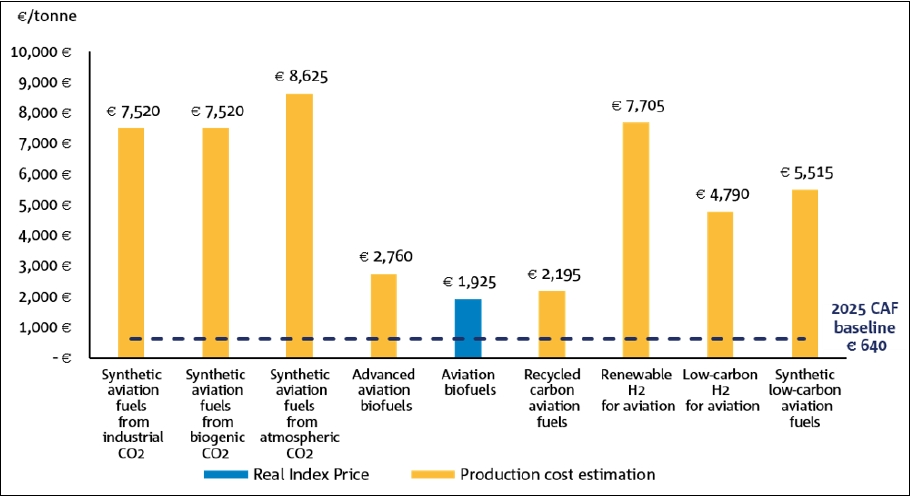
Source: EASA
EASA said the general positive trend in 2025 indicates EU production capacity is projected to remain on track to meet the next mandatory SAF blending target of 6% in 2030. It developed three scenarios to assess 2030 potential domestic production against the mandate.
The first scenario assumed that only facilities already capable of producing SAF will be operational in 2030. Under this scenario, the EU would have 1.5 Mt of SAF production capacity by 2030, well below the 2.1 Mt required to meet the minimum share requirement.
The second scenario additionally considered facilities under construction and those that have reached final investment decision. Under this scenario, 3.7 Mt of SAF production capacity would be available by 2030, well above the 2.1 Mt required (excluding synthetic aviation fuels).
The third additionally encompasses ‘high credibility’ projects based on the disclosure of key data and providing reasonable confidence that these projects will proceed to completion. Under this scenario, total SAF production is projected to reach 5.5 Mt in 2030, excluding synthetic aviation fuel, with an additional 0.6 Mt of synthetic aviation fuels that would meet the separate mandate for those fuels.
EASA says that while the synthetic aviation fuel market remains at an early stage of development, it points to the establishment of the first EU-based demonstration plant (Ineratec), “proving that the technology is being deployed”. Around 50 eSAF projects are awaiting final investment decision, it adds, with a number of EU member states taking steps to support scale-up.
Eight member states have launched the ‘eSAF Early Movers Coalition’ under the Commission’s Sustainable Transport Investment Plan. As part of the initiative, Germany, Luxembourg and Austria will launch a pilot double-sided auction with over €2.1 billion ($2.4bn) in funding. The Commission is also undertaking a study to explore the possible establishment of an EU financing mechanism.
“The fact that we have already exceeded the first SAF target under ReFuelEU Aviation is a sign that Europe is moving towards cleaner and more competitive aviation,” said Apostolos Tzitzikastas, EU Commissioner for Sustainable Transport and Tourism, commenting on the EASA report’s findings.
“The European framework is already delivering tangible results helping to increase the production and use of sustainable aviation fuels across the EU. Our priority now is to build on this progress, while continuing to support industry and national authorities through this transition.”
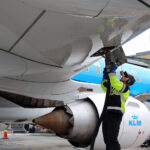
Photo (KLM): The Netherlands received the largest supplies of SAF in the EU in 2025

Christopher Surgenor
Editor



More News & Features
News Roundup September 2026
United and FedEx sign agreements to extend SAF supplies and scale up use
Transport NGOs call EU ETS aviation extension proposals a missed opportunity
Heathrow expansion incompatible with climate targets, advises UK government watchdog
Cathay Pacific trials Google’s AI-powered contrail avoidance technology across its network
Nova Pangaea takes major step towards commercial-scale SAF production