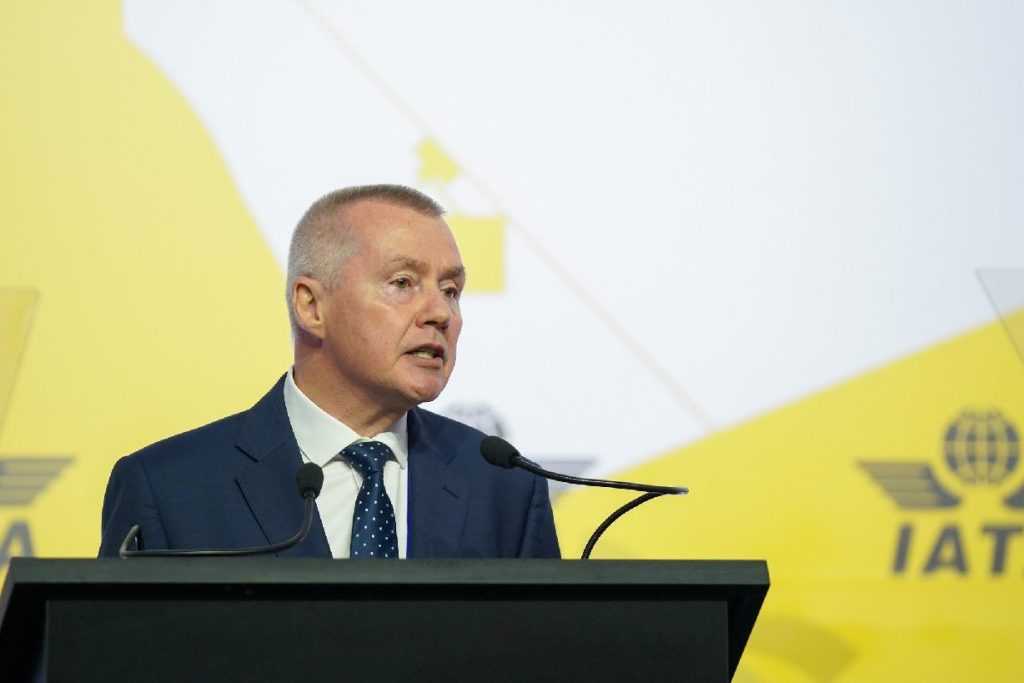
In his final speech as Director General of industry trade body IATA, Willie Walsh said although there was hope the aviation sector’s net zero by 2050 target could still be achieved, that hope was “fading fast”. He hinted a new timeline would be a likely outcome that would be more realistic and would be within the broader context of the global energy transition, and he called for an urgent “action oriented” dialogue. SAF production this year was likely to cover only 0.8% of airline fuel needs, around 2.4 million tonnes, up from 0.6% in 2025, and the gap with the 65%, or 500 million tonnes, required to meet net zero 2050 was not closing fast enough, he said. SAF mandates in the EU and UK were a “spectacular failure”, he added, and accused the EU of undermining ICAO’s CORSIA carbon scheme, which he suggested could likely fail.
In his state-of-the-industry address, Walsh told delegates to IATA’s 82nd annual meeting held in Rio de Janeiro that airlines had sent “unambiguous demand signals” for SAF, with over 180 purchase agreements signed since 2021 and had put in place initiatives to support the development of a global SAF market. “But where’s the actual SAF?” he questioned.
Since joining the net zero commitment, the fuel sector had cancelled or downsized SAF projects in Europe and further afield, noted Walsh, adding: “Subsidies to extract fossil fuel are just too appealing, as are the returns.”
Promoting SAF in support of sustainability, jobs and energy security should be a “no-brainer” for governments, he said, who had two basic policy tools at their disposal: mandates or incentives. However, sequencing was important, he suggested, and where incentives had been used first, such as with US tax credits, SAF production had increased.
“Sadly, most governments put the cart before the horse with mandates. These pushed prices up but did not create supply,” he said. “In the case of the EU and the UK, the situation is absurd. Airlines are paying billions in compliance add-ons associated with fuel supplier mandates. This compensates fuel suppliers for the penalties they – the fuel suppliers – would pay for not making sufficient SAF. That’s irrespective of whether they supplied SAF or not. And that’s despite airlines wanting to buy more SAF than is being made. You could not make this stuff up!
“Seemingly oblivious to these developments, governments, through ICAO, set a 5% emission reduction target through SAF by 2030. To be blunt, there is no path to meet that outcome.”
On CORSIA, Walsh said the parts of government that had created and were responsible for the scheme were not in sync with those responsible for the Paris Agreement. Airlines will need between 170 and 236 million CORSIA offset credits (EEUs) for the first phase but only 10 countries had so far made EEUs available, which was far from what is needed, he said.
“What’s harder to remedy are the pot shots that the EU keeps taking at CORSIA, presumably to favour its EU ETS,” said Walsh in another attack on the bloc.
“There is nothing to be gained by the EU repeating an embarrassing failure that we all remember,” he added, referring to the climbdown by the EU in 2012 on the intended extra-territorial scope of the EU ETS in the face of international opposition. “The EU was instrumental in CORSIA. Its current efforts to undermine CORSIA must be called out for what they are – disingenuous and unacceptable.
“Indeed, many of you have questioned our continuing support for an expensive system that will likely fail because of the action and inaction of the governments who designed it. I will leave that question for my successor but will not be surprised if we see a change in direction.”
Walsh said IATA would be investing “significantly” in its advocacy activities. “We are strengthening our Brussels office and aligning our global team with this priority,” he told delegates.
IATA reported at the meeting that passenger numbers are expected to reach 5.1 billion in 2026, up 2.4% on 2025, and cargo volumes up 0.2%, with industry revenues up by 9.4% to reach $1.165 trillion. However, as a result of the Middle East conflict, a previous forecast of a combined net profit of $41 billion for 2026 has been cut to $23.0 billion, which is around half of the $45 billion net profit estimated for 2025.
“All airline bottom lines are suffering from the rapid 70% rise in jet fuel prices,” said Walsh. “Some of the additional cost is being recuperated by adjusting prices and improving efficiency, but it will not be sufficient to maintain profitability at the previous year’s level.
“Airlines are bearing the brunt of the fuel price shock. While air fares are rising, airlines are still absorbing part of the hike in their bottom lines.”
Photo: Outgoing Director General of IATA, Willie Walsh, addresses delegates at the opening of IATA’s AGM 2026 in Rio de Janeiro

Christopher Surgenor
Editor


More News & Features
Synthetic aviation fuel projects advance in Europe, Africa, US and China
Over €400m in free EU ETS allowances given to airlines in 2025 to support SAF uptake
EASA reports 2025 supplies of SAF exceeded first year of EU mandate
United and FedEx sign agreements to extend SAF supplies and scale up use
Nova Pangaea takes major step towards commercial-scale SAF production
COMMENTARY: Why action lags ambition among States seeking SAF mandates