IATA has launched a stakeholder alliance of airlines and carbon market specialists to boost the availability of 225-250 million CORSIA-eligible carbon credits, called Eligible Emissions Units (EEUs), by Spring 2027. The Supporting Alliance for CORSIA EEU Supply is aiming to help facilitate and enable countries’ management of the interface between their Nationally Determined Contributions under the UNFCCC and the Letter of Authorization process required to make carbon credits available for use under CORSIA. IATA estimates the ICAO carbon scheme could generate $4-5 billion of climate finance in the first phase of the scheme (2024-26) and potentially $100 billion by 2035, depending on market prices. Meanwhile, carbon market data analysts Sylvera reports around 640 million tonnes of credits are potentially eligible for the first phase but only 47 million tonnes satisfy requirements due to a failure by host countries to authorise credits.
“CORSIA is the only globally agreed framework to address international aviation emissions, established by ICAO and its Member States in 2016. States, however, have their own obligations under the Paris Agreement and the UNFCCC. Credits must be transferred between these systems to avoid double-counting, which has become an important bottleneck,” said Marie Owens Thomsen, IATA’s SVP Sustainability and Chief Economist.
“The Supporting Alliance will provide implementation assistance to clear this and other bottlenecks that prevent credits from coming to the CORSIA market. We welcome all carbon market stakeholders and related organisations to join forces to help CORSIA realise its potential social, economic and climate benefits.”
Launched at its annual meeting in Rio de Janeiro, IATA said the Alliance was open to “all organisations and national governments willing to commit expertise and practical resources to make a significant implementation of CORSIA and Article 6.2 guidance of the Paris Agreement.”
The founding members of the Alliance encompass over 32 entities that include 16 airlines and airline groups: Air Asia, Air France-KLM, All Nippon Airways (ANA), Austrian Airlines, China Airlines, Corsair, Egyptair, IAG, Japan Airlines, KM Malta Airlines, Lufthansa Group, Pegasus Airlines, Qatar Airways, Scoot, Singapore Airlines and SWISS.
A Compact signed by the members says the current critical shortfall in the supply of EEUs was “a threat to the viability of CORSIA and to this promising flow of carbon finance for host Parties.”
Host country implementation assistance will be provided on a pro bono basis by Article 6 and CORSIA experts to countries upon request and tailored to their specific needs and their progress in implementing Article 6.2. The support will facilitate the process ahead of the first CORSIA compliance deadline in December 2027 and help countries manage reporting and review processes on an ongoing basis, said IATA.
The airline industry body said that to date only 10 countries have made EEUs available, with Guyana as a pioneer, along with six countries in Africa plus Laos, Cambodia and Uzbekistan.
“Together they have made available a total of 38 million EEUs. That’s far from what’s needed. But there is potential for much more,” IATA Director General Willie Walsh told delegates at the Rio meeting. “The $4-5 billion in climate finance at stake is a great incentive. And the solution is simply aligning internal government processes.”
Sylvera estimates demand for CORSIA’s first phase stands at 174.5 million tonnes, driven by international carriers including Emirates (10.82Mt), United Airlines (8.72Mt), Qatar Airways (7.6Mt) and Turkish Airlines (7.5Mt). It states that at least one unnamed airline in the top 15 by obligation has signalled it does not intend to comply. “This introduces further uncertainty into demand projections already complicated by a 53 million tonne swing depending on the outcome from the Iran conflict,” says Sylvera.
It points out a further complication is that CORSIA-eligible credits do not always end up in CORSIA, with data showing CORSIA-tagged African cookstove credits selling into the voluntary sector, meaning headline eligible figures overstate what is actually available for airline compliance.
“The strangest thing about this market is that everyone is behaving rationally and the outcome is still irrational,” commented Ben Rattenbury, VP Policy at Sylvera. “Buyers won’t commit because they can’t see the supply and host countries won’t issue authorisations because prices are too low to justify the political capital. Meanwhile a compliance deadline is approaching and the clock is running.”
Sylvera has just launched the Article 6 & CORSIA Hub, a platform consolidating supply tracking, sovereign risk scoring, demand forecasting, airline exposure modelling and live pricing.
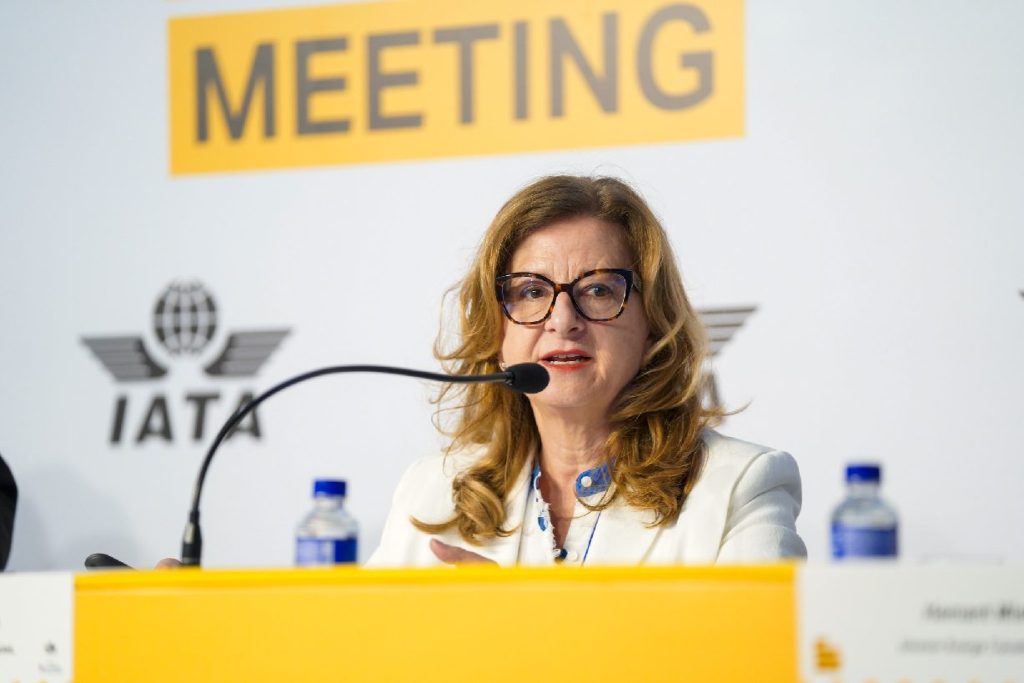
Top photo: IATA SVP Sustainability Marie Owens Thomsen announces new partnership at the IATA meeting in Rio

Christopher Surgenor
Editor


More News & Features
Over €400m in free EU ETS allowances given to airlines in 2025 to support SAF uptake
Commission proposes a limited extension of the ETS to international departing flights from Europe
Extending the EU ETS to all international flights departing Europe could raise $10bn a year, finds ICCT study
ANALYSIS: What an expanded EU ETS coverage could mean for airlines
COMMENTARY: CORSIA – A flawed scheme worth saving?
Hope fading fast for industry net zero by 2050 target as SAF growth slows, says IATA chief